The Celiac Care Gap: What Should Happen After Diagnosis, and What Usually Does Not
Published on September 26, 2026

For most people, a celiac diagnosis ends with one instruction: stop eating wheat, barley, and rye. Some leave with a handout or a dietitian’s number, plenty leave with neither, and then the calendar goes quiet. Years can pass without a blood test or anyone asking what you actually eat, while patient and doctor both assume the diet is working. A gastroenterologist writing for MedCity News this year put it plainly: diagnosis is not the finish line. It is the moment the daily work passes to the patient and the family.
Every major gastroenterology guideline treats celiac disease as a condition to monitor, with scheduled check-ins, a nutrition plan, and some way of confirming that the intestine is healing. Studies of what patients actually receive tell a different story. Here is the follow-up you should be getting, what each test can and cannot tell you, and what to do if you are one to five years in and suspect nobody is keeping watch.
What Follow-Up Is Supposed to Look Like
The most detailed schedule comes from the European Society for the Study of Coeliac Disease (ESsCD), whose 2025 adult guidelines pair the early check-ins with both a physician and a dietitian.
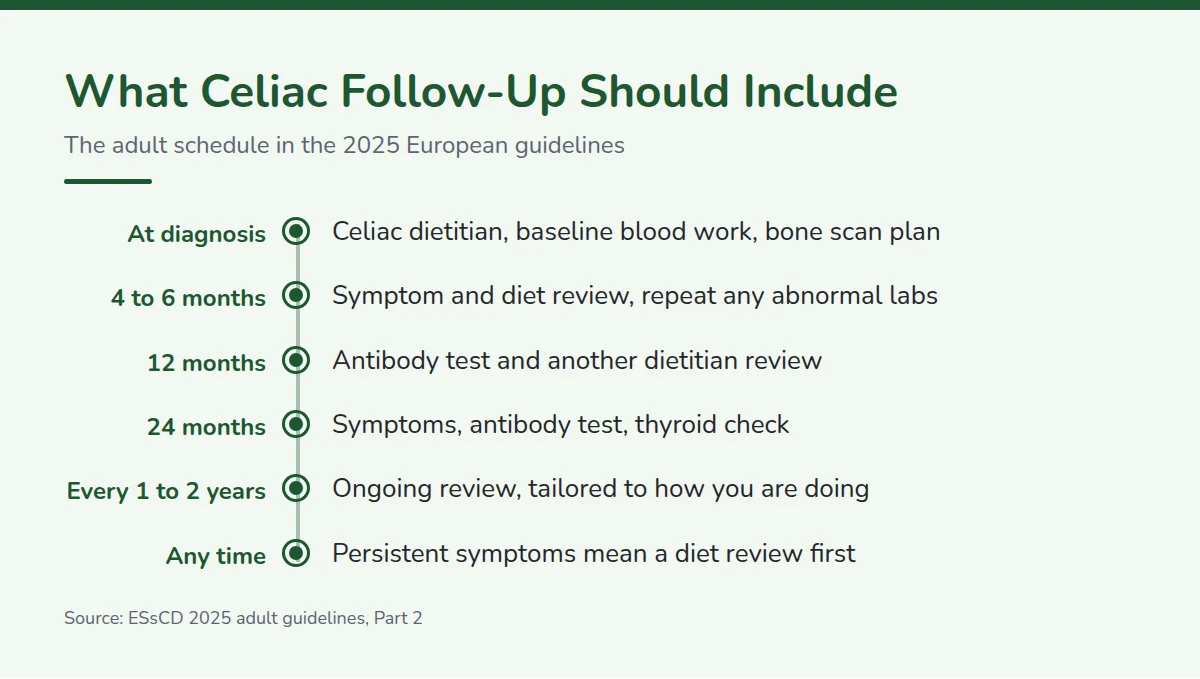
- At diagnosis: a dietitian who specializes in celiac disease, a physical exam, and baseline blood work including a blood count, iron, folate, vitamin B12, vitamin D, calcium, thyroid function, and liver enzymes. The visit should also cover screening for close relatives, a support group, and whether you need a bone density scan.
- At four to six months: symptoms, coping, a diet review, and repeats of any abnormal labs, with a psychologist referral offered if the diagnosis is weighing on you.
- At twelve months: symptoms, a celiac antibody test, and another diet review, which can happen by phone or video.
- At two years, then every one to two years: symptoms, a thyroid check, and other tests as needed. The antibody test becomes optional once your levels are normal.
The guidelines want that rhythm tailored, with more contact for anyone whose symptoms, antibodies, or nutrient levels are not settling. American and British guidance differs in detail but not in shape. The American Gastroenterological Association’s expert review recommends antibody testing sooner, at 6 and 12 months after diagnosis and yearly after that. In the UK, the National Institute for Health and Care Excellence (NICE) calls for an annual review of weight, symptoms, and diet, with specialist dietetic advice where needed. The American College of Gastroenterology’s 2023 guideline suggests vaccination against pneumococcal disease, since celiac disease can weaken the spleen’s ability to fight off those bacteria, and says a follow-up biopsy could be considered in adults without symptoms after two years on the diet, decided jointly by patient and doctor. Children have their own framework: a 2022 European pediatric position paper sets out 37 recommendations, from visit frequency to the handover to adult care.
What Usually Happens Instead
The clearest measurement of the gap comes from Olmsted County, Minnesota, where researchers reviewed the complete records of 122 people diagnosed with biopsy-proven celiac disease between 1996 and 2006. A year after diagnosis, only 41 percent had had any follow-up visit, 22 percent an antibody test, and 3.3 percent a visit with a registered dietitian. By five years, just 15.8 percent had ever seen a dietitian, and of those followed for more than four years, only 35 percent had received follow-up that matched the American Gastroenterological Association’s recommendations.
Those diagnoses are two decades old, and newer evidence is scattered rather than reassuring. International reviews in 2015 and 2022 both describe wide variation in follow-up, and the later one concluded that the best management strategy is still unclear. The 2025 European guidelines report that access to celiac-specialist dietitians “remains inconsistent, with shortages in dedicated clinics, staffing, and consultation time,” and acknowledge there is no consensus on who should provide long-term care. Children slip through as well: among 162 children diagnosed in Gothenburg, Sweden, one in seven had been lost to follow-up after an average of about five years.
The stakes are not small. The same guidelines put persistent symptoms and ongoing intestinal changes at 20 to 40 percent of adult patients, and state flatly that “simply avoiding gluten-containing products after diagnosis is not enough.”
Nutrition Is Treatment, Not an Extra
That 3.3 percent figure matters more than it looks, because in celiac disease the food is the treatment and the dietitian is the person trained to check whether it is working. The American College of Gastroenterology calls an interview with a dietitian experienced in the gluten-free diet the standard of care for assessing adherence. A clinical review of celiac nutrition assessment describes what that visit should cover: your diet history, calories and micronutrients, label reading, possible deficiencies or other digestive conditions, and, when there are signs of gluten exposure, a methodical hunt for cross-contamination.
The nutritional stakes start before the first gluten-free meal. When a Dutch team tested 80 newly diagnosed adults, 87 percent had at least one nutrient measurement below the reference range. Two thirds were low in zinc, 46 percent had depleted iron stores, a third were anemic, and about one in five were low in folic acid or B12. Weight was no guide, since 29 percent were overweight.

The diet does not automatically close those gaps. An Australian study found that newly diagnosed adults tracked through their first year ate much like people who had been gluten-free for years: fiber fell short for everyone except men with years on the diet, and more than one in ten women missed their targets for thiamin, folate, vitamin A, magnesium, calcium, and iron. Many gluten-free breads and pastas carry less fiber, iron, folate, B12, and vitamin D than the foods they replace, and more saturated fat, salt, and sugar. Most are also built on a narrow range of grains, especially rice. The European guidelines advise fortified versions and a diet built on naturally gluten-free foods, and another review asks clinicians to watch for weight gain during follow-up.
Bone belongs on the list too. More than half of adults have reduced bone density at diagnosis, and the European guidelines recommend a DXA scan after a year on the diet for anyone with added risk, such as a long delay before diagnosis, severe malabsorption, or a past fragility fracture.
Feeling Better Is Not the Same as Healing
The most common reason people drift out of follow-up is that they feel fine, which is exactly the signal the research says not to trust.
At the Mayo Clinic, Alberto Rubio-Tapia and colleagues reviewed 241 adults who had biopsies at diagnosis and again on the diet. Confirmed healing of the intestinal lining had been reached by only 34 percent at two years and 66 percent at five. Eighty-two percent reported some improvement in symptoms, but that improvement did not predict who had healed. Other cohorts heal faster, and the European guidelines cite full recovery rates of roughly 50 to 83 percent after one to five years. Either way, many people who feel well have an intestine that has not recovered.
That matters. In Sweden, Benjamin Lebwohl and colleagues followed 7,625 people who had a follow-up biopsy. The 43 percent with persistent villous atrophy went on to develop lymphoma and related blood cancers at roughly twice the rate of those who had healed. The absolute numbers stayed small, 53 cancers across all 7,625 patients over a median of almost nine years, but the pattern is one reason guidelines treat healing, not just comfort, as the goal.
Why a Normal Antibody Test Is Not an All-Clear
The usual follow-up blood test, IgA tissue transglutaminase (tTG-IgA), was designed to find celiac disease in people eating gluten, not to monitor people who have stopped. On the diet, levels usually start falling within weeks and return to normal for most people within about a year.

The problem is what the test misses. A meta-analysis led by Jocelyn Silvester pooled 26 studies in which people on the diet had both antibody tests and follow-up biopsies. Among those whose intestines had not healed, tTG-IgA flagged only 50 percent and the endomysial antibody test only 45 percent. The tests were better at avoiding false alarms, with specificities of 83 and 91 percent, but they missed about half the people with ongoing damage.
So read the result the right way round. A persistently positive test usually means ongoing gluten exposure and intestinal damage, according to the American Gastroenterological Association. A normal result is reassuring but is not proof, which is why NICE tells clinicians not to use serology alone to judge whether gluten has been excluded from someone’s diet.
Measuring What You Actually Eat
If blood tests cannot confirm adherence, three other kinds of tools try to, and each has a blind spot.
A dietitian’s review of what you eat, where, and how it is prepared remains the reference standard. The European guidelines find that specialist dietitians catch inadvertent gluten exposure more reliably than questionnaires do.
Questionnaires such as the seven-question Celiac Dietary Adherence Test, developed by Daniel Leffler and colleagues, are simple and inexpensive, and in its original 200-patient study the test outperformed tTG-IgA at identifying who was adhering. But a questionnaire can only record the gluten you know about. A 2021 review by Wieser and colleagues concluded that no routine method, whether questionnaires, antibody tests, or symptoms, measures adherence directly or accurately, and that accidental exposure, often through cross-contamination, is more common than deliberate slips.
Gluten immunogenic peptide (GIP) tests detect fragments of gluten that survive digestion, in stool for up to about four days or in urine for about 48 hours. In the study that developed the urine test, fragments could be detected as early as 4 to 6 hours after a single gluten meal.
What these tests find is humbling. In a Spanish multicenter study of 188 patients on the diet, 29.8 percent had gluten fragments in their stool, with no relation to their questionnaire answers or tTG levels. In Argentina, 88.7 percent of 53 adults who had been gluten-free for a median of eight years produced at least one positive sample over four weeks of repeated stool and urine testing. And in Canada, a team that had participants set aside a quarter of every portion they ate for a week found measurable exposures in 12 of 18 people two years into the diet, typically about 2 milligrams of gluten at a time, mostly without symptoms and from foods the participants could not identify. That is well under the 10 milligram daily ceiling most clinicians use, and it matches what cross-contact studies have measured in real kitchens: small, frequent, and mostly invisible.
The guidelines disagree on how to use these tests. The European guidelines say GIP testing can be considered when symptoms persist or adherence is uncertain, while cautioning that it is not fully reliable. The American College of Gastroenterology suggests against routine use of gluten detection devices in food or biospecimens, partly because they may not separate clinically significant exposure from trivial exposure. Several of the founding studies also disclose that co-authors held stock in the company that commercialized the underlying antibody. The same caution covers portable sensors that test a bite of food at the table. The MedCity News essay argues for using them selectively, when patients have done the basic work and still have elevated antibodies or symptoms, while stressing that they do not replace serology, biopsy, dietitian support, or follow-up care.
Knowing when you are most likely to slip helps too. The European guidelines link lower adherence to diagnosis at a young age (adolescence especially), frequent eating away from home, having no symptoms, and limited knowledge of the disease. Travel multiplies the meals eaten away from home, and our look at destinations built around celiac travelers covers how to vet a trip before you book.
When Symptoms Persist on a Strict Diet
Between 7 and 30 percent of adults on a gluten-free diet keep having symptoms, which is called nonresponsive celiac disease. The term describes a situation rather than naming a cause, and the cause is what matters.

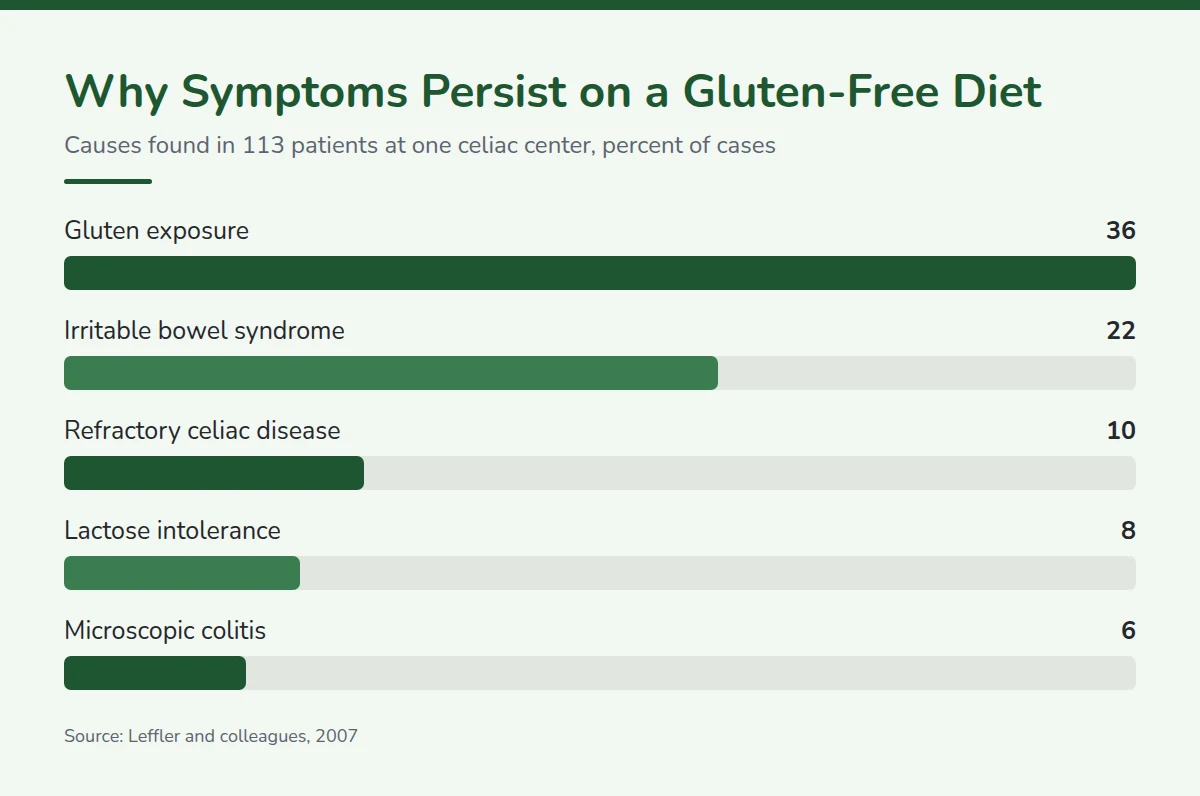
At one specialist celiac center, Leffler and colleagues reviewed 113 people with nonresponsive disease among 603 celiac patients. Gluten exposure was the most common cause at 36 percent, followed by irritable bowel syndrome, refractory celiac disease, lactose intolerance, and microscopic colitis. The blood test earned its keep here: average tTG-IgA was 67 units per milliliter in the gluten-exposed group against 17 for everyone else. The European guidelines attribute up to 80 percent of persistent symptoms to gluten exposure, deliberate or accidental.
That is why the workup starts in the same place every time. NICE, the European guidelines, and a review in American Family Physician describe the same sequence: confirm the original diagnosis, have a specialist dietitian hunt for hidden gluten, then look for other conditions such as irritable bowel syndrome, lactose intolerance, bacterial overgrowth, or microscopic colitis. The American Gastroenterological Association adds that persistent symptoms with no other obvious explanation warrant a biopsy even when tTG-IgA is negative. If you eat oats, look at them hard: even oats labeled gluten-free can be contaminated, and a minority of people with celiac disease react to oats themselves.
Refractory celiac disease, in which symptoms and intestinal damage persist after at least 12 months on a strict diet with no other cause found, is rare. Population studies suggest it affects around 1 percent of adults with celiac disease or fewer, and it belongs in a specialist center. Some people are simply slow healers. Either way, many of the therapies now in clinical trials are being tested in people like you, one more reason to get a proper workup rather than live with symptoms.
If Nobody Is Monitoring You
If you were diagnosed one to five years ago and little of this sounds familiar, ask for it. Most of it is routine and inexpensive. Bring this list to your gastroenterologist or primary care doctor:
- A referral to a registered dietitian who specializes in celiac disease, even years after diagnosis.
- Your antibody results as numbers, not just “normal,” so you can follow the trend.
- The nutrient tests you are due for, especially anything that was low at diagnosis, and a decision on a bone density scan.
- A conversation about pneumococcal vaccination.
- Whether a follow-up biopsy makes sense for you. The European guidelines consider one reasonable after one to two years for adults diagnosed after 45 or with severe disease, and at any point if symptoms persist or worsen.
- A detailed diet review before anyone settles on “probably IBS” for symptoms that have not gone away.
Mind how you are coping, too. The European guidelines describe strong evidence of increased anxiety and depression after diagnosis and a higher risk of eating disorders, fed partly by constant vigilance around food. Asking for psychological support is part of good celiac care, not a sign that you are failing at the diet.
The Bottom Line
The gluten-free diet treats celiac disease, but only follow-up shows whether the treatment is working. The guidelines agree on its shape: a celiac dietitian at the start and at intervals, scheduled nutrient and antibody checks, a considered decision about confirming healing, and a structured workup when symptoms persist. The research shows that many patients never get it, and that feeling well and a normal antibody result are weaker evidence of healing than they seem. If nobody has checked on you since diagnosis, start with one appointment and ask which parts of the schedule you have missed.
Further reading (sources)
- MedCity News, where a gastroenterologist argues that diagnosis is not the finish line
- European Society for the Study of Coeliac Disease on its 2025 adult guidelines for management and follow-up
- Husby, Murray and Katzka with the AGA expert review on serology and biopsy in monitoring
- National Institute for Health and Care Excellence for its annual review and persistent symptom recommendations
- American College of Gastroenterology on its 2023 celiac guideline update
- Mearin and colleagues for the European pediatric position paper on follow-up
- Herman and colleagues on how few Minnesota patients received recommended follow-up
- See and colleagues with practical insights into the gluten-free diet and its follow-up
- Makharia and colleagues on the global burden of celiac disease and variation in follow-up
- Ulnes and colleagues for children lost to follow-up in a Swedish region
- Simpson and Thompson on what a celiac nutrition assessment covers
- Wierdsma and colleagues with vitamin and mineral deficiencies at diagnosis
- Shepherd and Gibson on nutritional shortfalls that persist on the gluten-free diet
- Bascuñán, Vespa and Araya for building a balanced gluten-free diet
- Rubio-Tapia and colleagues on mucosal recovery at two and five years
- Lebwohl and colleagues with persistent villous atrophy and lymphoma risk
- Silvester and colleagues for the meta-analysis of antibody tests against follow-up biopsies
- Leffler and colleagues on the seven-question Celiac Dietary Adherence Test
- Wieser and colleagues with why gluten-free adherence is so hard to monitor
- Moreno and colleagues on detecting gluten peptides in urine
- Comino and colleagues for stool testing in 188 patients on the diet
- Stefanolo and colleagues on four weeks of stool and urine sampling in Argentina
- Silvester, Comino and colleagues with the saved-portion study of everyday gluten exposure
- Williams, Harris and Odom for common questions on celiac care in American Family Physician
- Leffler, Dennis and colleagues on the causes of nonresponsive celiac disease