Nightlife and Dating With Food Allergies: Bars, Cocktails, and the Disclosure Conversation
Published on September 8, 2026

The Advice Stops at the Restaurant Door
Almost every food allergy resource written for adults ends in the same place: how to order dinner. Ask for the manager, hand over a chef card, check the fryer. Good advice, all of it, and all of it assumes a room where you can hear the answer.
Then you turn 21, or you get diagnosed at 34, and the actual social calendar turns out to be something else. A loud bar where the bartender is four drinks deep into a rail order. A shared plate of wings that arrived while you were in the bathroom. A first date where you have ninety seconds to decide whether to make your allergy a topic before the drinks land.
This is also the group that dies. Fatal food anaphylaxis clusters in the second and third decades of life, and the risk factors named over and over in the case reviews are the ones a night out supplies all at once: not carrying epinephrine, delaying the dose, and making decisions after drinking. The gap in the advice is not a small one.
Your Drink Does Not Have to Tell You Anything
Here is the fact that surprises most people. The allergen labeling law you have relied on since 2004 does not cover most of what sits behind the bar.
FALCPA, and the FASTER Act that added sesame to it, apply to food regulated by the FDA. Most beer, wine, and distilled spirits fall instead to the Alcohol and Tobacco Tax and Trade Bureau under a separate statute. TTB issued an interim rule in 2006 letting producers declare the major allergens if they felt like it. Nearly twenty years on, that is still where things stand. Voluntary.
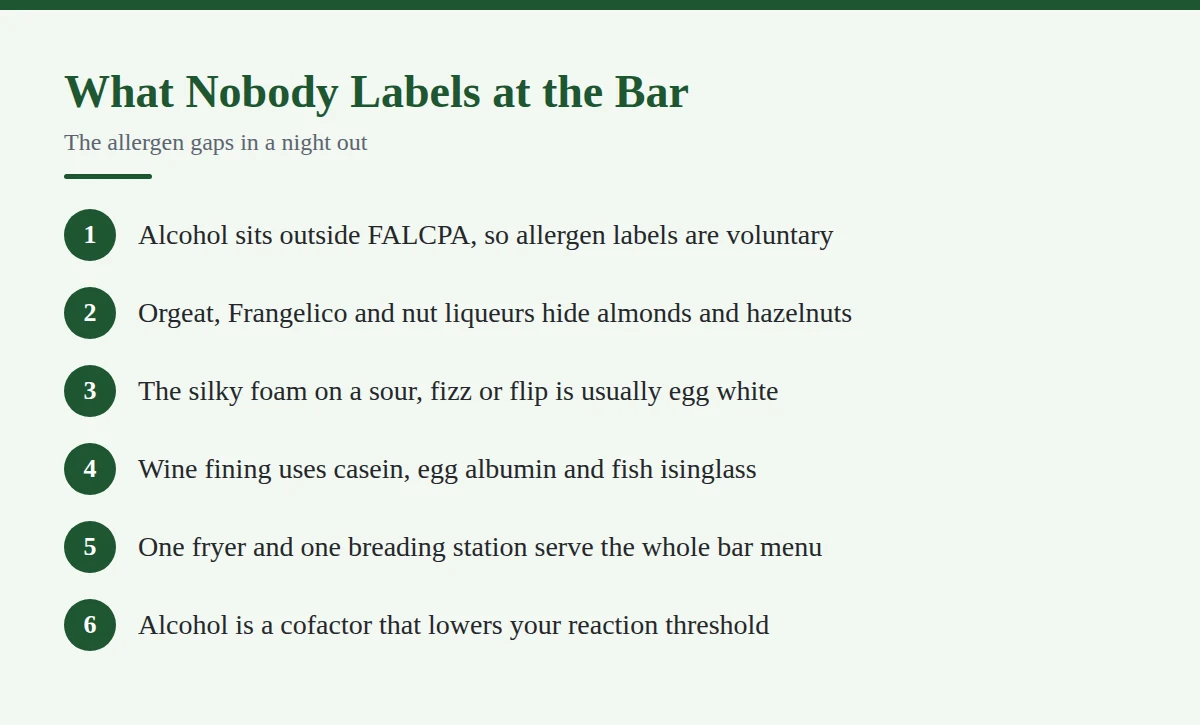
There is movement. In January 2025 TTB published a proposed rule that would make allergen declaration mandatory across wine, spirits, and malt beverages, covering all nine major allergens including sesame. The comment period ran into August 2025. But the proposal floats a compliance date five years after any final rule publishes, and no final rule has appeared. An adult buying a drink in the United States in 2026 should assume the label tells them nothing, and will keep telling them nothing for years yet.
The contrast with Europe is sharp. Since December 2023, EU wine labels have had to carry a full ingredient list, and fining agents derived from milk or egg, such as casein and egg albumin, must appear as allergens on the physical label rather than behind a QR code. Isinglass, the fish derived agent, is exempted. If you want the wider picture, our guide to how allergen labels differ by country covers the rest of the systems.
What Is Actually in the Glass
Beer is the one people get wrong most often. Standard beer is brewed from malted barley, frequently with wheat alongside it: a gluten problem for celiacs, a wheat problem for anyone with a wheat allergy. The confusing category sits in the middle, beer brewed from barley and then treated with an enzyme that breaks the gluten down. Since the FDA’s 2020 rule on fermented and hydrolyzed foods, those products cannot be labeled gluten-free, because the standard test cannot reliably measure gluten fragments once fermentation has scrambled them. They carry wording like “crafted to remove gluten” instead. Beer brewed from sorghum, millet, rice, or buckwheat is a different animal and can carry the gluten-free claim outright. Our guide to gluten free options for celiac and allergy sufferers works through where that line falls.
One extra note on cask ale: some of it is still fined with isinglass, made from fish swim bladders.
Wine raises the fining agent question, and the honest answer is more reassuring than the internet suggests. Casein from milk, albumin from egg white, isinglass from fish, and gelatin are all used to clarify wine and strip harsh tannins. Researchers writing in Clinical and Translational Allergy deliberately fined wines with heavy doses of casein, egg albumin, and isinglass, then tested what remained. No allergen was detectable afterward by either ELISA or PCR. Skin prick tests and basophil activation still came back positive in most of the milk, egg, and fish allergic patients they tested, so something survives at sub-trace level. But the reactions reported by allergic wine drinkers in the same study were few, mild, and no more common than in the control group. The authors concluded the residual risk is very low.
Very low is not zero, and vegan certified wine avoids animal fining agents altogether if you have had reactions you cannot account for. But wine fining is not the thing most likely to hurt you tonight.
While we are here: sulfites are not an allergy. The “contains sulfites” line is a mandatory declaration at 10 parts per million and above, and sulfites can trigger bronchospasm in some people with asthma. That is a sensitivity rather than an IgE mediated food allergy, and the difference matters for how you treat it.
Distilled spirits are the good news. Distillation leaves the proteins behind, which is why gin made from wheat and whiskey made from barley are generally considered safe for celiacs and for people with wheat allergy. The risk in spirits lives almost entirely in what gets added after the still: flavorings, colorings, cream, and nuts.
The Cocktail List Nobody Labels
A cocktail is a recipe assembled on the fly by someone with no ticket, no allergen matrix, and no manager standing behind them. These are the ingredients that catch people out.
- Nuts. Orgeat, the almond syrup that defines a mai tai, is the big one, and it runs through tiki drinks generally. Falernum often contains almond too. Frangelico is hazelnut, nocino is walnut, and crème de noyaux is built from stone fruit kernels. Amaretto is usually made with apricot kernels rather than almonds, which sounds like a reprieve and is not one worth testing at a bar.
- Dairy. Irish cream, RumChata, Amarula, and anything with a cream float. Cream of coconut in a piña colada is coconut, but the frozen version often picks up dairy ice cream on the way. Clarified milk punch is filtered, but it was made with milk.
- Egg. That silky foam on a whiskey sour, pisco sour, gin fizz, or flip is egg white, and it disappears completely into the drink. Advocaat, the base of a Snowball, is egg. Some bars use aquafaba instead. You cannot tell by looking, so ask.
- Fat washed spirits. A peanut butter washed bourbon is a legitimate craft cocktail technique and a legitimate peanut exposure. If a menu calls a spirit washed, infused, or “house,” ask what with.
- Coconut, which the FDA classifies as a tree nut for labeling purposes, is everywhere in tiki and frozen drinks.
Then there is the equipment, which nobody thinks about. One shaker tin rinsed in a dip well between drinks. One blender jar that made a mudslide before it made your daiquiri. A garnish caddy handled bare-handed all night. Speed pourers wiped with the same rag as everything else. A busy bar has no separate allergy station, and no version of a Friday rush where it acquires one.
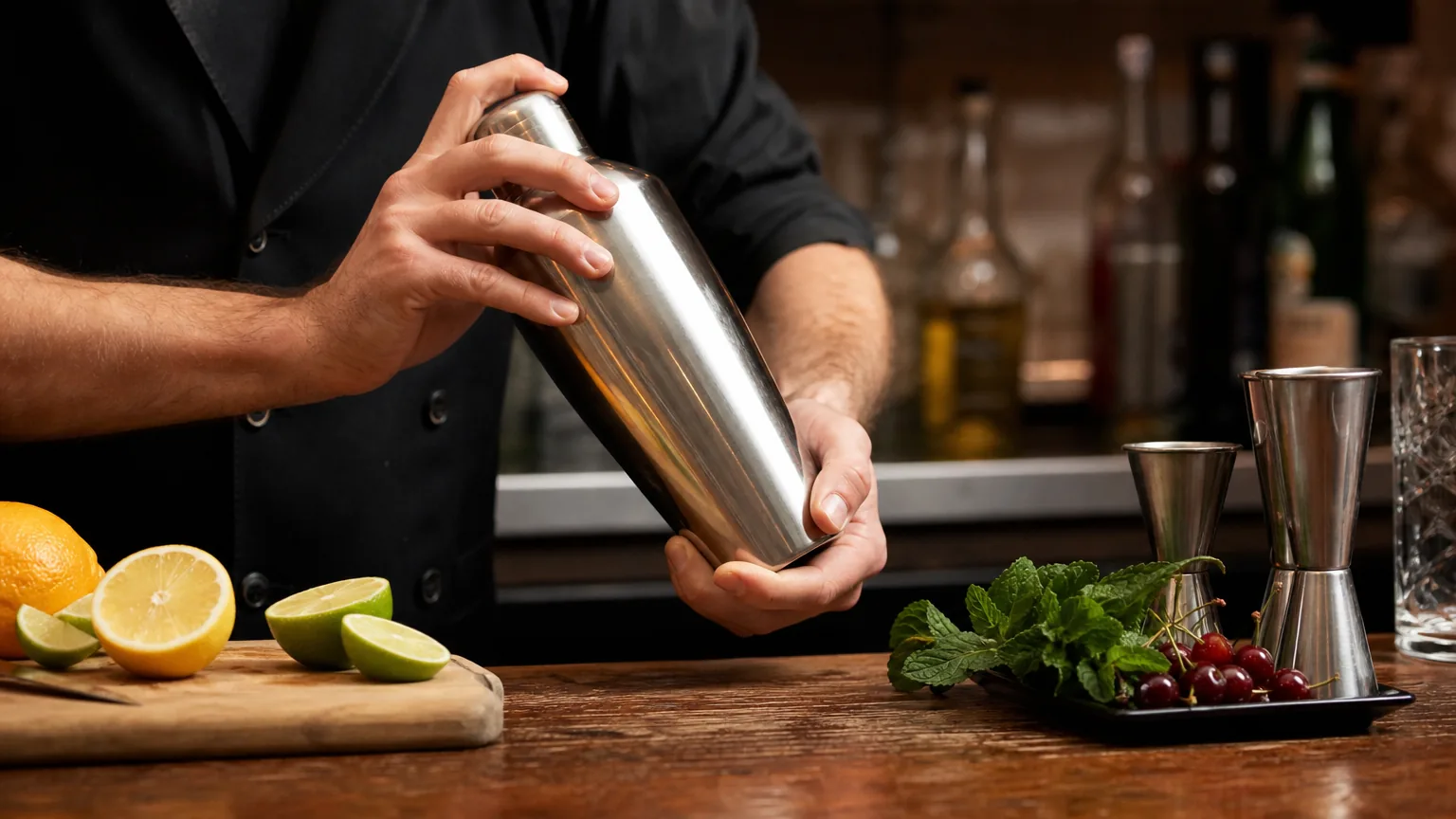
The workaround is not elegant, but it holds up: order things whose whole path you can see. A sealed can or bottle opened in front of you. A spirit poured from a labeled bottle over ice. Soda from the gun instead of a house syrup. Skip the garnish. It is a shorter menu, and it is a menu you can actually trust at 11pm.
Bar Food Is Fryer Food
The kitchen behind a bar is small, and it usually has one fryer. Calamari, mozzarella sticks, fries, wings, and pickles all pass through the same oil, often from one breading station. FDA researchers measured exactly this and found reused breading carried enough fish protein after twenty batches of cod to push a plain breaded chicken tender past the reference dose used for precautionary labeling. Our write up of what the breading study found and what to ask a fryer kitchen has the ordering questions.
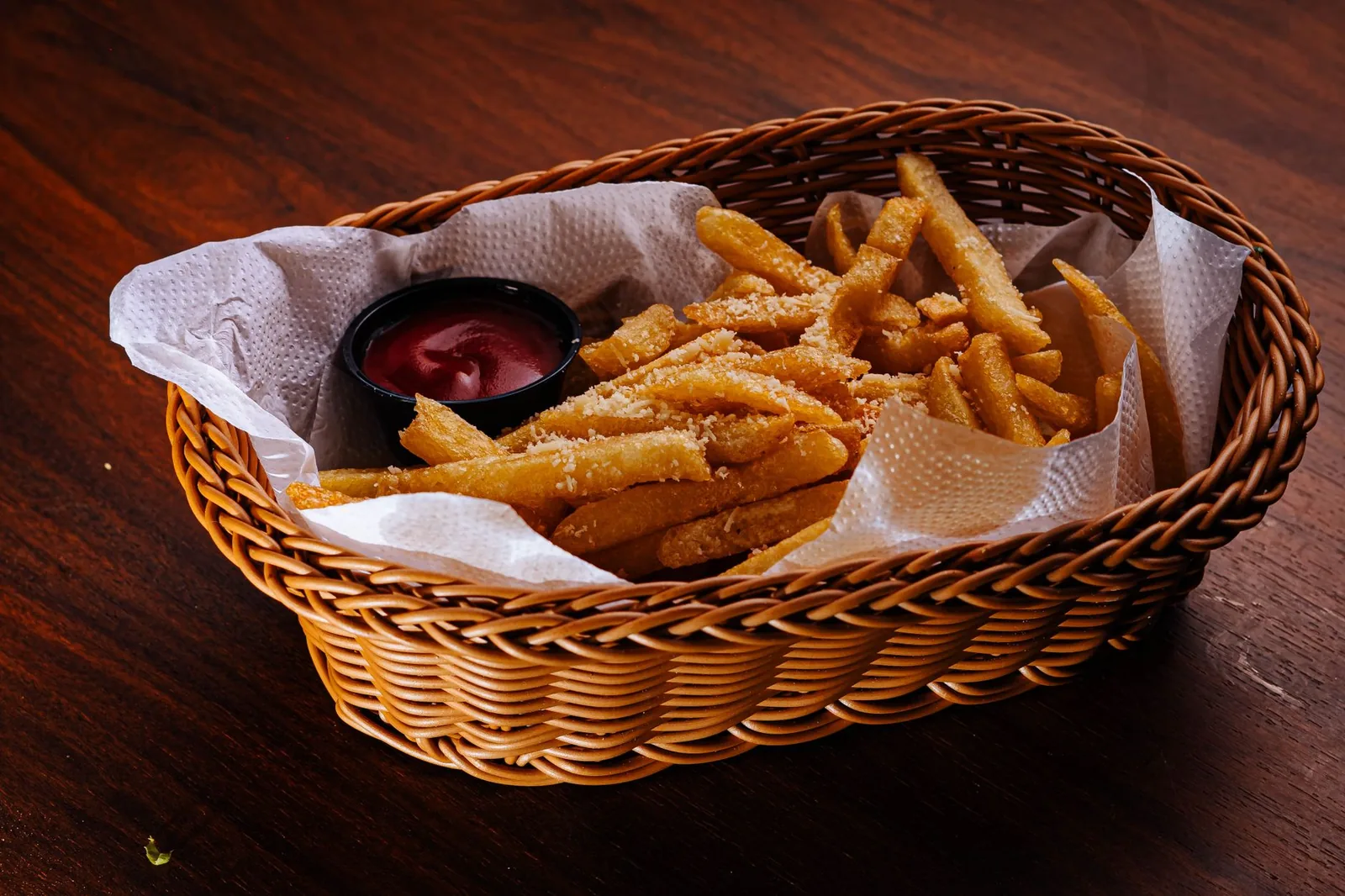
A few traps specific to bar menus, beyond the oil:
- Classic buffalo sauce is hot sauce emulsified with butter. Wings are rarely dairy free even before the ranch shows up.
- Beer batter is wheat, and so is the flour dredge on most fried pickles and onion rings.
- Bowls of nuts on the bar get handled by everyone, and the hand that grabbed them goes on to touch the taps, the menus, and the rims of glasses.
- Shared appetizers arrive in the middle of the table and get passed around. If you did not watch it arrive, you do not know what has been in it.
None of this is negotiable at volume in a loud room. Do the allergen conversation before you arrive, by phone or by reading the menu online, and treat the bar itself as somewhere you execute a decision rather than make one.
Alcohol Changes the Math
This is the section that matters most, and it is the one almost nobody gets told.
Alcohol is a recognized cofactor in anaphylaxis. Cofactors, sometimes called augmenting factors, lower the amount of allergen needed to set off a reaction. A survey of allergic patients found exercise and alcohol to be the two most important, and cofactors turn up in a substantial share of adult anaphylaxis cases. The proposed mechanisms include increased gut permeability, which lets more intact protein across, and interference with the enzyme that clears histamine.
Read that again in practical terms. A trace exposure you have tolerated a dozen times sober is not the same exposure after three drinks. Your threshold moved.
Alcohol also masks the early signs. Flushing, a racing heart, nausea, vomiting, dizziness, and confusion are all early anaphylaxis, and all of them are indistinguishable from being drunk, both to you and to everyone around you. The most dangerous version is the friend who decides you have overdone it and puts you somewhere quiet to sleep it off. Lying flat during a reaction is itself associated with worse outcomes.
And alcohol erodes the judgment call. The delay between symptoms and epinephrine is the single factor that turns reactions fatal, and hesitation is already the norm among sober, trained caregivers. Our piece on why epinephrine gets delayed and the drills that fix it was written about children, but the psychology is precisely what plays out at a bar.
Three things follow.
- Carry two auto-injectors, on your body. Going out clothes frequently have no pockets, which is a real and badly underrated failure point. Solve it before you leave the house, not at the door.
- Alcohol is not a contraindication to epinephrine. If you are reacting, use it, then call emergency services. Our guide to the anaphylaxis treatment landscape covers the devices, including the nasal option, and what a second dose is for.
- One person in the group has to know. Where the injector is, how to fire it, and that “she’s just drunk” is not a diagnosis anyone in that room is qualified to make.
The Disclosure Conversation
FARE frames dating with food allergies around three C’s: communication, confidence, and cognizance. The structure earns its keep by putting communication first, because first is exactly where people get it wrong.
Say it before the venue is picked, not at the table. A text is fine. “Heads up before we book, I have a serious nut allergy so I’m picky about where I eat. Any of these three places would be great.” That does three jobs at once: it discloses, it sets a boundary, and it hands them an easy yes. It also moves the conversation out of the loud room and away from the moment when food is already in front of you.

Say what a reaction looks like and what you need. Not the medical history. Three items: what you are allergic to, that a reaction means the auto-injector goes into your thigh and someone calls emergency services, and that “wait and see” is the wrong answer. Thirty seconds, total.
Do not apologize for it. Framing matters more than wording. This is a medical condition with a treatment protocol, not a preference or a diet, and people take their cue on how seriously to treat it from how seriously you present it.
Watch what they do with the information. A partner who asks a follow up question, or reads the menu ahead without being asked, is telling you something useful. So is one who calls it dramatic, tests it, or keeps forgetting. That is real information arriving early, and early is when it is cheapest to learn.
Kissing Is a Real Exposure, Not a Punchline
It reads like a joke right up until it happens. Reactions after kissing a partner who has eaten the allergen are documented in the medical literature, and researchers went and measured the mechanism.
In a study published in the Journal of Allergy and Clinical Immunology, 38 people ate two tablespoons of peanut butter and had their saliva sampled over time. Immediately after eating, salivary peanut protein reached levels well inside the range expected to cause a reaction. The reassuring part: in most subjects, peanut was undetectable roughly an hour later with no intervention at all. The unreassuring part: brushing teeth, rinsing, or chewing gum did not reliably clear it. What worked was time plus an allergen free meal in between.
The practical version, worth saying out loud once so it never has to be said awkwardly again:
- A few hours plus a meal without the allergen is the standard. A quick brush is not.
- Toothpaste and mouthwash are not decontamination.
- Lip balm, lip gloss, and lipstick can contain nut oils and other allergens. So can the drink someone just finished.
- Sharing a straw, a glass, or a sip of a cocktail is the same exposure route with none of the romance.
The Ten Minute Plan
Before you go out:
- Read the venue’s menu online, and call during a quiet hour if you plan to eat there.
- Decide what you are drinking before you arrive. Sealed containers and simple pours.
- Put two auto-injectors somewhere on your person, not in a bag you will set down.
- Tell one person in the group where they are and what to do with them.
- Eat something safe first, so hunger is not making the decision at midnight.
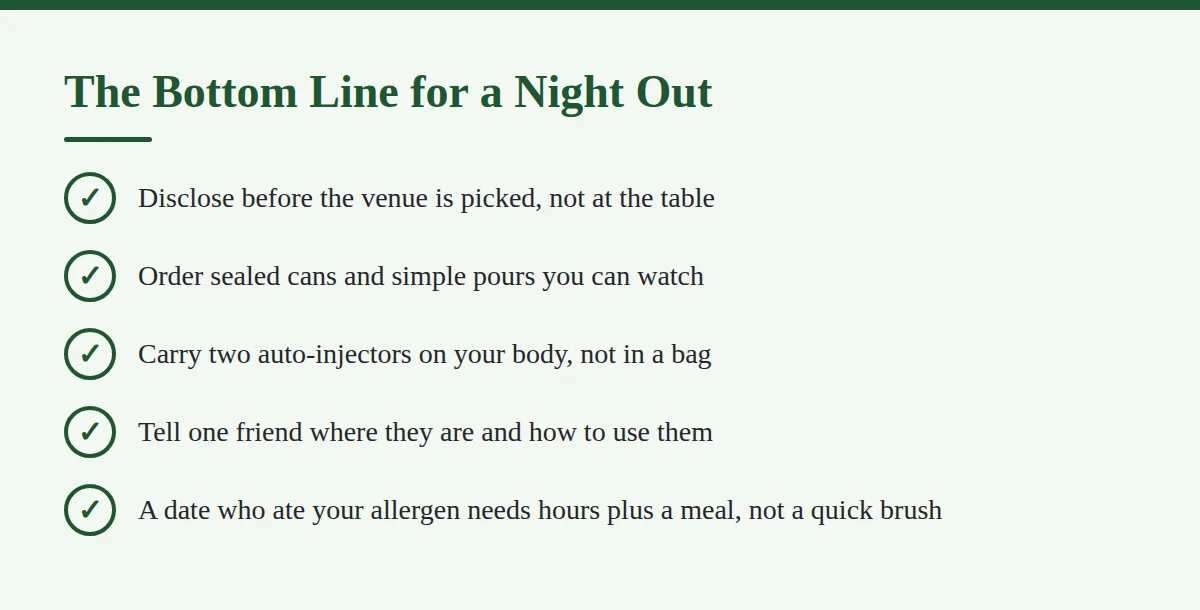
None of this makes an evening feel clinical. It makes it boring in the one place where boring is the point, which frees you to stop thinking about it for the rest of the night.
Anyone with a diagnosed food allergy should build their own version of this with an allergist, particularly if you have asthma or have ever reacted with a cofactor in play. And no “free from” claim, whether printed on a bottle or offered by a bartender, guarantees zero cross contact.
Further reading (sources)
- FARE on what changes about allergy management once you are an adult
- TTB for the proposal that would finally make alcohol allergen labeling mandatory
- Alcohol and Tobacco Tax and Trade Bureau with the voluntary allergen rules that still apply today
- FDA on why beer and fermented foods cannot be verified gluten-free by testing
- Clinical and Translational Allergy for what fining agents actually leave behind in wine
- Immunity, Inflammation and Disease with the survey that ranked alcohol second only to exercise as a cofactor
- Journal of Allergy and Clinical Immunology on how long peanut protein lingers in saliva after a meal
- European Commission for the wine labelling rules that took effect in December 2023