Food Allergy 504 Plans From Kindergarten to High School: How the Document Should Change as Your Child Grows
Published on September 1, 2026

The Plan That Gets Easier
Writing a food allergy plan with a school for the first time is one of the more exhausting things a parent does. You arrive with an allergist’s letter and a list of fears, and you leave wondering whether anyone in the building actually read it. So it is worth hearing from parents further down the road that it does not stay that hard. Megan Lavin, writing for Allergic Living in August 2026 as her oldest son with multiple food allergies started high school, described the 504 conversation as far easier by ninth grade than it had been in the early years.
That is not because high schools care more. It is because the document itself is supposed to change. A 504 plan written for a five-year-old who cannot read an ingredient panel is describing a completely different safety problem than one written for a sixteen-year-old who drives to an away game with an auto-injector in their bag. Parents who copy last year’s plan forward, year after year, end up with a document that protects a child who no longer exists.
The Legal Machinery Behind the Document
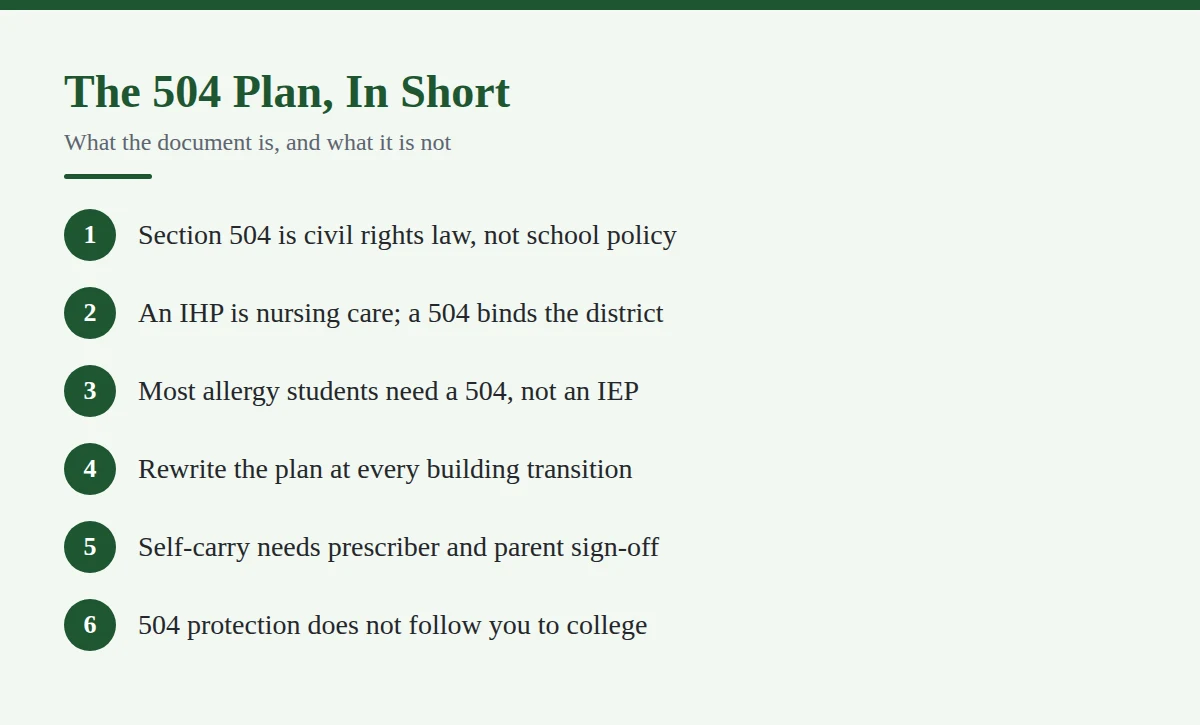
Section 504 of the Rehabilitation Act of 1973 is a civil rights law. It prohibits disability discrimination in any program that receives federal financial assistance, which covers virtually every public school district in the country, and it is enforced by the U.S. Department of Education’s Office for Civil Rights. A “504 plan” is simply the written record of the accommodations a district has agreed to provide so that a student with a disability gets the same access to education as everyone else.
Food allergy landed firmly inside that definition with the ADA Amendments Act of 2008, which expanded what counts as a major life activity to include eating, and added major bodily functions, including the digestive, respiratory, and immune systems. Crucially, the law says you assess the impairment without regard to mitigating measures. A child whose allergy is well controlled because the family is vigilant is still a child with a disability. The Department of Education treats allergy as a hidden disability, and FARE’s guidance puts the standard plainly: when a physician diagnoses a food allergy as impacting a major bodily function or other major life activity, the child meets the definition.
The process starts with the district’s 504 coordinator, who convenes a team that can include the school nurse, teachers, food service staff, coaches, and counselors, and who reviews documentation from your allergist or pediatrician. Plans run anywhere from a single page to twenty. Private schools that take no federal money sit outside Section 504, but ADA Title III still reaches most of them, with a carve-out that some religious schools claim.
504, IHP, and IEP Are Not Interchangeable
Schools use these three acronyms loosely, and the difference decides what you can actually enforce.
An Individualized Healthcare Plan (IHP) is a nursing document. The school nurse writes it, it describes the nursing care a student receives, and it is often paired with a one-page Emergency Care Plan signed by the prescribing physician that lists symptoms and treatment steps. IHPs are genuinely useful and every allergic student should have one. What they are not is a civil rights document. An IHP carries no procedural safeguards, no right to a hearing, and no obligation that survives a change of nurse. If a school offers you an IHP instead of a 504, you are being offered a description of intentions in place of a commitment.
An IEP comes from a different statute entirely, the Individuals with Disabilities Education Act. It requires that a student need specially designed instruction under one of thirteen eligibility categories. Food allergy would sit under Other Health Impairment, but only if the condition adversely affects educational performance in a way that demands special education. For most allergic students it does not, which is why they qualify under 504 and not IDEA. An IEP is not an upgrade. It is a tool for a different problem, and a student who has one for another reason can carry allergy accommodations inside it.
The workable arrangement is all three doing their own job: a 504 plan that binds the district, an IHP that tells the health office how to deliver care, and an emergency care plan that any adult can follow in ninety seconds.
Kindergarten Through Fifth Grade: The Adults Own Everything
In the early grades the plan is a set of instructions for adults, because the child cannot yet be a reliable link in the chain. A kindergartener may not know their allergen by name, cannot read a label, and will not connect an itchy throat to the cupcake they were handed twenty minutes ago.

What belongs in the document at this stage:
- Named adult supervision at every eating occasion, including snack, lunch, class parties, and any food used in a lesson. The international school allergy guidelines put supervised eating near the top of what actually works, which is one reason a nut-free sign on the front door is not a safety plan.
- No food in curriculum or crafts without advance parent review. Counting with beans, playdough containing wheat, milk carton science, and food-based holiday projects are all avoidable.
- Handwashing with soap before and after eating, for the whole class. Hand sanitizer does not remove food protein from skin.
- Cafeteria and meal service. Under USDA rules, school food authorities must modify meals for a child whose disability restricts their diet, on the strength of a written medical statement from a state-licensed healthcare professional. That is a federal obligation, not a favor, and it comes with its own dispute process.
- Transportation, substitutes, and after-school care, each named explicitly, because these are where plans quietly fail.
- Epinephrine stored unlocked and reachable, with trained staff who can get to it in seconds rather than in a locked office three corridors away.
By third to fifth grade, the shift begins. The child learns to say their allergens out loud, to refuse unfamiliar food, to tell an adult when something feels wrong, and to practice with a trainer device. Those become written goals in the plan, not just things you hope happen at home.
Middle School: One Child, Seven Classrooms
Middle school breaks every assumption the elementary plan was built on. There is no single teacher who knows your child. There are passing periods, lockers, vending machines, club meetings, and a schedule that changes by trimester.

Three things change in the document. First, the distribution list. The plan must reach every teacher on the schedule, plus coaches, club advisors, and the front office, with a written confirmation that each has read it. Second, self-carry usually starts here. All fifty states now have laws allowing students to carry and self-administer prescribed epinephrine at school, an approach the federal Asthmatic Schoolchildren’s Treatment and Health Management Act of 2004 pushed states toward by tying grant preference to it. Self-carry authorization typically requires the prescriber’s written order, parent consent, and a demonstration that the student can use the device correctly. Write all three conditions into the plan so nobody improvises later.
Third, bullying stops being hypothetical. In a study of 251 families published in Pediatrics, 31.5 percent of children with food allergy reported being bullied specifically because of the allergy, while only 24.7 percent of parents reported the same. Later work in the Journal of Pediatric Psychology found that roughly a third of children described victimization behaviors while only 12 percent of parents were aware of it, and that children whose parents knew had better quality of life. A 504 plan can require that the district’s anti-bullying policy explicitly names food allergy, and that staff report allergen-based harassment rather than treating it as teasing.
High School: Self-Carry Is the Headline, Not the Whole Story
By ninth grade the plan is largely a set of permissions rather than a set of instructions, which is exactly why the meeting gets shorter. The student carries their own device, orders their own food, reads their own labels, and knows the drill better than most of the adults in the room.
The reason the plan still matters is that adolescence is the highest-risk period for fatal food-induced anaphylaxis, with most deaths occurring in the second and third decades of life. The behavior behind that statistic is not ignorance. It is inconsistency. Research on teenage auto-injector carriage found that 29 percent of adolescents aged 13 to 21 did not always carry their device, most of them making a fresh risk calculation each time they left the house. Delayed epinephrine, not lack of knowledge, is what turns a reaction into a tragedy.
So the high school plan should be written around the moments when a teenager is furthest from an adult who knows their history:
- Athletics and away games, including who holds a backup device on the bus and at the opposing school.
- Off-campus and dual-enrollment periods, work-study, and driver’s education.
- Overnight and international trips, where two devices travel and the student carries both. If a class trip crosses a border, the packaged food in front of them is labeled under a different system entirely, which our guide to allergen labels around the world walks through.
- Dances, fundraisers, and unsupervised campus events.
- A backup device in the health office, because self-carry and stock epinephrine are complements, not alternatives. Our 2026 guide to the anaphylaxis treatment landscape covers the newer devices, including nasal epinephrine, that a growing number of state statutes now accommodate.

The high school version should also name the student as a participant in the meeting. A teenager who helped write the document is measurably more likely to follow it than one who was handed it.
The Clauses That Should Never Age Out
A few provisions belong in every version of the plan, kindergarten through senior year, and are the first things to disappear when a document gets trimmed:
- Epinephrine is administered first and the ambulance is called second, with no waiting to see whether symptoms progress.
- Nobody sends a student experiencing a suspected reaction to the health office alone.
- Staff training happens at the start of each school year, not once when the plan was written.
- The plan travels to every off-site activity, including the bus.
- The student is never excluded from an activity as a substitute for accommodating them, which is the discrimination Section 504 exists to prevent.
Writing It So It Holds Up
The wording does real work. A few habits make a plan enforceable rather than aspirational.
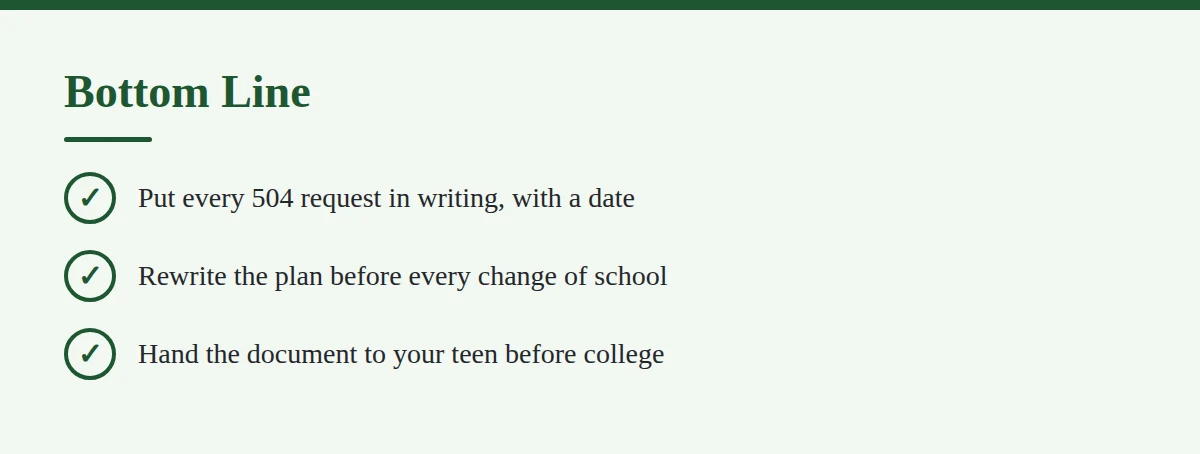
Use “will,” not “will try to” or “when possible.” Name roles rather than individuals, since the nurse who agreed to everything in August may be gone by January. Attach the emergency care plan and the medical documentation as part of the record. Put in a review trigger, so that the plan is revisited before any building change, before any significant change in placement, and at least annually. Section 504 requires periodic reevaluation and reevaluation before a significant change in placement; annual review is the practice standard, not a statutory one, so write it in rather than assuming it.
And make requests in writing. A verbal agreement in a hallway is not a 504 plan, and a written request creates the date stamp everything else hangs on.
When the School Pushes Back
The most common refusals are that the child is “not disabled enough,” that an IHP covers it, or that the school has an unwritten practice that works fine. Section 504 gives you procedural safeguards for exactly these moments: notice of decisions, access to records, an impartial hearing with the right to participate and be represented, and a review procedure. If the district will not budge, a complaint can be filed with the Office for Civil Rights, generally within 180 days of the discriminatory act.
The CDC’s Voluntary Guidelines for Managing Food Allergies in Schools and Early Care and Education Programs, developed under Section 112 of the FDA Food Safety Modernization Act, is a useful thing to bring to a hostile meeting. It is voluntary, but it is a federal document laying out five priority areas, and it makes it much harder for a district to argue that what you are asking for is unusual.
The Handoff You Cannot Delegate
Section 504 protection does not end at graduation, but the 504 plan does. Colleges receiving federal funds remain covered by Section 504 and by the ADA, and the Justice Department’s 2012 agreement with Lesley University established that a university requiring students to buy a meal plan has to make that plan work for students with celiac disease and food allergies. What disappears is the machinery. There is no child-find duty, no team convening on your behalf, and no parental role. The student must self-disclose to the disability services office and produce their own documentation.
That is the real argument for aging the document up deliberately rather than letting it drift. The point of every revision between kindergarten and twelfth grade is to move responsibility, one manageable piece at a time, from the adults in the building to the person who will be carrying it alone. If the fundamentals feel shaky, our complete food allergy guide for 2026 is the place to start, and none of this substitutes for a plan built with a board-certified allergist who knows your child.
Further reading (sources)
- Allergic Living on why one parent found the high school 504 conversation far easier
- Food Allergy Research and Education for how Section 504 and written management plans fit together
- U.S. Department of Education with the parent and educator resource guide to Section 504
- Office for Civil Rights covering what protecting students with disabilities actually requires of a district
- USDA Food and Nutrition Service on meal modifications for children with disabilities in school meal programs
- Centers for Disease Control and Prevention for the voluntary guidelines on managing food allergies in schools
- Allergy & Asthma Network with a state-by-state tracker of self-carry and stock epinephrine laws
- PubMed on what stops teenagers from carrying their auto-injectors
- PubMed covering how often children with food allergy report bullying their parents never hear about
- Journal of Pediatric Psychology for the gap between child-reported and parent-reported allergy bullying
- U.S. Department of Justice with the Lesley University agreement on campus meal plans and food allergy