Tree Nut Allergy: A Complete Guide to the Nine Recognized Tree Nuts and Cross-Reactivity
Published on September 12, 2026
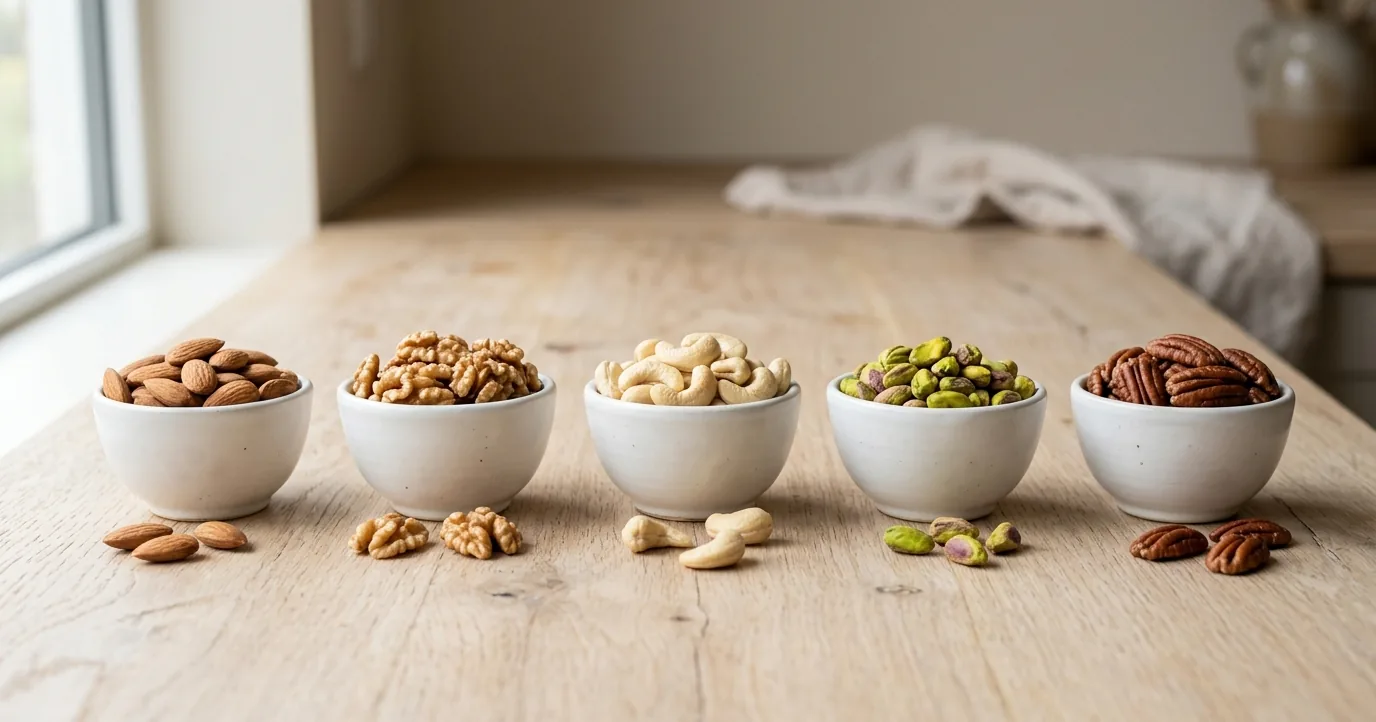
Nine Nuts Wearing One Label
“Tree nut allergy” is a single phrase covering a group of foods that are not closely related to each other, do not share one culprit protein, and do not behave as one allergy. A person who reacts to cashew is told to avoid almonds. A child who reacted to walnut loses pistachios, pecans, hazelnuts, and macadamias in the same appointment. Sometimes that blanket approach is right. Often nobody has checked.
About 3.9 million people in the United States are allergic to at least one tree nut, which makes it one of the most common food allergies in both children and adults. It is also one of the most persistent, and along with peanut it accounts for a large share of severe and fatal food reactions. Those two facts together explain why allergists default to caution: the downside of eating the wrong nut is high, and the evidence needed to safely narrow the list takes real testing to produce.
This guide covers which nuts genuinely cluster together, why the FDA’s official tree nut list dropped from twenty-one entries to nine, where nut protein hides in food that does not look nutty, what the oils actually contain, and what the growing shelf of nut-free alternatives does and does not replace.
The FDA’s Tree Nut List Got Shorter
On 6 January 2025 the FDA published the fifth edition of its food allergen labeling guidance, and quietly rewrote what the word “tree nuts” means on a US package. The old list ran past twenty entries. The new one covers nine nuts: almond, Brazil nut, cashew, hazelnut (also called filbert), macadamia, pecan, pine nut, pistachio, and walnut, with the walnut varieties named individually.
Twelve came off: coconut, beech nut, butternut, chestnut, chinquapin, cola nut, ginkgo nut, hickory nut, palm nut, pili nut, shea nut, and lichee nut. The agency’s reasoning was that only the remaining nine have a robust body of scientific evidence behind them as major food allergens.
Two practical consequences follow, and the second one catches people out.
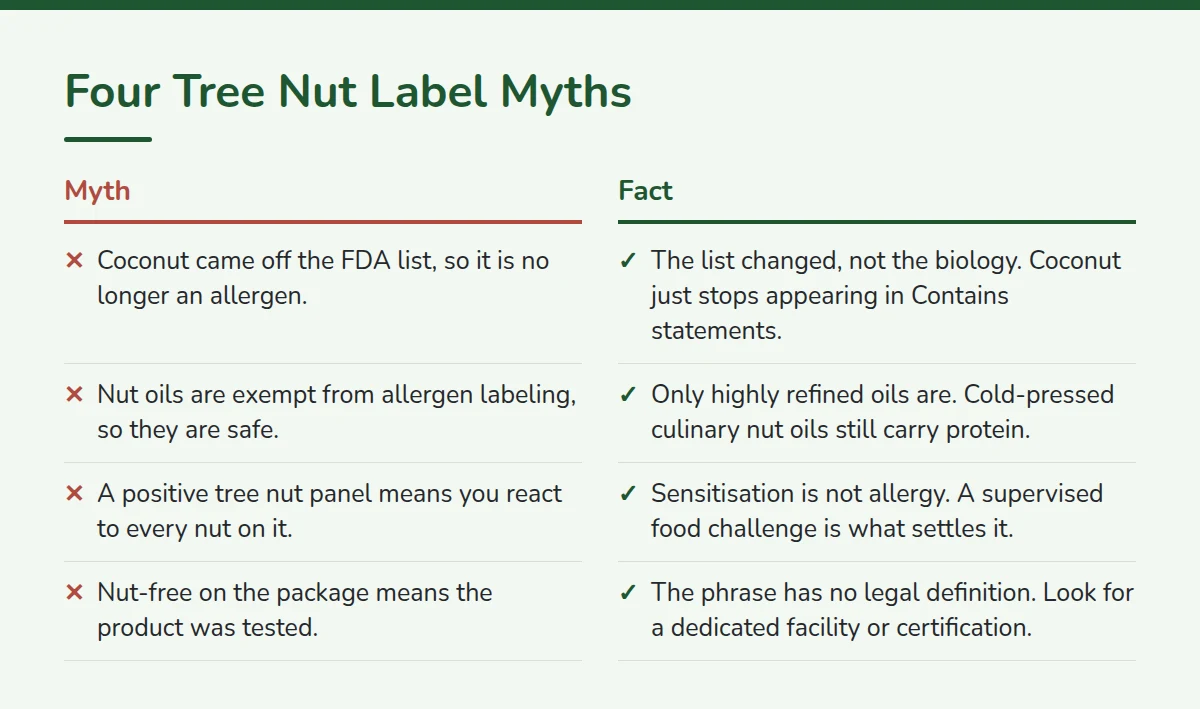
First, a removed nut should no longer appear in a “Contains” statement, because that statement is reserved for major allergens. Coconut is the one that matters to most households. If you have a coconut allergy, the bold “Contains” line will stop flagging it, though coconut still has to appear in the ingredient list by its common name. The exception is worth memorising: an ingredient such as a natural coconut flavor can legally be listed as “natural flavor” with no coconut mentioned anywhere.
Second, there is a transition period. Packaged food has a long shelf life, and labels printed under the old rule are still moving through the supply chain, so you will see coconut in “Contains” statements for a while yet. A label that flags it is not wrong, and a label that omits it is not necessarily safe. Check the ingredient list either way.
It also helps to know that this is guidance, not statute. Guidance documents describe what the FDA currently thinks, and other countries draw the line elsewhere. The EU’s mandatory list names eight specific nuts and does not include pine nut, while coconut sits outside it entirely. Our comparison of how allergen labeling differs country by country sets out what each system covers.
Which Nuts Actually Travel Together
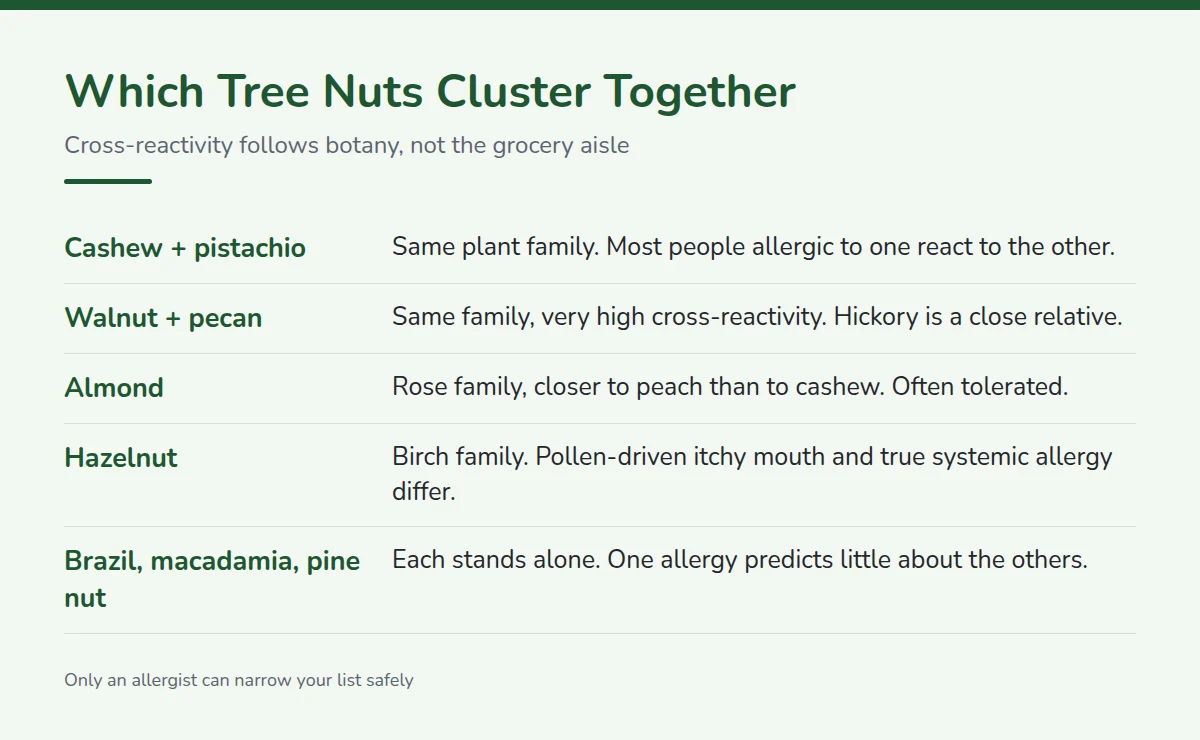
Cross-reactivity follows botany, not the grocery aisle. Nuts in the same plant family carry similar storage proteins, and similar proteins are what an IgE antibody recognises.
- Cashew and pistachio are the tightest pair. Both are in the Anacardiaceae family, their major allergens are close relatives, and most people allergic to one react to the other. Cashew allergy in particular has a reputation for severe reactions at small doses, and its major allergen Ana o 3 is one of the more reliable markers allergists use. Mango and pink peppercorn are in the same family, but clinical reactions to them are uncommon.
- Walnut and pecan are the other tight pair, both in the walnut family. Cross-reactivity between them is very high. Hickory nut is a close relative, which is a reason to stay careful with it even though it came off the FDA list.
- Almond sits in the rose family alongside peach, apricot, and cherry, and is not closely related to the other tree nuts. Plenty of people allergic to cashew tolerate almonds.
- Hazelnut is in the birch family, and this is where the picture gets genuinely confusing. Many hazelnut reactions are pollen-driven: a birch-allergic person reacts to a protein in hazelnut that resembles birch pollen, and the result is oral allergy syndrome, an itchy mouth that settles quickly and usually does not escalate. A different set of hazelnut proteins, the heat-stable storage proteins, signals real systemic risk. Same nut, two very different diagnoses, and component testing is what separates them.
- Brazil nut, macadamia, and pine nut each sit alone in their own family. Brazil nut allergy is less common but often severe. Macadamia allergy is rare. Pine nut is botanically a conifer seed rather than a nut at all, and allergy to it is rare, though many people meet the harmless “pine mouth” effect, a lingering metallic taste that is not an allergic reaction.
Roughly a third of tree nut allergic people react to more than one nut. That leaves a majority who do not, which is exactly why the blanket-versus-partial question is worth asking rather than assuming.
Partial Avoidance Is an Allergist Decision, Not a Home Experiment
The honest version of the cross-reactivity story is that a blood or skin test showing sensitisation to six nuts does not mean you are allergic to six nuts. Tree nut panels produce a lot of positive results that never translate into a reaction, which is how one bad cashew evening turns into a permanently emptied cupboard.
Component testing helps. Instead of asking whether you react to “hazelnut”, it asks which protein within the hazelnut your antibodies recognise, and the answer distinguishes a pollen-driven itchy mouth from a genuine anaphylaxis risk. It is the same logic behind Ara h component testing in peanut allergy, covered in our complete peanut allergy guide. Peanut is worth keeping straight here: it is a legume, not a tree nut, and being allergic to one does not predict the other, although the two allergies do co-occur often enough that both usually get tested.
What settles the question is a supervised oral food challenge in a clinic, with staff and drugs on hand. Nothing about that process can be replicated at a kitchen table, and a nut you have never eaten is not a nut you have tolerated. Direct-to-consumer panels are especially unhelpful here, for reasons we set out in our look at why at-home food sensitivity tests are not allergy tests.
Where Tree Nut Protein Hides
The dangerous items are rarely the bowl of nuts on the table.
- Almond in disguise. Marzipan, almond paste, frangipane, macarons, amaretti, nougat, torrone, and almond extract, which is genuinely made from bitter almonds unless it says imitation. Almond flour is now everywhere in gluten-free and low-carb baking, a real trap for anyone shopping the free-from aisle for a different reason.
- Hazelnut in disguise. Gianduja and chocolate hazelnut spreads, praline fillings, and Frangelico. Praline is the single most under-declared word on a chocolate box.
- Pistachio in mortadella, baklava, halva, Persian and Turkish desserts, and ice cream.
- Cashew in vegan cheeses, cashew cream, dairy-free desserts, Indian korma and pasanda sauces, and much commercial pesto, where cashew is often substituted for pine nuts to cut costs. The plant-based aisle is a high-nut environment that many people assume is a safe one.
- Walnut and pecan in salads, pie fillings, crumb toppings, granola, energy bars, banana bread, and Middle Eastern muhammara.
- Mixed and unlabelled. Mole sauces, romesco, satay-style sauces, some barbecue sauces and salad dressings, Worcestershire-style marinades, and nut liqueurs and orgeat syrup behind a bar.
Two settings deserve their own note. Airline catering has produced repeated reports of reactions to nut that was not declared on the meal card, and Allergic Living documented two such cases in 2026 alone. And “natural flavoring” on a US label does not have to name a nut source unless the nut itself is a major allergen present in the food.

Nut Oils, and the Refining Question
Nut oils sit in a gap most people do not know exists.
US law exempts highly refined oils from allergen labeling, because the refining process strips out essentially all of the protein that causes a reaction. Refined peanut oil is the usual example, and the same logic applies to refined nut oils.
The catch is that the nut oils sold for cooking mostly are not highly refined. Walnut oil, hazelnut oil, and almond oil are typically cold-pressed or expeller-pressed precisely because that is what preserves the flavour people buy them for, and that process leaves protein behind. Treat a gourmet nut oil as the nut. The same goes for nut oils in skincare, massage oil, and hair products, which are almost always unrefined and which sit on skin for hours.
Argan oil and shea butter are the grey area. Both come from tree kernels, neither is on the FDA’s nine, and documented allergic reactions to either are rare. Rare is not never, and if you have a broad tree nut allergy it is a reasonable thing to raise with your allergist rather than settle from a blog.
Bakeries, Ice Cream Counters, and Shared Equipment
Cross-contact for tree nuts follows the equipment and the scoop.
An independent bakery is one of the hardest rooms in food service for this allergy: shared mixers, a nut-flour dust that travels, decorating stations where praline and chopped nuts sit open, and staff who reasonably believe a plain sponge is a plain sponge. Bakeries are difficult for more than one allergen at once, and our guide to where egg hides in baked goods covers the other half of that problem.

At an ice cream counter, the scoop moves between tubs and the well water is shared. Asking for a fresh scoop from a clean tub is a legitimate request, and a shop that cannot do it is telling you something useful. The same is true of a bulk bin aisle, a candy counter, a salad bar with a nut topping, and a buffet where one pair of tongs serves two trays.
Precautionary labels such as “may contain tree nuts” remain voluntary in the US and carry no legally defined threshold, which means an absent warning is not a guarantee of anything. We cover what the FDA is doing about that in our piece on the 2026 allergen threshold meeting.
What the Nut-Free Alternatives Actually Replace
The free-from shelf has grown a great deal, and it is worth knowing what each product is doing.
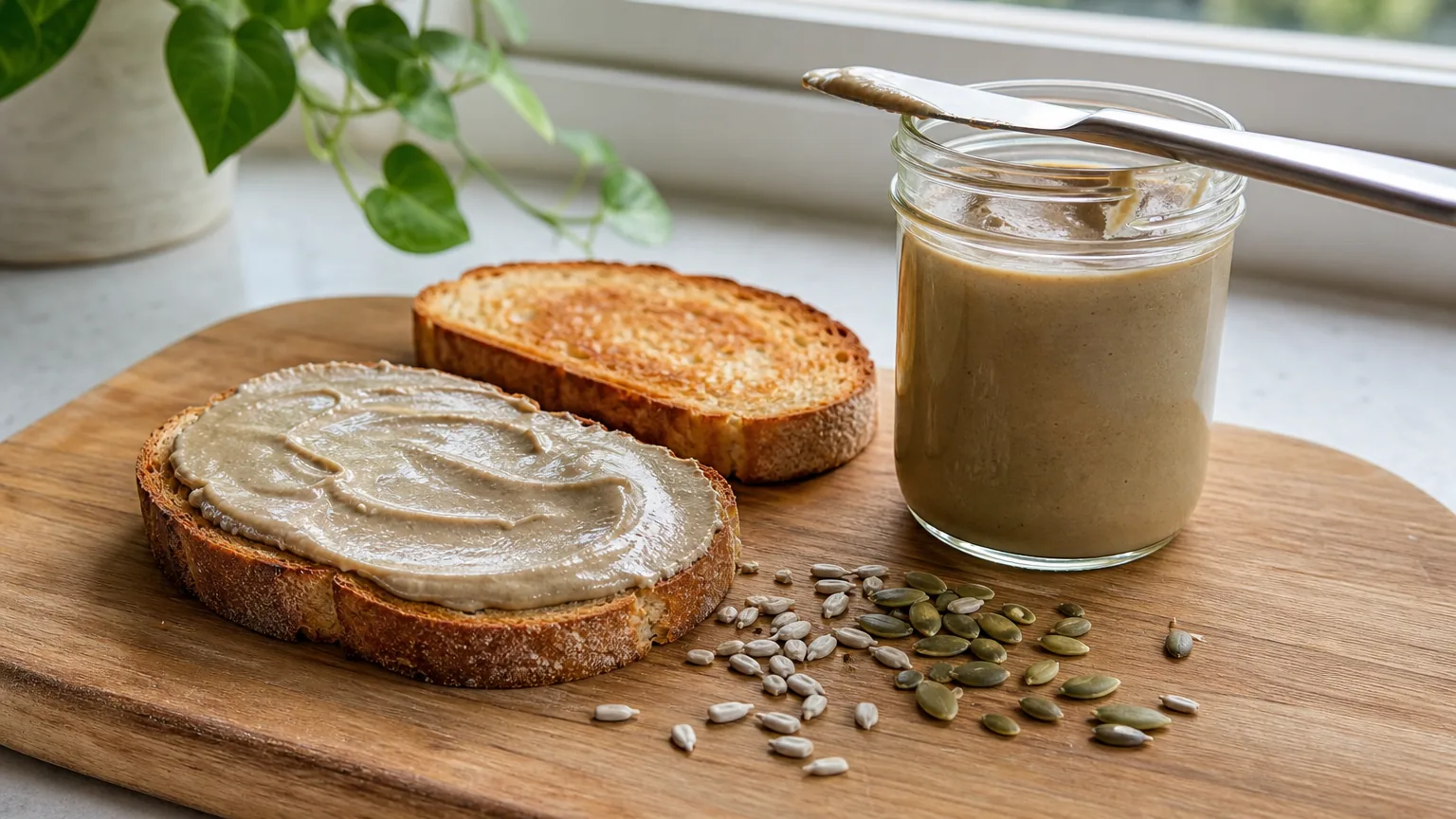
Seed butters are the workhorse substitution. Sunflower seed butter and pumpkin seed butter match the texture and the protein role of nut butters closely enough for sandwiches and baking, and roasted seeds handle the crunch job in granola and trail mixes. Tiger nut, despite the name, is a small tuber and contains no nut at all. Coconut-based crumbs and soy nut products fill other gaps. Engineered nut substitutes are arriving too, and the research pipeline now runs to the nut itself: a startup called Nurtured Nuts took the top prize at the 2026 IFT FIRST pitch competition for using CRISPR to breed peanuts without their allergenic proteins, with a first crop growing in Georgia. That work is peanut, not tree nut, but it points at where the category is heading.
Three cautions apply to all of it. “Nut-free” is a marketing phrase with no legal definition, so it tells you about intent rather than testing. Many nut-free products are made in facilities that also run sesame, coconut, or soy, which matters if the household manages more than one allergy. And a product engineered to remove an allergen still needs third-party verification before you treat it as safe, which is the standard any new category should be held to.
Why This One Usually Stays
Tree nut allergy is outgrown by roughly one child in ten, a much lower rate than milk or egg. For most people it is a lifelong diagnosis, and reactions to accidental exposure do not reliably get milder with time.
There is no approved oral immunotherapy specific to tree nuts in the way there is for peanut, though trials are running and omalizumab is now used to raise reaction thresholds across multiple allergens at once. Our 2026 guide to the anaphylaxis treatment landscape covers where each option stands.
Until something changes, the plan is the same one that works for every severe food allergy: know exactly which nuts you react to rather than which nuts you were told to fear, read the ingredient list every time because formulations change, ask about the bakery and the scoop, and carry two epinephrine auto-injectors. If you want the fundamentals in one place, our complete food allergy guide for 2026 covers labels, cross-contact, and emergency planning across all nine major allergens.
The single most useful thing you can do with this diagnosis is to get it named precisely. Nine nuts is a long list to give up on the strength of one reaction, and for most people the real list is shorter.
Further reading (sources)
- U.S. Food and Drug Administration on why the tree nut list dropped to nine and what happens to coconut labels
- Food Allergy Research and Education for how tree nuts differ from peanuts and seeds
- Food Allergy Research and Education with the US prevalence figures behind each major allergen
- Current Allergy and Asthma Reports on why pollen-driven and systemic tree nut reactions need separating
- Clinical Reviews in Allergy and Immunology covering the cashew allergens and why labelling compliance matters so much
- Critical Reviews in Food Science and Nutrition for what roasting and processing do to nut allergens
- Allergic Living reporting two reactions to undeclared nut in airline meals
- Food Technology Magazine on the CRISPR peanut startup that won the 2026 IFT pitch competition