Will They Outgrow It? The Natural History of the Top 9 and When to Ask for a Food Challenge
Published on October 6, 2026

“Will she outgrow it?” is usually the second question a family asks after a food allergy diagnosis, right after “how do we keep her safe?” The answers tend to arrive as folklore from two directions at once. One relative says most kids grow out of these. Another says it’s for life. Both are right, about different foods. Milk and egg allergies fade for most children. Peanut, sesame, and tree nut allergies fade for a minority. Fish and shellfish allergies usually stay, and both often begin in adulthood in the first place. What families are rarely told is which of those groups their own diagnosis sits in, or how an allergist decides that the moment has come to find out.
This guide sits above our single-allergen guides. It lays out what long-term studies show for each of the Top 9, what falling test results can and cannot tell you, where component testing and baked ladders fit, how often to retest without over-testing, and how to decide with your allergist that it is time for a supervised oral food challenge. It is written for parents of children diagnosed young, and for adults who were told something in childhood and have never checked whether it still holds.
Three Groups, Not Nine Separate Stories
The simplest honest summary of food allergy natural history has three groups.
- Usually outgrown: milk, egg, wheat, and soy. Most children with these allergies eventually tolerate the food, though often years later than families are promised.
- Outgrown by a minority: peanut, sesame, and tree nuts. Somewhere between one child in ten and one in three loses these, depending on the food.
- Usually lifelong: fish and shellfish. FARE estimates that about 40 percent of people with fish allergy, and about 60 percent of people with shellfish allergy, had their first reaction as adults.
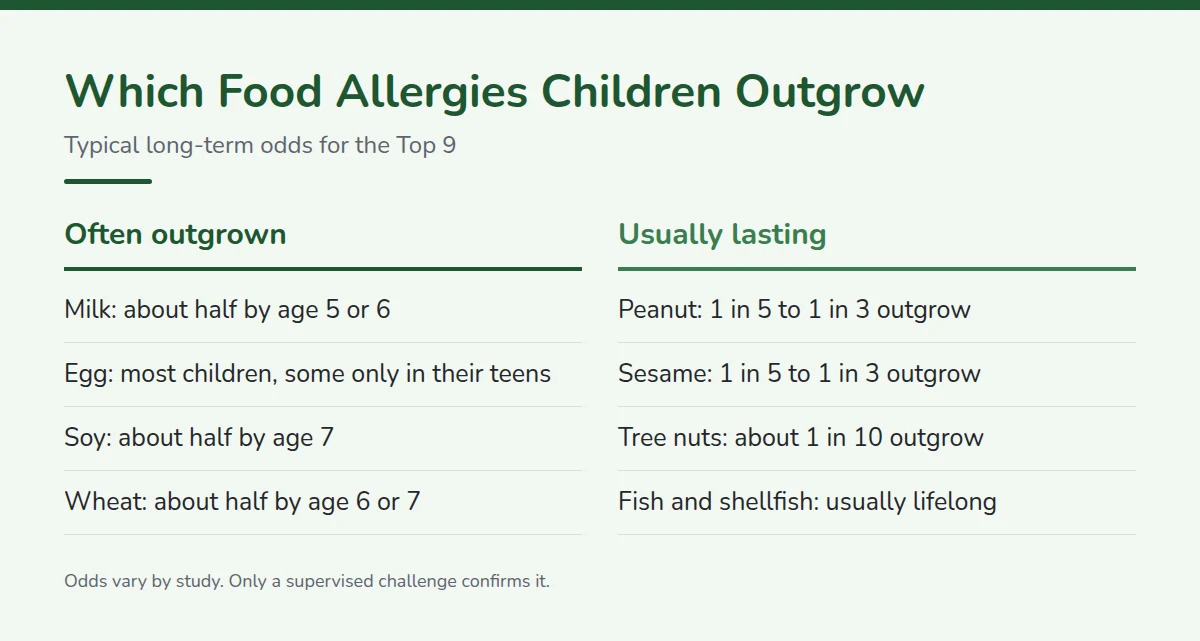
Two cautions apply to everything below. The figures come from different kinds of studies, and specialist referral clinics see the more stubborn cases, so they report slower resolution than studies that follow every child in a region. And a group is a probability, not a forecast for your child. Plenty of children outgrow peanut allergy, and some carry a milk allergy into adulthood.
The Numbers, Allergen by Allergen
The table pulls together the best long-term data for each allergen. Our single-allergen guides go deeper on the egg timeline and the baked egg ladder and on how wheat allergy resolves and how it differs from celiac disease.
| Allergen | What long-term studies found |
|---|---|
| Milk | About half resolved by age 5 or 6 in a US study that enrolled infants; 79 percent by age 16 in a specialist clinic |
| Egg | 89 percent resolved by age 6 in an Australian population study; 68 percent by age 16 in a specialist clinic |
| Soy | About half resolved by age 7, and 69 percent by age 10 |
| Wheat | Typical resolution around age 6 and a half; 65 percent by age 12 |
| Peanut | About one in five to one in three resolve, mostly by age 6 |
| Sesame | About one in five to one in three resolve in the studies so far |
| Tree nuts | About one in ten resolve |
| Fish | Uncommon in young children; about one in five in a Greek study, far more often in teenagers |
| Shellfish | Usually lifelong; very little data on resolution |
Three patterns are worth pulling out of that table.
Referral and population studies disagree, and both are right. Egg spans 68 percent by age 16 in one study and 89 percent by age 6 in another because the two looked at different children. The Johns Hopkins clinic saw allergies severe or complicated enough to need a specialist center. The Australian HealthNuts study tested a whole population of one-year-olds and kept following them. If your child’s allergy was found in infancy and has stayed mild, the population numbers probably describe you better. If you are several years in with high test results, the referral numbers are closer.
Peanut has an early window. In HealthNuts, about a third of infant peanut allergy had resolved by age 10, and almost all of that resolution had already happened by age 6. That is one reason allergists watch peanut results closely through the preschool years, and why fewer surprises come after that.
Fish and shellfish are less absolute than their reputation. The Greek study found that most fish-allergic children could eat tuna and swordfish under challenge even while cod was still a problem. A small Thai study found that close to half of people with milder shrimp allergy tolerated shrimp a decade after diagnosis, although anyone with past anaphylaxis was excluded. Neither finding is a reason to try anything at home. Both are reasons to ask whether a supervised, species-specific challenge makes sense. Our complete fish and shellfish allergy guide explains which species tend to cluster together.
What Falling IgE and a Shrinking Wheal Do and Do Not Predict
Between challenges, two tests carry most of the weight. The blood test measures food-specific IgE, reported in kUA/L. The skin prick test measures the raised bump, or wheal, in millimeters. Families tend to read both as a severity score. They work better as odds.
One result gives the odds of passing a challenge today. In a review of 604 challenges at Johns Hopkins, children with milk, egg, or peanut IgE at or below 2 kUA/L passed about half the time. That is the honest meaning of a low result: closer to a coin toss than a clearance, and never permission to try the food at home.
The trend gives the odds of outgrowing it. The direction of travel says more than any single result.
- In children with milk and egg allergy, how fast IgE fell over time predicted who became tolerant, most strongly in children under 4.
- In the HealthNuts peanut cohort, falling IgE to Ara h 2 and rising IgG4, a blocking antibody, tracked with resolution by age 10. The levels measured at diagnosis were only weakly predictive, and no single cutoff worked well.
- In a Turkish sesame study, children whose skin test wheal shrank went on to develop tolerance 37 percent of the time. Among those whose wheal held steady or grew, 93 percent stayed allergic.

Peak values matter too. In the Johns Hopkins referral studies, the highest IgE a child ever recorded was one of the strongest predictors of a slow course for milk, egg, soy, and wheat, and children whose egg IgE topped 50 kUA/L were unlikely to outgrow egg. Numbers are not destiny, though. In the wheat study, many children outgrew the allergy even from the highest levels. Early skin tests point the same way: in HealthNuts, a peanut wheal of 8 mm or more at age 1, or an egg wheal of 4 mm or more, predicted persistence, as did severe eczema that started early in infancy.
What none of these numbers do is predict how severe the next reaction will be. FARE is blunt that no current test can. A child with a modest number can still react hard, and a child with a towering number may only ever have had hives. Epinephrine and the emergency plan stay exactly the same whatever the trend.
A positive test is not always an allergy in the first place, either. In the Johns Hopkins tree nut study, 14 of 19 children who had never eaten tree nuts but had tested positive passed their challenges. Some of the allergies families are waiting to outgrow were never there.
Component Testing: Separating Likely Outgrowers From Persistent Cases
A standard IgE test measures the response to a whole food. Component testing measures the response to individual proteins inside it, and some proteins are far more telling than others. For prognosis, a few are worth knowing by name.
- Ovomucoid (egg) is the egg white protein that survives baking. In a Japanese challenge study, ovomucoid IgE predicted reactions to heated egg better than a standard egg white test did, which makes it a natural number to check before a baked egg challenge.
- Casein (milk) is the milk protein that survives the oven. In a large cohort of milk-allergic children, casein IgE was the best of the measures tested at predicting who would react to baked milk.
- Ara h 2 (peanut) is the strongest single marker of genuine peanut allergy, and the one whose falling trend tracked resolution in HealthNuts. A child sensitized mainly to Ara h 8, a protein that resembles birch pollen, is in a very different position, as our complete peanut allergy guide explains.
- Ana o 3 (cashew) and Cor a 14 (hazelnut) sit alongside Ara h 2 in the European diagnosis guidelines as components that help confirm a peanut, hazelnut, or cashew allergy, especially in people who are also sensitized to pollen.
Two limits keep components in proportion. They refine the odds of passing a challenge rather than replacing it. And for fish, shellfish, and sesame, the evidence linking components to long-term outcome is still thin.
Where Baked Ladders Fit
For milk and egg, the first challenge is often not a glass of milk or a scrambled egg but a muffin. About 75 percent of milk-allergic children in the original New York study tolerated milk that had been extensively baked into a wheat-based food, and the same principle drives the baked egg ladder. Sustained heat and a flour matrix break down or trap the proteins the immune system recognizes. Our explainer on how cooking changes allergens covers the chemistry.
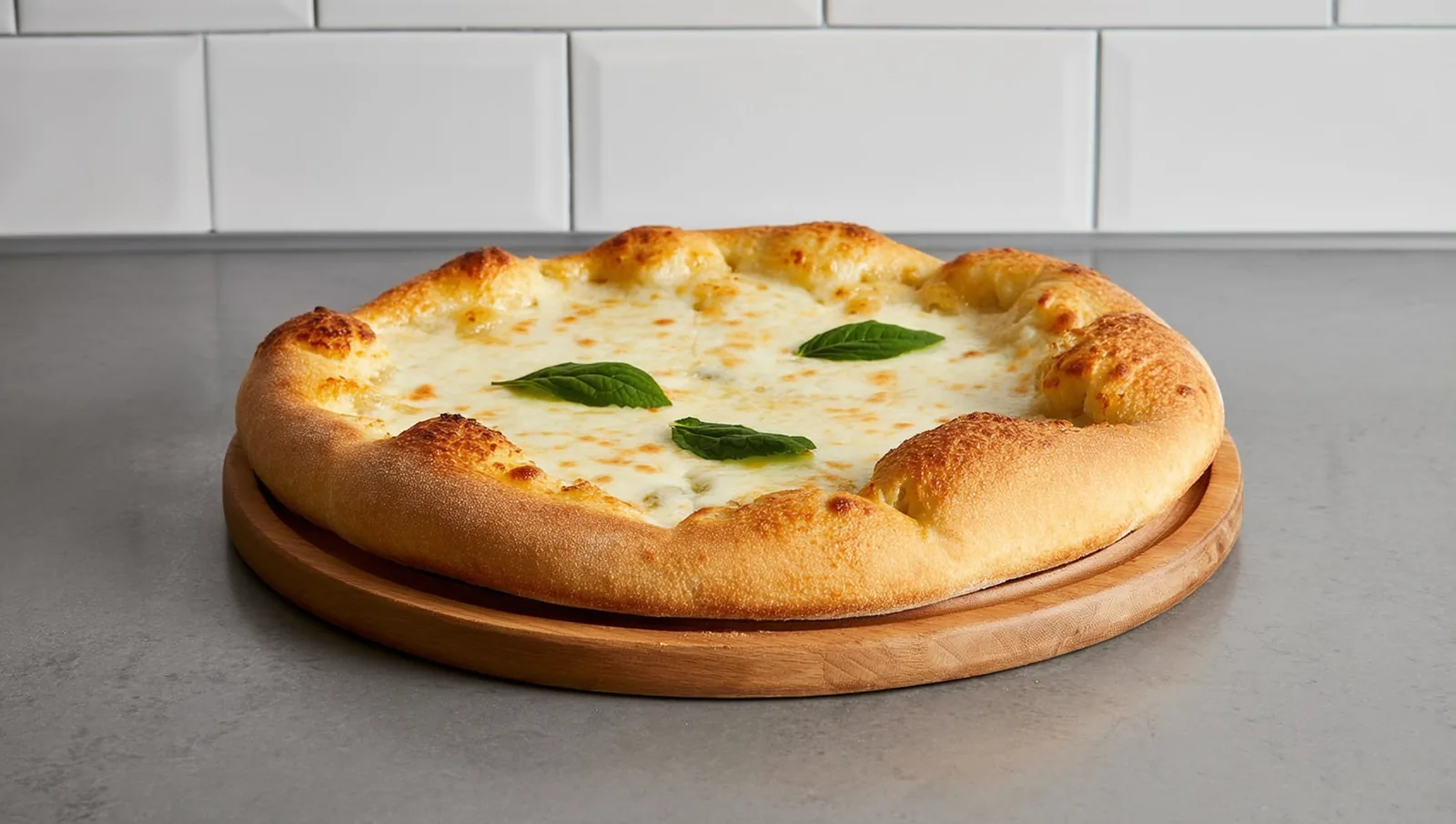
The baked step matters for prognosis as much as for diet. In HealthNuts, infants who reacted to baked egg had roughly seven times the odds of still being egg-allergic at age 6. In a New York milk study, children who passed a baked milk muffin moved on to baked cheese, such as pizza, before plain milk. Those who tolerated baked milk were 28 times more likely to go on to tolerate plain milk than children who reacted to it, and those who kept baked milk in their diet were 16 times more likely to outgrow the allergy than a matched comparison group. That was an observational study, and part of the effect may simply be that baked-tolerant children were already on their way out.
Either way, passing a baked challenge is two pieces of good news at once: a wider diet now and a strong hint about the future. Reacting to baked milk or egg is useful information too. It marks the more persistent pattern and argues for patience before trying the plain food.
Two warnings. A widely shared milk ladder comes from UK primary care guidance, and that guidance says its home ladder is only for mild to moderate non-IgE milk allergy, the delayed and mostly digestive kind, and not for the immediate, IgE-mediated allergy this article is about. Ladders built for IgE-mediated milk and egg allergy do exist, including Canadian versions designed for use at home, but they are meant to be used under an allergist’s direction, and whether the first rung happens at home or in a clinic is the allergist’s call. A ladder downloaded and started alone is a home challenge with nobody watching. And heat only helps where the troublesome proteins break down. The main peanut and tree nut allergens survive heat, roasting can make peanut more allergenic, and the main shellfish allergen survives frying, so there is no baked shortcut for those.
How Often to Retest Without Over-Testing
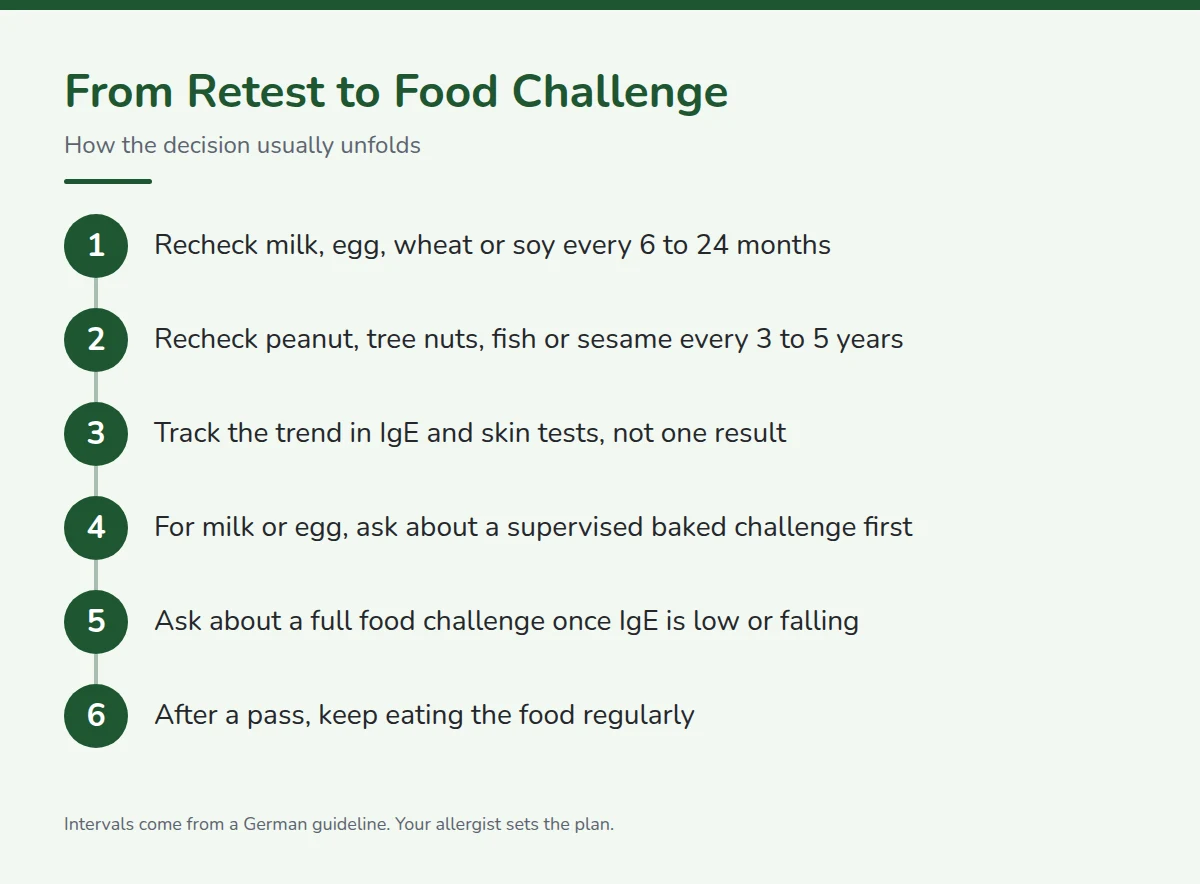
There is no single US schedule, and allergists vary. The clearest written guidance comes from a German consensus guideline, which ties the interval to each allergen’s natural history.
- Milk, egg, wheat, and soy in children: repeat the challenge at regular intervals, for example every 6, 12, or 24 months.
- Peanut, tree nuts, fish, and oilseeds such as sesame: longer intervals, for example every 3 to 5 years.
- Between challenges: the IgE trend is a useful guide to whether another challenge is worth doing yet.
The European diagnosis guidelines make the same point more broadly: reassessing children with tests or challenges over time is how a food gets back into the diet once tolerance arrives on its own.
Over-testing has costs of its own. A blood draw in a toddler is no small thing, a skin test means stopping antihistamines first, and a single number read without its history produces false comfort and false alarm in roughly equal measure. A yearly visit is still worth keeping in years with no test, to update the emergency plan, the school paperwork, and the epinephrine dose as a child grows.
Adults deserve the same recheck. In a national survey, 19 percent of US adults believed they had a food allergy, but only 10.8 percent described reactions convincing enough to count, and the researchers urged confirmatory testing so that food is not avoided needlessly. If you were diagnosed with a milk, egg, wheat, or soy allergy as a child and have avoided the food ever since without a recent reaction, it is reasonable to ask an allergist whether it still holds. The same survey found that nearly half of food-allergic adults developed food allergies as adults, and the most common adult allergy, shellfish, is also among the least likely to leave.
Deciding It’s Time for a Food Challenge
An oral food challenge is the reference test for food allergy. The patient eats gradually increasing doses of the food under medical supervision, and if the full amount goes down without a reaction, the allergy is gone or was never there. Allergists weigh a handful of things before offering one.
- The odds of passing. Low or falling IgE, a shrinking wheal, and reassuring components all push toward a challenge. The Johns Hopkins tree nut study, for example, suggested considering a challenge for children aged 4 and older whose tree nut IgE levels were all 5 kUA/L or lower.
- Time since the last reaction. A recent reaction usually resets the clock. The Johns Hopkins peanut study offered challenges only to children who had been reaction-free for at least a year.
- What the food is worth. Milk, egg, and wheat run through school lunches and birthday parties, so clearing one changes daily life far more than clearing a single tree nut. Nutrition, culture, and a child’s own wishes all count.
- Readiness. A teenager who has spent ten years being told a food is dangerous may need time before agreeing to eat it. The AAAAI work group’s guidance on running challenges covers psychosocial preparation for children and families.
- Health on the day. A cold, a fever, or asthma that is not well controlled is a reason to reschedule.
Families often fear the challenge more than the allergy. In a survey of 6,377 clinic challenges at five US centers, 86 percent ended with no reaction at all, and 2 percent involved anaphylaxis, which the staff were there to treat. Expect to stop antihistamines for several days beforehand (your allergist will give the exact window), to spend most of a morning in the clinic, and to ask whether you should bring a food your child already likes for mixing the doses into.
After a Pass, and After a Fail
A passed challenge starts a new routine rather than ending the old one. In a Johns Hopkins follow-up of children who had outgrown peanut allergy, about 8 percent saw it come back, and every recurrence was in a child who ate peanut rarely or in small amounts afterward. None of the 23 children who ate it frequently relapsed. The researchers’ advice was to eat the food regularly and keep carrying epinephrine until ongoing tolerance is established.

Update the paperwork as soon as the allergist confirms the result: the school plan, the daycare forms, and the note on the grandparents’ fridge should all change together, so nobody is working from the old rules.
A failed challenge is not wasted. It confirms the allergy is still active, it shows roughly how much of the food it takes to cause a reaction, and it resets the retest clock rather than closing the question.
Outgrowing an allergy is also different from being treated for one. Oral immunotherapy raises the amount a person can tolerate, but that protection usually depends on continuing regular doses. A naturally resolved allergy needs no maintenance dose, only the food eaten often enough to keep it that way.
Questions to Bring to the Next Appointment
- Which group does this allergy fall into, and what do the long-term studies suggest for a child like mine?
- What is the trend across all the IgE and skin test results so far, not just the latest one?
- Would component testing, such as ovomucoid, casein, Ara h 2, or a nut component, change the plan?
- For milk or egg, is a supervised baked challenge the right next step?
- How often should we recheck this particular allergen, and what result would make you offer a challenge?
- If we pass, how often should the food be eaten afterward, and what changes in the emergency plan?
“Will they outgrow it?” has an honest answer, and it is a probability rather than a promise. It depends on the food, the starting numbers, and above all the trend, and the right tests read over time can narrow it a great deal. Until a supervised challenge says otherwise, nothing about daily safety changes: read every label, carry two epinephrine devices, and leave the testing to a clinic with epinephrine on hand.
Further reading (sources)
- Food Allergy Research and Education on which of the nine major allergens tend to last into adulthood
- Food Allergy Research and Education for what skin, blood, and challenge tests can and cannot show
- Wood and colleagues on how milk allergy resolved in a multicenter infant cohort
- Skripak and colleagues with milk allergy outcomes to age 16 in a referral clinic
- Peters and colleagues on egg and peanut allergy from age 1 to 6 in the HealthNuts population study
- Parker and colleagues for Ara h 2 and IgG4 trends in children who outgrew peanut allergy
- Savage and colleagues covering the slow resolution of egg allergy in a specialist clinic
- Savage and colleagues on soy allergy resolution and peak soy IgE
- Keet and colleagues for the natural course of wheat allergy
- Skolnick and colleagues with the challenge study that showed peanut allergy can be outgrown
- Fleischer and colleagues on how rarely tree nut allergy resolves
- Mahlab-Guri and colleagues for spontaneous resolution of sesame allergy
- Kazancioglu and colleagues on shrinking skin tests and persistent sesame allergy
- Xepapadaki and colleagues with fish allergy in children and species-specific challenges
- Ittiporn and colleagues on shrimp allergy rechallenged a decade after diagnosis
- Perry and colleagues for how IgE levels relate to passing a challenge
- Shek and colleagues on falling milk and egg IgE as a sign of coming tolerance
- Ando and colleagues with ovomucoid testing before a heated egg challenge
- Caubet and colleagues for casein IgE and reactions to baked milk
- Nowak-Wegrzyn and colleagues on milk-allergic children who tolerate baked milk
- Kim and colleagues with baked milk in the diet and later tolerance of plain milk
- Venter and colleagues on the iMAP milk ladder and which children it is meant for
- Chomyn and colleagues for Canadian milk and egg ladders built for IgE-mediated allergy
- Worm and colleagues for the German guideline’s challenge intervals by allergen
- Santos and colleagues with the European guideline on diagnosing IgE-mediated food allergy
- Gupta and colleagues on how many US adults have a food allergy, and when it began
- Bird and colleagues for the AAAAI work group update on conducting food challenges
- Akuete and colleagues on reaction rates across 6,377 clinic challenges
- Fleischer and colleagues with peanut allergy returning after it was outgrown