Why Kids Don't Always Get Epinephrine in Time, and What Caregivers Can Change Tonight
Published on September 7, 2026
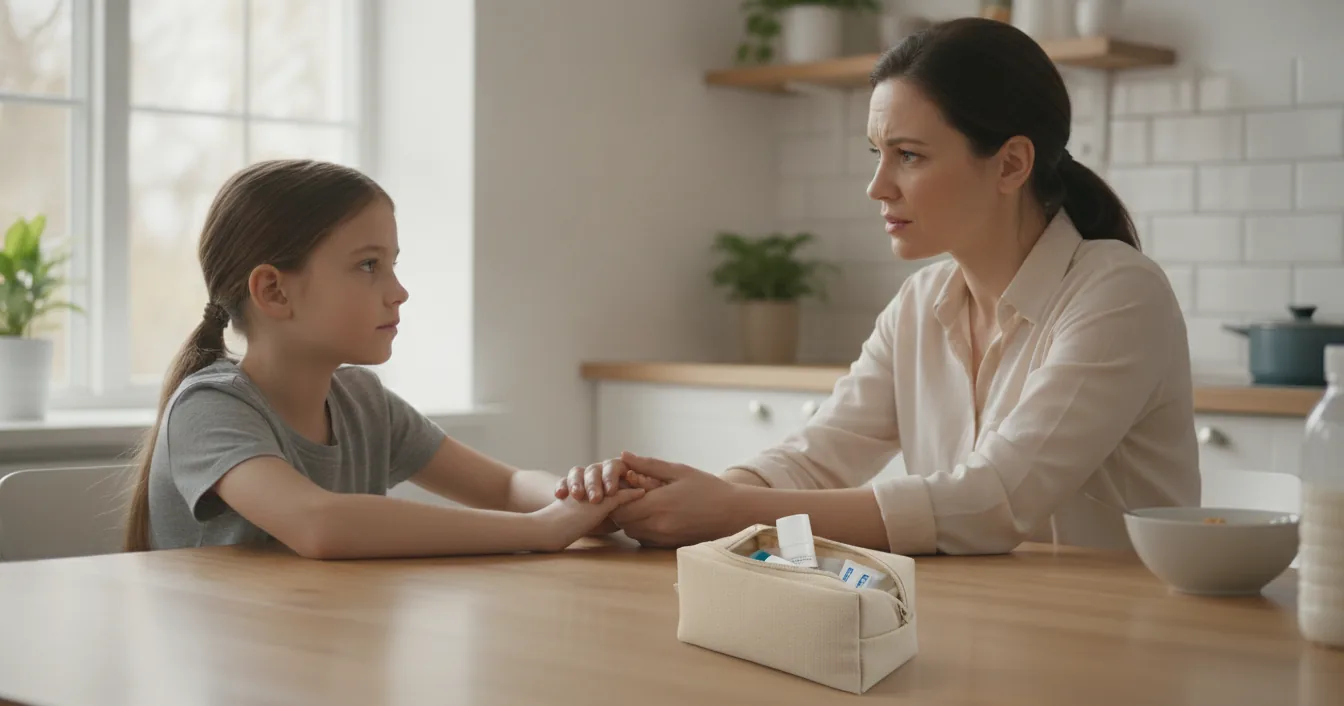
The Gap Between Carrying It and Using It
Almost every allergy household gets the first part right. The allergist writes the prescription, the pharmacy fills the two-pack, the pouch goes in the backpack, and the family gets on with life. What the research keeps finding is that the second part, the part where somebody actually presses the device into a child’s thigh while the reaction is still small, fails far more often than anyone would guess.
Researchers at National Jewish Health in Denver looked at the medical records of more than 400 children, average age seven, who were treated for anaphylaxis at an emergency department or urgent care in Columbus, Ohio. Fewer than half of them received epinephrine before they arrived. About two thirds had a known history of anaphylaxis. Nearly half already had a prescription for an auto-injector. The finding was published in the Annals of Allergy, Asthma and Immunology, and the uncomfortable thing about it is how old it is: it dates to July 2017, and the pattern it describes has been confirmed in study after study since. This is not a knowledge problem the field has solved. It is the same gap, still open.
The Findings That Should Change How You Prepare
Four results from that study are worth sitting with, because each one points at a fixable habit rather than a mystery.
The device was not there. Only two thirds of the children who had been prescribed an auto-injector had it available at the moment they reacted. A prescription that lives in a kitchen drawer, a glovebox, or a bag that stayed home is not protection. It is paperwork.
Home was worse than school. Reactions that started at home were less likely to be treated with epinephrine than reactions that started at school. That inversion surprises parents, who tend to assume school is the risky place and home is the safe one. Schools have a written plan, a trained nurse, and a protocol that removes the judgment call. Kitchens have a parent trying to decide, alone, whether this is the bad one.
Sicker children were treated less, not more. Children whose reaction involved several organ systems at once were less likely to get epinephrine before hospital than children with only one system involved. This is the single most counterintuitive result in the paper, and the most useful. Two systems involved is the classic teaching definition of anaphylaxis. What it looks like in a real living room, though, is a scattering of moderate things: some hives, a stomach ache, a cough, a child who says their mouth feels funny. No single symptom looks like an emergency, so the caregiver waits for the one dramatic sign that never arrives on schedule.
Waiting cost them. Children who arrived without pre-hospital epinephrine were less likely to be sent home from the emergency department. Treating late does not just carry risk in the moment. It buys an admission.

Dr. Melissa Robinson, the allergy and immunology fellow who led the work, listed the drivers plainly: delayed recognition of symptoms, poor understanding of when epinephrine is indicated, access to specialist care, and cost. Three of those four are things a household can work on this week.
Why Caregivers Hesitate
Nobody hesitates because they do not love the child. They hesitate for reasons that feel responsible in the moment.
They are grading the reaction. Caregivers try to sort symptoms into mild, moderate, and severe, then match the treatment to the grade. It feels careful. It is actually the mechanism behind the multi-system finding above, because a reaction that is escalating across several systems reads, minute to minute, as a collection of moderate complaints.
They reach for an antihistamine first. Diphenhydramine is the most common substitute for epinephrine, and it is the most dangerous one, because it does something. Itching settles, hives fade, the child seems calmer, and the clock keeps running on the airway and blood pressure changes that the antihistamine has not touched at all. Antihistamines treat skin symptoms. They do not treat anaphylaxis.
They are afraid of the device. The needle is a documented barrier, and not only for children. Adults hesitate to fire a spring-loaded injector into a small thigh, especially if they have never held one that was not sealed in a box. Grandparents and babysitters hesitate most of all, because they have had no practice and are terrified of getting it wrong.
They are waiting for permission. A surprising number of caregivers call a parent, a partner, or an after-hours line before they use the device, and lose ten minutes to the phone call. Any plan that requires someone to reach you before acting is a plan with a built-in delay.
Early Beats Late, Every Time
Epinephrine works on the mechanism of the reaction rather than its symptoms. It tightens leaking blood vessels, relaxes the airway, and supports blood pressure, and it does that within minutes of an intramuscular dose in the outer thigh. Given early, it usually stops the reaction where it stands. Given late, it is fighting a process that has already progressed, which is why delayed administration is such a consistent feature of the case series on fatal food anaphylaxis.
Severe reactions typically begin five to thirty minutes after contact with the trigger, though the American Academy of Allergy, Asthma and Immunology notes it can occasionally take more than an hour. That window is the entire margin. Spending it on observation, or on an antihistamine, or on a phone call, is spending the only advantage the household has.
The counterweight most caregivers worry about barely exists. In a child, an unnecessary dose of epinephrine typically produces a racing heart, pallor, shakiness, and a rush of anxiety that passes in fifteen or twenty minutes. Allergists are near unanimous that the risk of withholding it in a suspected anaphylaxis outweighs the risk of giving it in a reaction that turns out to be milder. If you are debating, that debate is itself the indication.
The Decision Rule, Written Down and Stuck to the Fridge
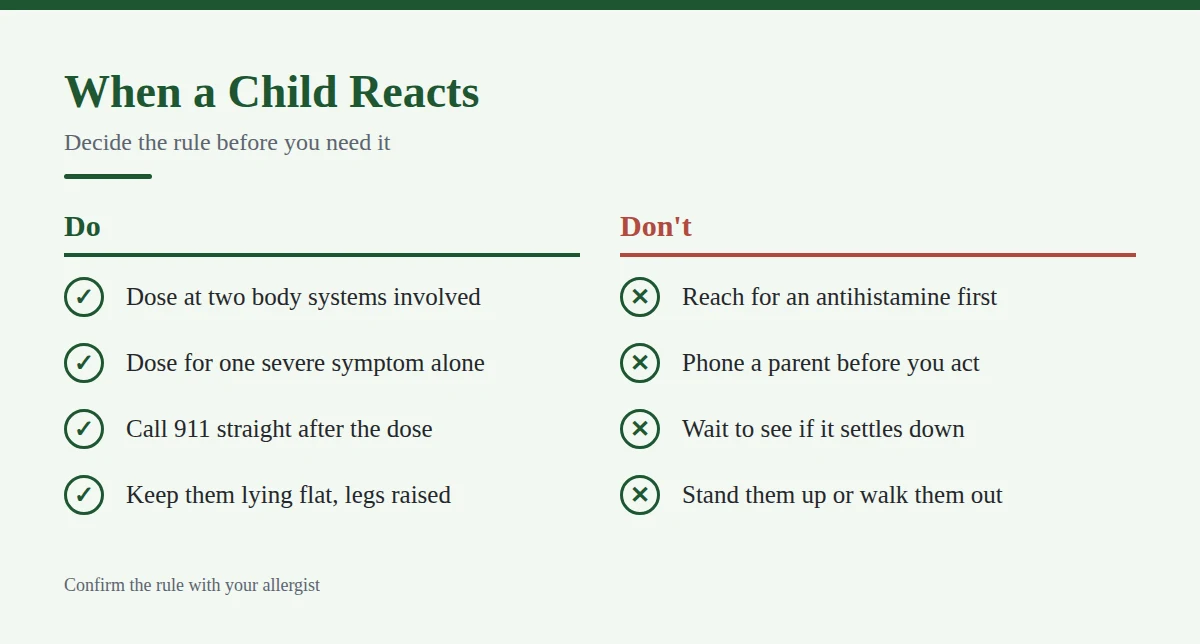
The way out of grading symptoms in real time is to decide in advance, when nobody is frightened. Get the rule from your allergist, in writing, on a signed emergency care plan, and put a copy where a caregiver will find it. Most plans come down to three triggers.
- Two or more body systems involved. Skin, mouth or throat, breathing, gut, or circulation. Hives plus vomiting is two. A cough plus a swollen lip is two. “When two or more body systems are involved,” as Dr. Vivian Hernandez-Trujillo of Nicklaus Children’s Hospital put it in commenting on the study, “it’s time for treatment.”
- One severe symptom, on its own. Trouble breathing, throat tightness, a hoarse or barking voice, repeated vomiting, dizziness, pallor, floppiness, or collapse. One is enough. Do not wait for a second.
- A known ingestion, if your plan says so. For children with a history of severe reaction, many allergists write the plan to give epinephrine immediately after a confirmed exposure, before symptoms appear at all.
Then the sequence, in this order: give epinephrine, call emergency services and say the word anaphylaxis, keep the child lying flat with legs raised (sitting up if breathing is hard, on their side if vomiting), and do not stand them up or walk them to the car. A second dose can be given five to fifteen minutes after the first if symptoms persist or worsen, which is why the prescription comes as a two-pack and why both devices need to travel together. Our 2026 guide to the anaphylaxis treatment landscape covers what those devices are, including the needle-free nasal option now available for children.
The Trainer Pen Drill
Every manufacturer supplies a free trainer device. It has no needle and no medicine, it resets, and it is the single highest-value object in an allergy household. Almost nobody uses it more than once.
Run the drill monthly, and make it about retrieval as much as injection.
- Find it in five seconds. Start with the pouch where it actually lives. If someone has to ask where it is, the storage spot is wrong.
- Fire it against your own thigh, through clothing. Denim is fine. The point is to feel that the device needs firm, committed pressure, not a tap.
- Hold for the count your device specifies. Devices differ, most modern injectors are around three seconds, and the instructions on the label are the authority. Practising the wrong number is worse than not practicing.
- Say the sequence out loud. Device, then call, then lie flat. Saying it builds the recall that panic erodes.
- Let the child practice too, at whatever age they are ready, so the device stops being frightening long before they have to self-carry. That handover is one of the things a good 504 plan should re-negotiate as a child grows.
Two housekeeping items belong in the same monthly slot. Check the expiry dates on both devices and the liquid in the window if your device has one, and get the devices out of the car. Heat and freezing both degrade epinephrine, and a glovebox does neither the medicine nor the “always available” rule any good.
The 90-Second Substitute Caregiver Brief
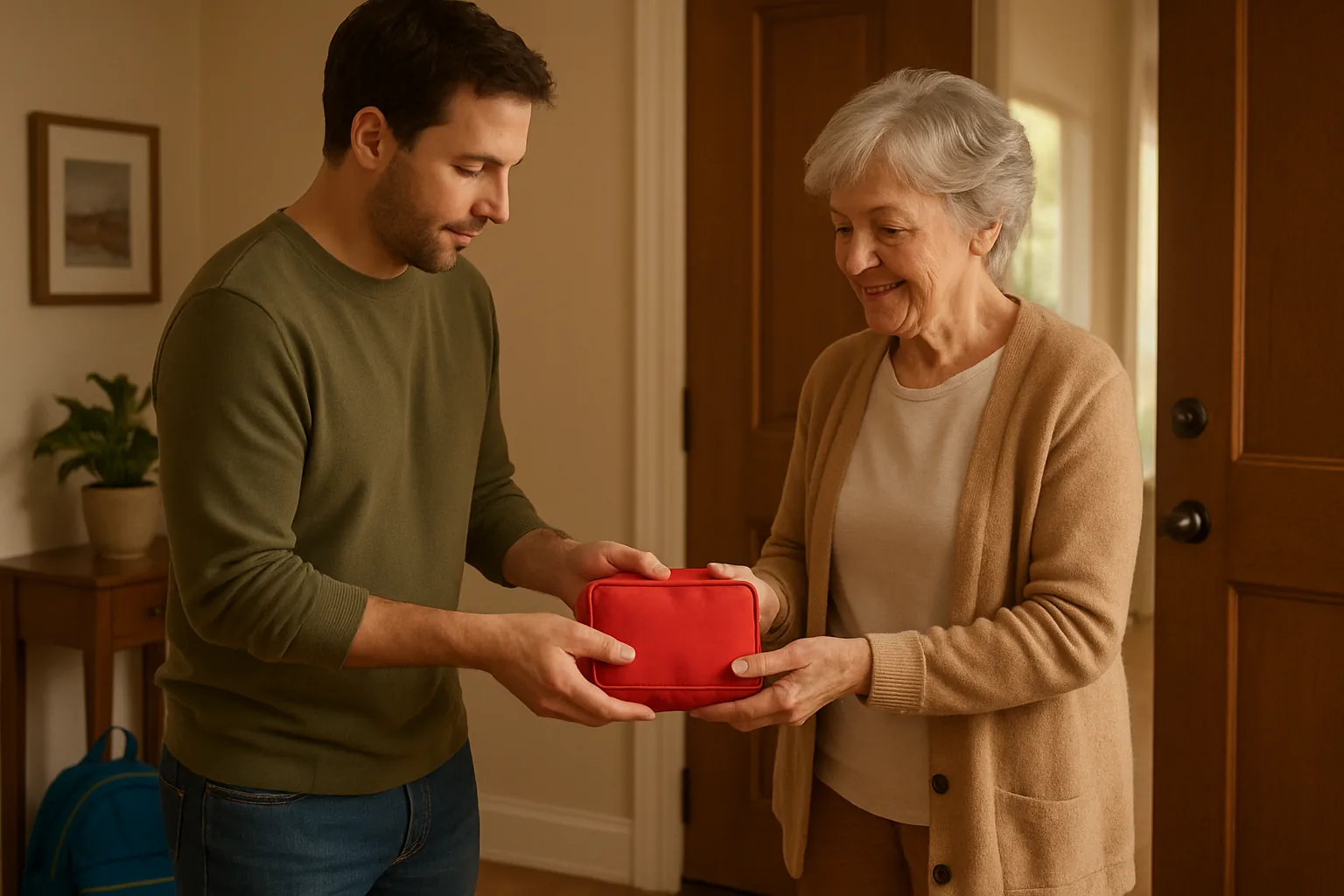
Most reactions in front of a substitute caregiver happen to a grandparent, a babysitter, a friend’s parent, or a coach. Handing them a pouch and saying “she’s allergic to peanuts” is not a brief. This is, and it takes a minute and a half at the door.
- The allergen, and the sneaky version. “Peanut, including sauces and anything from a bakery. If you did not read the label, she does not eat it.”
- Where the device is, pointed at. Say it and point. Do not describe it from the next room.
- The trigger rule, in one sentence. “If two of these show up, hives, coughing, throwing up, swelling, or if she says her throat feels tight, use it. Do not wait, and do not call me first.”
- Ten seconds with the trainer. Put it in their hand, let them fire it into their own leg. This is the step everyone skips and the one that changes behavior.
- Then call 911, then call me. In that order. Hand them the written plan with your number and a backup number on it.
The same brief works for a birthday party host or a new coach. It is the school protocol, compressed, and the study’s home-versus-school finding is the argument for it. The thing that makes schools better at this is not equipment. It is that somebody wrote the decision down in advance and rehearsed it, which is exactly what the evidence-based school guidelines find prevents reactions, rather than the bans that get more attention.
After the Dose
Using epinephrine is not the end of the episode. Emergency services still need to come, because a minority of reactions rebound hours later in a biphasic pattern and because the child may need a second dose, oxygen, or fluids. Bring the used device with you so the treating team knows exactly what was given and when.
Afterwards, book the allergist. The study’s authors were direct that close follow-up to review the signs of anaphylaxis is part of the fix, and a post-reaction visit is the natural moment to re-cut the emergency plan, replace the used device, and work out what the exposure actually was. If the trigger is still unclear, or the allergy list has never been confirmed properly, our complete food allergy guide for 2026 walks through how diagnosis is meant to work. For families whose child reacts to seafood, where reactions are often abrupt and adult-onset, our complete guide to fish and shellfish allergy covers the triggers that catch households by surprise.
What to Actually Do Tonight
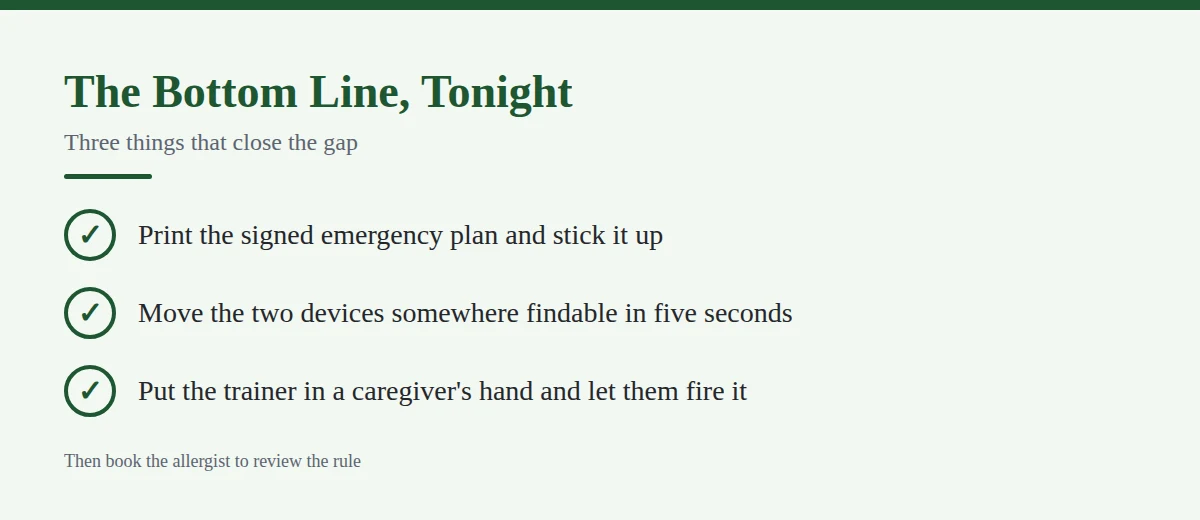
The gap between a prescription and a dose is not closed by buying anything. It is closed by deciding in advance, storing the device where a frightened person can find it in five seconds, and rehearsing with a trainer until the caregiver’s hands know what to do while their brain is still catching up. Fewer than half of those children got epinephrine before hospital. Nearly all of them had adults nearby who would have done anything for them and did not know that the moment had already arrived.
Print the plan. Point at the pouch. Hand somebody the trainer. Because food allergy management is individual, build the specific rule with a board-certified allergist who knows your child’s history, and treat the written plan as the thing that decides, not the adult in the room at the time.
Further reading (sources)
- UPI on the study that found fewer than half of children received epinephrine before hospital arrival
- Food Allergy Research and Education for what anaphylaxis looks like and how quickly it moves
- American Academy of Allergy, Asthma and Immunology with the symptom picture and timing of a severe allergic reaction
- Food Allergy Research and Education covering the written emergency care plan every caregiver should be handed