Allergen Labels Around the World: How the EU 14, UK, Canada, Australia, and Japan Differ From the US Top 9
Published on August 30, 2026

The Same Cookie, Three Different Warnings
Buy an identical packaged cookie in Boston, Berlin, and Osaka and you will get three genuinely different label experiences. The American package lists nine major allergens in a bold “Contains” line. The German one bolds allergens inside the ingredient list and covers fourteen categories, including a few the American label has no legal reason to mention. The Japanese one flags eight mandatory items, and soy and sesame are not among them. None of these labels is wrong. They are answers to different laws.
That gap matters more every year. Roughly 4.3 percent of the global population lives with a food allergy, an estimated 220 million people, and free-from shelves are increasingly stocked with imported products. If you travel, live abroad, or buy specialty groceries online, you are already reading labels written under rules you did not learn. Here is how the major systems actually differ, and what the new Codex standard adopted in July 2026 is about to change.
The United States: The Top 9
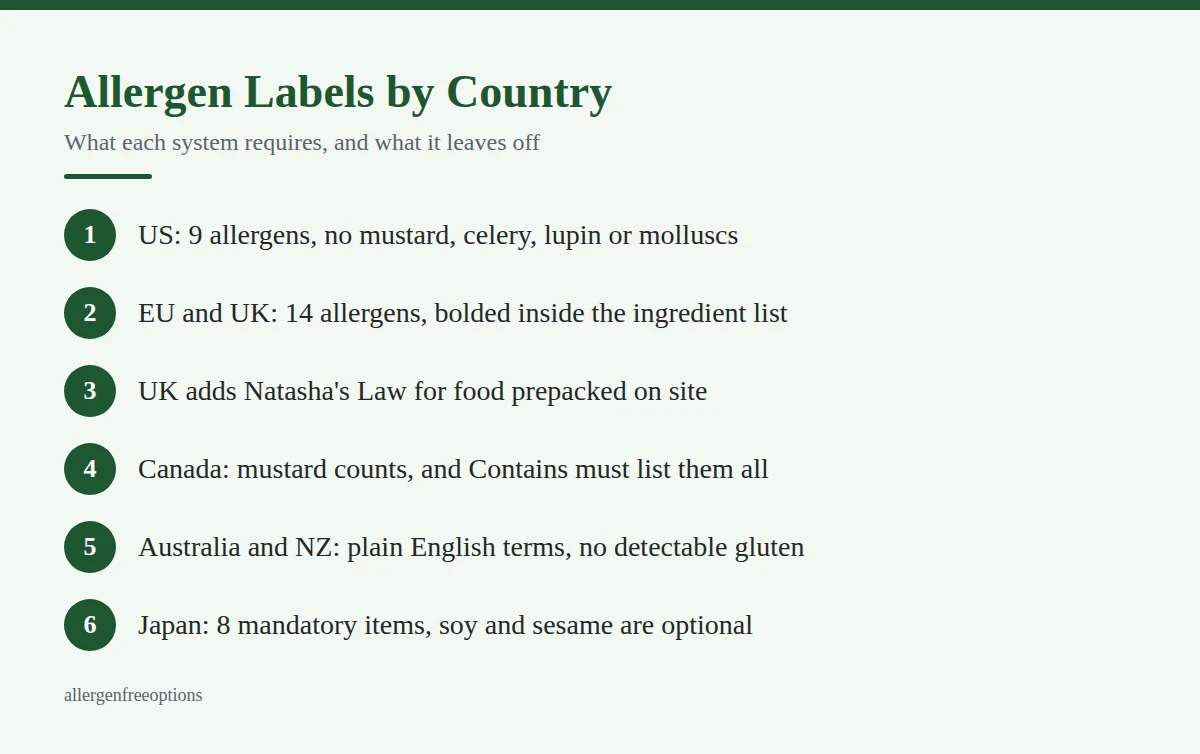
The Food Allergen Labeling and Consumer Protection Act of 2004 (FALCPA) established eight major allergens. The FASTER Act added sesame as the ninth, effective January 1, 2023. The current US list is milk, eggs, fish, crustacean shellfish, tree nuts, peanuts, wheat, soybeans, and sesame. A manufacturer can satisfy the rule either inside the ingredient list or with a separate “Contains” statement below it. Our complete food allergy guide for 2026 covers how to read that panel in detail.
Two omissions matter for anyone comparing labels across borders. First, the US names wheat, not gluten-containing cereals, so barley and rye can appear under names like “malt extract” with no allergen flag attached. Second, molluscan shellfish (clams, mussels, oysters, scallops, squid) is not a major allergen in the US, while crustaceans are. Celery, mustard, lupin, and sulphites are absent entirely. A person who reacts to mustard is effectively unprotected by American labeling law.
Precautionary allergen labeling (“may contain,” “made in a facility that also processes”) is voluntary and unregulated in the US, which is exactly the problem the FDA’s ongoing threshold work is trying to solve.
The European Union: 14 Allergens, Emphasized in Place
Regulation (EU) No 1169/2011, the Food Information to Consumers rules, requires fourteen allergen categories to be declared: cereals containing gluten (wheat, rye, barley, oats, spelt, kamut), crustaceans, eggs, fish, peanuts, soybeans, milk, nuts, celery, mustard, sesame seeds, sulphur dioxide and sulphites above 10 mg/kg or 10 mg/litre, lupin, and molluscs.
Two structural differences trip up American shoppers. The EU does not use a “Contains” box. Allergens are emphasized within the ingredient list itself, usually in bold or a contrasting typeface, so you have to read the whole list rather than jump to a summary line. And EU rules extend to non-prepacked food, meaning restaurants, bakeries, and deli counters must be able to tell you which of the fourteen are present. That obligation does not exist in most of the US.
The EU list also covers the two big celiac-relevant gaps in the American system. Barley and rye are declared because the category is “cereals containing gluten,” not “wheat.” If you follow a gluten-free diet, our guide to gluten-free options for celiac and allergy sufferers explains why that distinction is not academic.
The United Kingdom: The Same 14, Plus Natasha’s Law
Post-Brexit, the UK retained the same fourteen allergens and the same emphasis-in-the-ingredient-list format. The meaningful difference is what happens at the counter.
Natasha’s Law, which took effect on 1 October 2021, was passed after the death of 15-year-old Natasha Ednan-Laperouse, who reacted to sesame baked into a baguette that carried no allergen labeling because it had been made on the premises. The law closed that gap. Food that is prepacked for direct sale (PPDS), meaning packaged on site before a customer orders it, now needs a full ingredient list with the allergens emphasized. Sandwiches in a chiller cabinet, salad boxes at a bakery, and pre-wrapped hot food at a café counter all qualify. No other major system requires this.
The UK also demonstrates why labeling law and label reality are not the same thing. A Food Standards Agency surveillance survey collected 845 food products from retail across England, Wales, and Northern Ireland between July and October 2025 and found 28 percent unsatisfactory, with imported products singled out as an area of concern alongside supplements, slush-ice drinks, and certain meats. A rule is only as good as its enforcement at the border.
Canada: Priority Allergens, Gluten Sources, and Sulphites
Canada frames the question differently. Its Food and Drug Regulations cover priority allergens, gluten sources, and added sulphites as three distinct groups.
The priority allergens are eggs, milk, mustard, peanuts, crustaceans and molluscs, fish, sesame seeds, soy, tree nuts, and wheat and triticale. Gluten sources are handled separately and include barley, oats, rye, triticale, and wheat. Sulphites are declared at 10 parts per million or more.
Two Canadian specifics are worth memorizing. Mustard is a priority allergen, matching the EU and unlike the US. And the “Contains” statement, if a manufacturer uses one, must list every priority allergen, gluten source, and added sulphite present in the food. It cannot be partial. That makes a Canadian “Contains” line more trustworthy as a summary than its American equivalent, where the statement covers only the major nine and you still need the ingredient list for everything else.
Australia and New Zealand: Plain English, in Bold, Both Places
Food Standards Australia New Zealand runs what is arguably the most reader-friendly system of the group. The Plain English Allergen Labelling requirements, phased in with a transition that ran into 2024 and a stock-in-trade allowance into 2026, force manufacturers to abandon technical vocabulary.
Under PEAL, allergens must appear in bold in the ingredient list and again in a bold “Contains” summary statement, using prescribed plain-English terms. “Casein” and “whey” become milk. “Spelt” becomes wheat. Individual tree nuts must be named specifically rather than lumped under “tree nuts.” Fish, crustacea, and molluscs are named separately rather than merged into “seafood.” The declared set covers cereals containing gluten, crustacea, egg, fish, milk, peanuts, sesame, soy, named tree nuts, lupin, molluscs, and sulphites at 10 mg/kg or more.
Australia and New Zealand are also stricter than everyone else on one specific claim. Where the US, EU, Canada, and the Codex standard all set “gluten-free” at 20 parts per million, FSANZ requires no detectable gluten for a gluten-free claim, with a separate “low gluten” category at 20 mg/kg or less. A product legally sold as gluten-free in Sydney clears a higher bar than one in Seattle.
Japan: Eight Mandatory Items, and Two Big Absences
Japan’s system, run by the Consumer Affairs Agency under the Food Labelling Act, splits allergens into mandatory and recommended tiers, and the mandatory tier is short.
The eight mandatory items are shrimp and prawn, crab, walnut, wheat, buckwheat, egg, milk, and peanut. Walnut was elevated from the recommended list to mandatory status in 2023 after a sustained rise in reported reactions, with a transition period that ran to 2025. Around twenty further items sit on a recommended list that manufacturers are encouraged but not required to declare, including soybean, sesame, cashew, almond, kiwifruit, banana, peach, apple, beef, pork, chicken, gelatin, squid, salmon, and mackerel.
For a visitor, two consequences stand out. Soy and sesame are not mandatory in Japan, and both are heavily used in Japanese cooking. And buckwheat is mandatory there while it appears on no other major list, which reflects a real national allergy pattern rather than a quirk. Japan is also unusual in mandating specific fish species rather than fish as a category, so a general fish allergy is poorly served by the label alone. If you are heading there, pair label reading with the chef card and pre-planning tactics in our 2026 travel playbook.

What Codex Changed in July 2026
On July 7, 2026, at its 49th Session in Geneva, the Codex Alimentarius Commission adopted the first internationally harmonized guidelines on precautionary allergen labeling, as an annex to the General Standard for the Labelling of Pre-packaged Foods (CXS 1-1985).
The core of it is a risk-based framework built on threshold levels and reference doses for priority allergens, underpinned by seven joint FAO and WHO expert consultations. The principle is that “may contain” should not be a legal shield sprayed onto every package. A precautionary statement should appear only after a business has implemented proper allergen management and a scientific risk assessment shows a residual risk remains. It complements the existing Code of Practice on Food Allergen Management for Food Business Operators (CXC 80-2020).
For the celiac community, the gluten provisions are the headline. The guidelines bring cereals containing gluten into the framework for the first time, with a reference dose of 4 mg of gluten to anchor risk assessment. Just as importantly, negotiators agreed that a product needing a precautionary statement for gluten-containing cereals should not simultaneously carry a gluten-free claim. The Association of European Coeliac Societies, which welcomed the agreement, considers that separation fundamental to keeping gluten-free claims meaningful.
Two caveats belong with the good news. Codex texts are voluntary benchmarks, not law. They matter because national regulators build on them and because they smooth international trade, but nothing on any shelf changes until individual countries write them into their own rules. The US, UK, and EU have all opened discussions on adopting a risk-based framework nationally, which is why this standard is worth tracking. And a harmonized “may contain” is still not a promise of zero allergen. It is a promise that the warning was applied for a reason.
Reading an Imported Label Without Guessing
Six habits cover most of the risk when the package was written for someone else’s rulebook.
- Assume the list is shorter than yours. A Japanese label does not have to mention soy. A US label does not have to mention mustard, celery, lupin, molluscs, or sulphites. Read the full ingredient list, never just the summary line.
- Know where the emphasis lives. EU and UK labels bold allergens inside the ingredient list with no “Contains” box. Australia and New Zealand do both. The US and Canada permit either.
- Watch the gluten wording. “Wheat-free” is not gluten-free anywhere, and in the US a label flagging wheat tells you nothing about barley or rye.
- Treat translated stickers with suspicion. An importer-applied English sticker is a translation, not a re-certification, and the FSA survey found imported products to be a recurring problem category.
- Do not read “may contain” as a ranking. Until Codex is implemented nationally, wording variation between “may contain,” “may be present,” and “made in a facility with” reflects a company’s legal counsel, not a risk gradient.
- Check how that country announces problems. Recall systems differ as much as labels do; our guide to decoding allergen recall notices explains why the notice type matters as much as the headline.
The Bottom Line
There is no universal allergen label, and 2026 did not create one. What Codex delivered in July is narrower but genuinely useful: a shared, science-based method for deciding when a “may contain” warning is warranted, plus a firm line between precautionary gluten statements and gluten-free claims. Adoption is now a national question, and it will take years.
Until then, the practical rule for anyone buying across borders is to read the label the country wrote, not the one you are used to. Learn which allergens your destination leaves off its mandatory list, read the full ingredient list rather than the summary, and remember that a “free from” claim describes a recipe rather than guaranteeing zero cross-contact. If your allergies are severe, build the specifics with a board-certified allergist who knows your history, and carry your epinephrine wherever the label was printed.
Sources
- Mirage News on Codex adopting new international guidance for may-contain statements
- Food Safety Magazine for the risk-based precautionary labeling framework agreed at CAC49
- AOECS with the gluten reference dose and the split from gluten-free claims
- Food Safety News on the FSA survey that flagged imported food and allergen problems
- Mexico Business News for the global allergy burden and the legacy of Natasha’s Law
Further reading
- U.S. Food and Drug Administration on the nine major allergens and how the Contains statement works
- Food Standards Agency with what Natasha’s Law requires for prepacked for direct sale food
- Health Canada for the priority allergens, gluten sources and sulphites list
- Food Standards Australia New Zealand on plain English allergen labelling requirements
- Food Safety News on the wider slate of standards adopted at the Codex session