Allergens in Medicine: Excipients, Vaccines, Anesthesia, and the Hospital Tray
Published on September 29, 2026
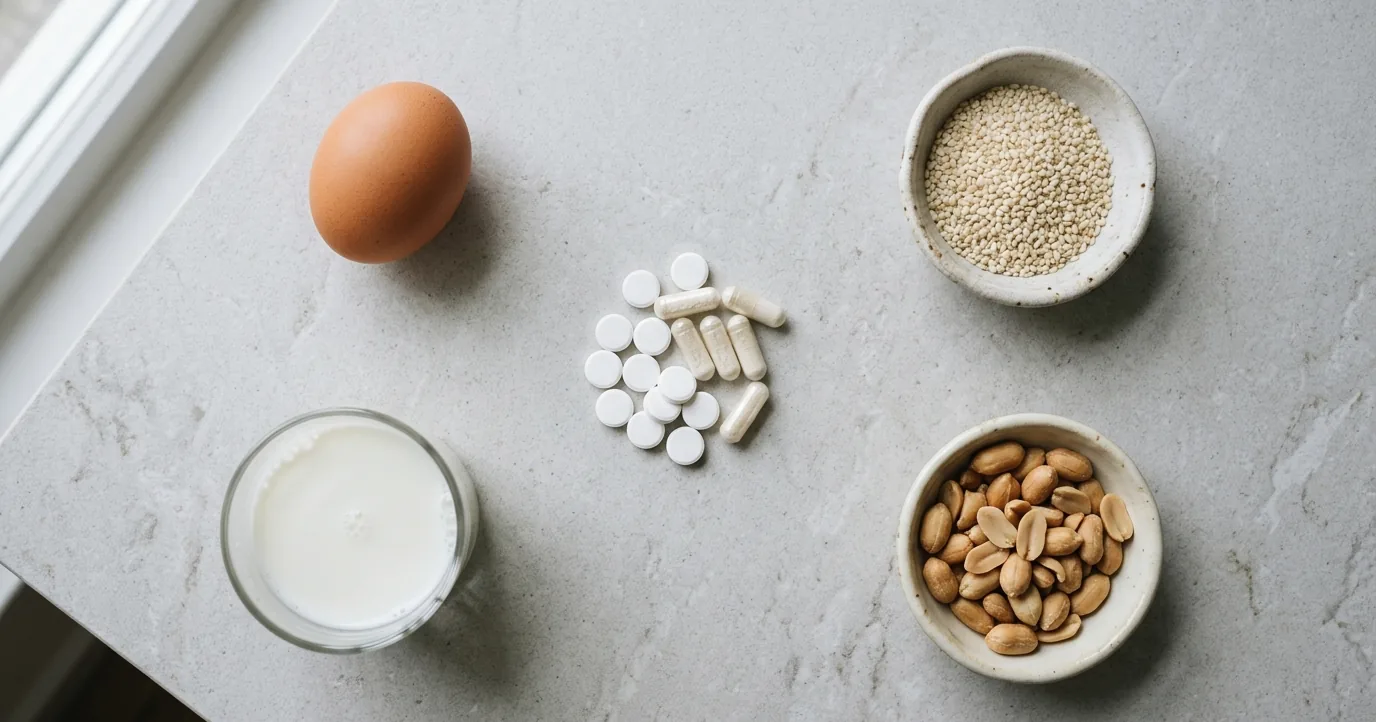
Anyone who manages a food allergy learns to lean on one line of the package: the plain-English allergen declaration that federal law requires. That habit stops working at the pharmacy counter. The Food Allergen Labeling and Consumer Protection Act (FALCPA) covers packaged food and dietary supplements, and the FDA lists drugs among the products it does not reach. A tablet can be bulked out with milk sugar, a capsule can be made of gelatin and filled with peanut oil, and an anesthetic can be an emulsion of soybean oil and egg, all without a “Contains” statement anywhere on the box.
The scale is bigger than most people assume. When a team at MIT and Brigham and Women’s Hospital led by Daniel Reker and Giovanni Traverso analyzed 42,052 tablets and capsules in the National Library of Medicine’s Pillbox database, the average pill held 8.8 inactive ingredients, lactose appeared in 45 percent of them, and 92.8 percent contained at least one inactive ingredient that has been reported to cause allergic symptoms. The counterweight comes from allergist John Kelso’s review of food-derived ingredients in medicine: reactions are rare, usually because too little food protein is present to provoke one, and most of these drugs should not be withheld from people with food allergies. So the skill here is not suspicion of every pill. It is knowing the short list of places where that reassuring rule breaks, and who to ask about them.
Why a Medicine Label Is Not a Food Label
Drug labels do list inactive ingredients: in the “Inactive ingredients” line of an over-the-counter Drug Facts panel, and in the “Description” section of prescription labeling, which the FDA suggests looking up on the National Library of Medicine’s DailyMed site. What the label will not do is translate. There is no “Contains: milk” line, and ingredient names often hide their source. Lecithin can come from soy or egg. Starch can be corn, potato, or wheat. Gelatin can be bovine, porcine, or fish. One prescription progesterone capsule prints plain “lecithin” in its description, while the data filed with the same label specifies soybean.
The pill in your hand can also change. The same drug is sold by many manufacturers, each with its own fillers, binders, dyes, and coatings. A follow-up study from Reker’s group found that the number of versions of a single medication has grown dramatically over the last 40 years, and that prescribers commonly do not consider inactive ingredients when writing a prescription. Pharmacies also change suppliers, so the version you vetted in the spring may not be the one you pick up in the fall.
Europe handles this differently. Under the European Commission’s excipient labeling guideline, any medicine containing arachis (peanut) oil or soya oil must tell patients “If you are allergic to peanut or soya, do not use this medicinal product,” however small the amount, partly because the European pharmacopoeia standard for purified peanut oil includes no test for leftover protein. Sesame oil must carry a warning that it “may rarely cause severe allergic reactions,” and medicines made with wheat starch must state their gluten content and tell people with wheat allergy not to take them. The US has no equivalent rule. Our guide to allergen labels around the world covers the same transatlantic gap on the food side.
For gluten, the FDA’s 2017 draft guidance recommended a label statement and estimated that wheat starch and other wheat-derived ingredients add no more than 0.5 milligrams of gluten to a single dose, less than a 30 gram serving of food labeled gluten-free may contain. That is reassuring, but still worth confirming for any daily medicine, and a routine celiac follow-up visit is a good moment to ask.
Where Food Hides in Medicine, Allergen by Allergen
Kelso’s review sets the frame: the ingredients below are common, reactions to them are uncommon, and the cases worth planning around are mostly the ones where the manufacturer itself names your allergy on the label.
Milk. Lactose is the most common food-derived ingredient in medicine, a filler in nearly half of all tablets and capsules. Pharmaceutical lactose is refined milk sugar that can carry traces of milk protein, and most people with milk allergy take lactose-containing pills without trouble. Two places break the pattern. Dry powder inhalers use lactose as the carrier for the drug, and in 2004 allergists led by Anna Nowak-Wegrzyn reported finding milk proteins in lactose-based inhalers. The label for one widely used combination inhaler now describes its lactose as containing milk proteins, notes anaphylaxis in people with severe milk protein allergy after inhaling lactose-containing powders, and rules the device out for them.
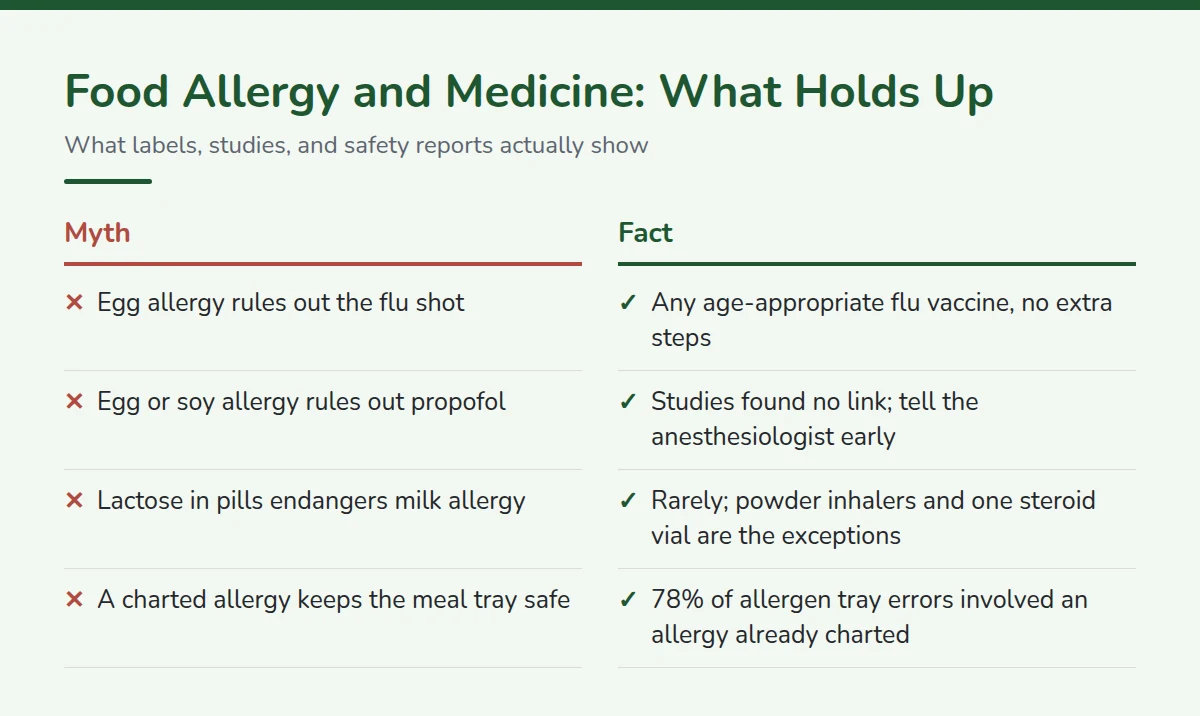
The second is an emergency drug. The 40 milligram vial of methylprednisolone sold as Solu-Medrol, an injectable steroid whose uses include severe allergic conditions and asthma, contains lactose made from cow’s milk. Its label contraindicates that vial for anyone with a known or suspected cow’s milk allergy because it may carry trace milk, and it warns clinicians that symptoms worsening during treatment of an acute allergic reaction could be a reaction to that milk. The 125 milligram vial lists no lactose.
Lactose intolerance is a separate question about the sugar, not the protein, and it is the only lactose warning European labels carry. Our dairy-free living guide explains why the two conditions call for different precautions.
Egg and soy. These two travel together in the fat emulsions given by vein. Propofol, a widely used intravenous anesthetic and sedative, contains 100 milligrams of soybean oil and 12 milligrams of purified egg phospholipids in every milliliter. The lipid emulsions that feed patients who cannot eat are built the same way. One soybean oil emulsion’s label lists known hypersensitivity to egg, soybean, or peanut as a contraindication, a blend that adds fish oil adds fish to that list, and a pure fish oil emulsion names fish or egg. Peanut appears because, in the manufacturer’s words, “cross reactions have been observed between soybean and peanut.”
Peanut. Peanut oil, called arachis oil on many international labels, dissolves drugs that do not mix with water. In the Pillbox data it was in every progesterone capsule and in 62.5 percent of valproic acid capsules, although some valproic acid makers use corn oil instead. The label for the best-known micronized progesterone capsule states that it contains peanut oil and is contraindicated for people allergic to peanuts. Dimercaprol, an injectable antidote for heavy metal poisoning, is dissolved in peanut oil as well.
Sesame. Sesame oil is a standard vehicle for long-acting intramuscular injections. Progesterone injection, testosterone enanthate, and the long-acting antipsychotic haloperidol decanoate are all formulated in it. Sesame became the ninth major food allergen in 2023, which changed food labels and nothing on this list. The drug labels are inconsistent: the patient leaflet for progesterone injection tells anyone allergic to sesame oil or seeds not to use it, while the testosterone enanthate and haloperidol decanoate labels we reviewed list sesame oil without any allergy warning. Name the allergy before any oil-based shot and ask what the oil is.
Fish and shellfish. Prescription omega-3 capsules made from fish oil carry a label caution for people allergic to fish or shellfish, while acknowledging that it is not known whether they face a higher risk. Protamine, the drug that reverses the blood thinner heparin at the end of heart surgery and some catheter procedures, is a protein found in salmon sperm. Its label lists fish allergy among possible risk factors for a reaction, even though no link has been established. The more famous worry, iodinated contrast dye, is a myth our fish and shellfish allergy guide takes apart.
Gelatin. Not a major allergen under US food law, but it forms the shell of many capsules and stabilizes several vaccines. People with alpha-gal syndrome, the tick-linked allergy to mammal products, belong in this group too, and the CDC suggests they check with a physician before any vaccine that contains gelatin.
Vaccines: Mostly Good News, With a Few Exceptions to Plan For
Flu shots and egg. This one is settled. The CDC’s Advisory Committee on Immunization Practices recommends a flu vaccine for everyone 6 months and older with egg allergy, allows any vaccine suited to their age and health, egg-based or not, and states that egg allergy alone “necessitates no additional safety measures” beyond those for any vaccine, however severe the past reaction to egg. Our egg allergy guide covers how that advice changed.
MMR, chickenpox, and gelatin. Here the concern is gelatin, not egg. The Johns Hopkins Institute for Vaccine Safety lists hydrolyzed gelatin in the MMR II, ProQuad, and Varivax vaccines and porcine gelatin in the FluMist nasal flu vaccine. In 1993, Kelso and colleagues traced a 17-year-old’s anaphylaxis to MMR vaccine to IgE antibodies against its gelatin. She was not allergic to egg, but eating gelatin made her ears and throat itch and her tongue swell. Priorix, a second MMR vaccine licensed in the US in 2022, lists no gelatin among its ingredients, which is worth raising with your allergist if gelatin is a known problem.
Yellow fever. This is the genuine exception for egg. The CDC’s Yellow Book lists hypersensitivity to “chicken proteins, eggs, egg products, or gelatin” as a contraindication. When the vaccine is essential for a trip, an experienced clinician can perform skin testing and, if indicated, desensitization, so raise it when the trip is booked, not the week before.
Rabies. One US rabies vaccine, RabAvert, is grown in chicken cells, and its label notes residual egg and chicken proteins as well as processed bovine gelatin. The other, Imovax, is grown in human cells and lists neither. If you ever need rabies shots after an animal bite, tell the team about an egg or gelatin allergy so the choice is deliberate.
Milk. Many diphtheria, tetanus, and pertussis vaccines (the DTaP and Tdap family) list casein-derived ingredients from their growth media. In 2011, Jennifer Kattan, Scott Sicherer, and colleagues described anaphylaxis after these vaccines in children with cow’s milk allergy. For a child whose milk allergy is severe, that is a reason to talk with the allergist before the booster appointment.
Anesthesia: The Propofol Question
Propofol is where the label and the research disagree most visibly. The current US label for the brand-name product contraindicates it for anyone with “a history of anaphylaxis to eggs, egg products, soybeans or soy products.” The studies point the other way. The egg ingredient is a purified phospholipid, a fat-like molecule from the yolk rather than the egg white proteins behind most egg allergy, and the soybean oil is refined.
At the Danish Anaesthesia Allergy Centre, Asserhøj and colleagues investigated 153 patients who had received propofol before a suspected allergic reaction during surgery. Four turned out to be allergic to propofol, and none of the four reacted to eating egg, soy, or peanut. The team also pulled 171 anesthetic charts for 99 adults with IgE antibodies to egg, soy, or peanut and found no reactions to propofol. Their conclusion was blunt: the practice of choosing alternatives to propofol for these patients “is not evidence based and should be reconsidered.” At the Children’s Hospital at Westmead in Sydney, Murphy and colleagues reviewed 43 propofol anesthetics given to 28 egg-allergic children and found a single reaction, not anaphylaxis, in a boy with a history of egg anaphylaxis and several other food allergies. They concluded that propofol is likely safe for most egg-allergic children who have never had egg anaphylaxis.

Reconciling the label with the evidence is the anesthesiologist’s call, not yours. Your job is to hand them precise information early: each allergen, your worst reaction and whether it was anaphylaxis, and whether you eat baked goods made with egg or foods containing soy lecithin without trouble. Do it at the pre-operative visit or phone call, not for the first time in the pre-op bay with an IV already placed. If the team prefers a different drug, alternatives exist. If they are comfortable with propofol, the research is on their side for most patients with these allergies.
Procedure day has a few other items worth naming to the team: the milk-derived lactose in that 40 milligram steroid vial, protamine if heart surgery or a catheter procedure is planned and you have a fish allergy, and the IV lipid emulsions if you might go several days without eating.
The Hospital Tray
Food is where a hospital’s allergy list is supposed to protect you, and a Pennsylvania analysis shows how often it does not. Susan Wallace of the Pennsylvania Patient Safety Authority reviewed 285 dietary errors reported by the state’s hospitals from January 2009 through June 2014. The most common kind, 181 events or 63.5 percent, was a meal tray containing a food the patient was allergic to. In 77.9 percent of those, the allergy was already known and documented in the medical record. Eight of the 181 caused serious harm, including emergency epinephrine, transfer to a higher level of care, or intubation.

Documentation, in other words, is not delivery. The fixes Wallace’s analysis points to are procedural: match each allergy against the actual ingredients of each dish, and use communication tools such as whiteboards. When Hadassah Medical Center in Jerusalem rebuilt its policy, Rivki Harari and colleagues report, the changes included building food allergies into the computerized food service system, highlighted labels on patients’ trays, safety checks during delivery, allergy-specific menus, and procedures for tube feeding to prevent accidental exposure. That last item is easy to overlook, because hospital nutrition formulas, whether sipped or given by tube, are overwhelmingly built on milk or soy protein. In a study of 60 US hospitals, Millovich and colleagues counted 65,338 adults on dairy or soy protein formulas, against 243 on pea protein.
A few habits close most of the gap:
- Ask that the allergy be attached to the diet order, not only the allergy list, and whether the kitchen checks it against ingredients.
- Check every tray before the first bite, including sauces, packets, and desserts. Ask about anything unlabeled before eating it.
- Ask for a dietitian early if you have several allergies or a stay longer than a day or two.
- Ask which formula or IV nutrition products the hospital would use if you cannot eat.
- Find out where epinephrine is kept on the unit, and whether you may keep your own device at the bedside. Policies vary.
What to Ask, and When
Before a new prescription:
- Tell the prescriber the allergen and your worst reaction, and ask them to check the specific product, not just the drug.
- Read the inactive ingredients on the Drug Facts panel or DailyMed, watching for lactose, lecithin, starch, gelatin, arachis or peanut oil, sesame oil, egg phospholipids, casein, and fish oil.
- Ask the pharmacist to confirm the manufacturer of what is in the bag, and ask again whenever a refill looks different.
- When a name is ambiguous, call the manufacturer’s number on the label and ask where that ingredient comes from.
- If no suitable version exists, ask about a different drug, form, or device, or a compounding pharmacy.
Before surgery or a hospital stay:
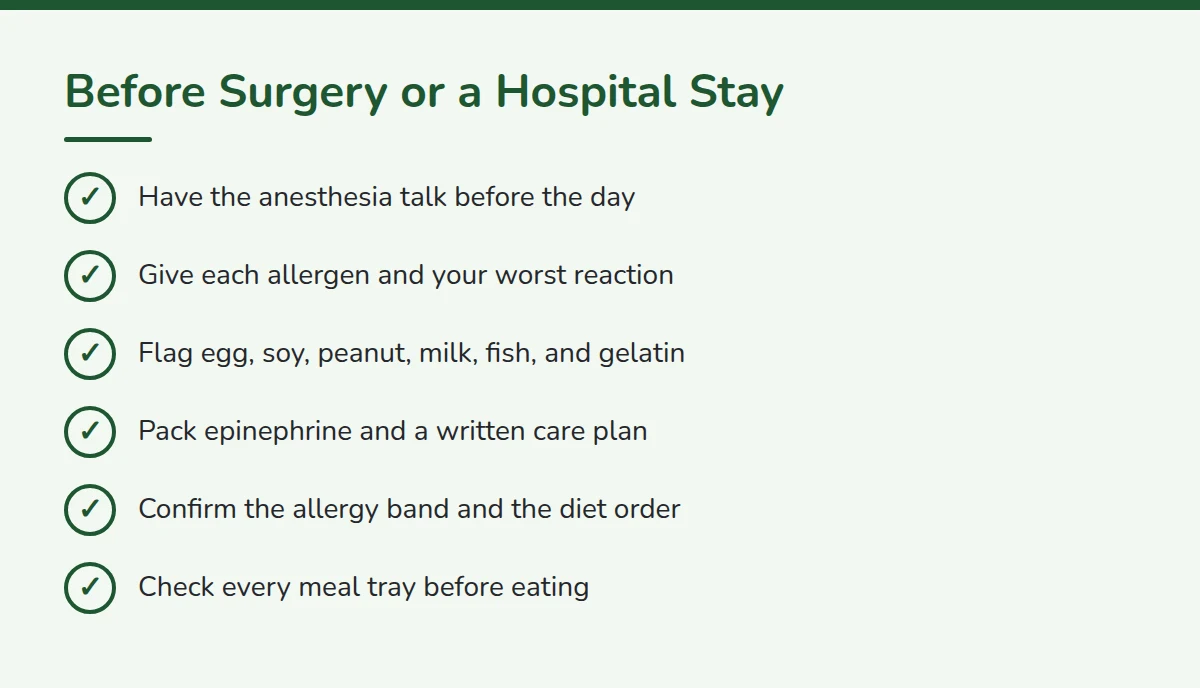
- Have the anesthesia conversation ahead of time, with each allergen, your worst reaction, and what you tolerate.
- Name the medicine-specific items: egg, soy, and peanut for propofol and IV lipids, milk for that steroid vial and powder inhalers, fish for protamine, and gelatin.
- Pack your epinephrine and a written emergency care plan (FARE publishes a free template), plus an allergist’s letter for a child.
- On arrival, confirm the allergy band, the chart entry, and the diet order, then keep checking trays.
None of this is a reason to avoid medicine. Flu shots are fine for egg allergy, lactose-containing tablets are fine for most people with milk allergy, and propofol is very likely fine for most people with egg, soy, or peanut allergy. The work is the same work you already do in the grocery aisle, with one difference: at the pharmacy and the hospital, nobody prints the warning for you. You bring it.
Further reading (sources)
- FDA on which products food allergen labeling law covers, and which it leaves out
- FDA’s drug center for how much gluten wheat-derived ingredients can add to a pill
- Reker and colleagues on inactive ingredients across 42,052 oral medications
- Reker, Blum and colleagues with how many versions of one drug now exist, and how rarely prescribers weigh them
- Kelso for a review of food allergens in medications and who actually reacts
- Nowak-Wegrzyn and colleagues on milk proteins found in lactose-based dry powder inhalers
- DailyMed with the methylprednisolone label that rules out its 40 mg vial in cow’s milk allergy
- DailyMed for the propofol label’s soybean oil, egg phospholipid, and anaphylaxis contraindication
- European Medicines Agency on the excipient warnings EU leaflets must carry for peanut, soya, sesame, and wheat starch
- CDC’s MMWR with the current ACIP flu vaccine recommendations for people with egg allergy
- CDC Yellow Book on yellow fever vaccine contraindications, including egg and gelatin
- Johns Hopkins Institute for Vaccine Safety for its table of excipients in US vaccines
- Kelso, Jones and Yunginger on the case that tied MMR anaphylaxis to gelatin
- Kattan and colleagues with anaphylaxis to diphtheria, tetanus, and pertussis vaccines in children with milk allergy
- Asserhøj and colleagues for propofol in adults allergic to egg, soy, or peanut
- Murphy and colleagues on propofol in egg-allergic children
- Pennsylvania Patient Safety Authority with its analysis of dietary errors in Pennsylvania hospitals
- Harari and colleagues for one hospital’s rebuild of its food allergy safety policy
- Millovich and colleagues on how often hospitalized adults on formula receive dairy or soy protein
- Food Allergy Research and Education for its emergency care plan template