Beyond the Gluten-Free Diet: What the Celiac Drug Pipeline Can and Cannot Do in 2026
Published on September 17, 2026
Every few months another headline promises the end of the gluten-free diet. A celiac vaccine. An enzyme pill. A drug that finally lets you eat the birthday cake. If you have celiac disease you have probably learned to read these with a raised eyebrow, and you are right to. As of September 2026, no drug for celiac disease is approved, and the Celiac Disease Foundation’s tracker of therapies in development states plainly that the only available treatment is a strict gluten-free diet.
What has changed is the pipeline behind that sentence. There are candidates at every stage from preclinical work to Phase 2b, built on at least five different theories of how to interrupt the disease. The honest read is less exciting than the headlines and more useful. The candidates are being developed as a backstop for the diet, not a replacement for it, so the realistic goal is a contaminated restaurant meal that does less damage, not a sandwich. Several of the most publicized programs have already failed. This guide takes each approach in turn: what it does, what the trials actually showed, and how far it is from your pharmacy.
Why People Who Never Cheat Still Need a Drug
Celiac disease is not a food allergy. It is an autoimmune condition: in genetically susceptible people, gluten from wheat, barley, and rye triggers an immune attack on the lining of the small intestine, damaging the villi that absorb nutrients. A wheat allergy is a different disease, an IgE reaction that can cause anaphylaxis, and nothing in this pipeline treats it. Our food allergy 101 guide explains how true allergies are diagnosed if you are unsure which one you are dealing with.
The diet works, but it leaks. In their review of the global burden of the disease, Makharia and colleagues list the barriers to strict adherence: cost, limited availability, cross-contamination, and the sheer restrictiveness of eating this way. Francavilla and colleagues describe where the gluten gets in, from shared manufacturing equipment to a toaster used for both regular and gluten-free bread, along with oats contaminated by wheat while they are grown and processed. That last problem is the subject of our look at why gluten-free Cheerios still make some celiacs sick.
How much gets through is the uncomfortable part. Syage and colleagues, a team that included scientists from the company then developing latiglutenase, pooled stool and urine test data with results from earlier drug trials. They estimated that people with celiac disease on a gluten-free diet accidentally eat roughly 150 to 400 milligrams of gluten a day on average, with typical (median) exposures around 100 to 150 milligrams, and concluded that many of them regularly consume enough to trigger symptoms and keep intestinal damage going.

The FDA acknowledges the same reality. Its guidance for drug developers notes that some adults never achieve a normal intestinal lining even on a strict diet, and that both intentional and inadvertent slips can make the disease worse. That gap between a perfect diet on paper and a real one is the target of almost everything below.
What “Adjunct” Means, and Why It Changes How to Read a Headline
In April 2022 the FDA issued draft guidance, still labeled a draft, on how companies should test celiac drugs. Its scope is specific: treatments for adults, taken as an adjunct to a gluten-free diet. It states directly that it does not cover drugs meant to replace the diet. A 2024 review by Buriánek, Gege and Marinković notes the same emphasis, describing the FDA framework as focused on an adjunct for patients who still have signs and symptoms despite a strict diet.
You can see that thinking in how the trials are built. Takeda’s Phase 2 study of its enzyme TAK-062 had participants eat gluten bars with meals, formally described as a “simulated inadvertent gluten exposure.” The latiglutenase trial gave patients 2 grams of gluten a day. The current TAK-227 study doses people under “controlled minimal gluten exposure.” Each of those designs asks whether a drug can blunt a measured dose of gluten on top of a gluten-free diet. None asks whether people can go back to eating normally.
So when a headline says a drug “lets celiacs eat gluten,” translate it before you believe it. The realistic promise is protection from the gluten you did not know you ate.
Enzymes That Break Gluten Down in the Stomach
Gluten is unusually hard to digest. Human digestive enzymes leave some gluten fragments intact, including the pieces that set off the celiac immune response. Cooking does not solve this either: heat changes some food proteins and leaves others untouched, and baked bread is plainly still harmful. The idea behind glutenase enzymes is to finish the job in the stomach, before those fragments reach the small intestine.
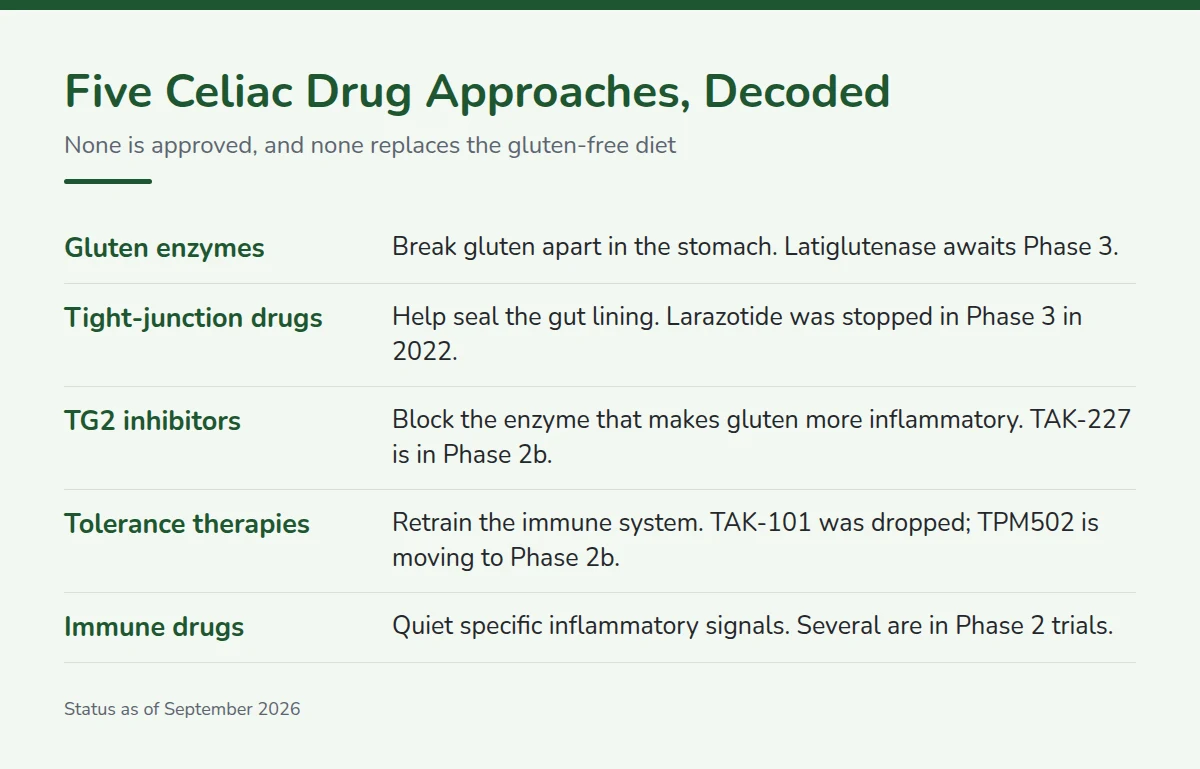
Latiglutenase is a drink-based mixture of two gluten-specific enzymes. In a Phase 2 trial led by Murray and colleagues, 50 people with celiac disease were randomized to latiglutenase or placebo while eating 2 grams of gluten a day for six weeks. The main biopsy measure of intestinal damage, the ratio of villus height to crypt depth, fell by 0.04 on the enzyme and by 0.35 on placebo, a difference that just missed statistical significance. The rise in inflammatory lymphocytes in the gut lining was significantly smaller on the drug, and abdominal pain, bloating, and tiredness worsened less over the six weeks, a trend rather than a clear-cut win. Its developer, ZymagenX, plans a Phase 3 trial focused on relieving symptoms after accidental gluten exposure.
The cautionary tale is TAK-062, also called zamaglutenase, an enzyme designed by computer to shred gluten. In early testing in healthy volunteers reported by Pultz and colleagues, it broke down between 97 percent and more than 99 percent of the gluten in meals containing 1 to 6 grams. The real-world test went differently. In Takeda’s Phase 2 trial, 152 people with celiac disease who were trying to keep a gluten-free diet took the enzyme or a placebo along with gluten bars, and the results posted to the federal trial registry show no meaningful difference in gastrointestinal symptoms at 12 weeks. On the biopsy measure at 24 weeks, the villus ratio actually declined more in the enzyme group than on placebo. Takeda has since ended development.
None of this applies to the “gluten digestion” enzyme supplements sold without a prescription. Krishnareddy and colleagues at Columbia University’s celiac center examined 14 such products. Thirteen claimed to break down the harmful gluten fragments, the labels carried the standard disclaimer that they are not intended to treat any disease, and the researchers found no scientific basis for the implied promise. One product even declared wheat and milk as allergens. A supplement is not a safety net.
Tight-Junction Regulators: Guarding the Gut Lining
Another strategy is to stop gluten fragments from crossing the gut lining at all. The cells of the intestinal wall are held together by protein seals called tight junctions, and restoring that barrier is one of the approaches catalogued by Serena, Kelly and Fasano in their review of nondietary therapies.
Larazotide acetate, a tight-junction regulator, made it to a Phase 3 trial in adults who still had symptoms after at least six months on the diet. In June 2022 its sponsor stopped the study after an independent statistician determined that a substantial number of new patients would have to be added to get meaningful results, which the company judged impractical.
The barrier idea has not been abandoned. IMU-856, from Immunic, is designed to help restore intestinal barrier function. The company reported positive Phase 1b results in celiac patients in May 2023 and is preparing further clinical testing, which is still a long way from a finished answer.
Transglutaminase 2 Inhibitors: Blocking the Step That Makes Gluten Inflammatory
If you have celiac disease, you may know tissue transglutaminase from your diagnosis, since the standard blood test looks for antibodies against it. The enzyme also drives the disease. In the small intestine it chemically modifies gluten fragments in a way that makes them more stimulating to the T cells that cause the damage. Block the enzyme, and gluten should provoke less of a response.
The leading candidate is TAK-227, originally called ZED1227, a pill developed by Zedira and Dr. Falk Pharma and now partnered with Takeda. In the proof-of-concept trial published in the New England Journal of Medicine by Schuppan and colleagues, 163 adults with well-controlled celiac disease ate gluten daily for six weeks. All three doses (10, 50, and 100 milligrams) reduced gluten-induced damage to the intestinal lining compared with placebo, and the highest dose may also have improved symptoms and quality of life. Headache, nausea, and other common side effects occurred at similar rates across groups, although a rash appeared in 3 of 40 people on the top dose.
The next step proved harder. In the first part of a Phase 2b study, in people with ongoing symptoms and mild to moderate intestinal damage despite the diet, the 50 milligram dose improved the biopsy picture, but no dose significantly improved symptoms. Part 2 resumed enrollment in 2026 and is testing several doses under controlled minimal gluten exposure. TAK-227 is now Takeda’s one remaining celiac candidate.
Tolerance Therapies: What “Celiac Vaccine” Headlines Actually Mean
The word vaccine is misleading here. These are not shots that prevent an infection. They are attempts to retrain the immune system so it stops treating gluten as a threat, the approach that aims most directly at the disease itself. It is also where the biggest disappointments have landed.
Nexvax2, built from small pieces of gluten designed to target the T cells that drive celiac disease, was stopped in Phase 2 in 2019. An interim analysis found no statistically significant benefit over placebo in protecting people from gluten symptoms, though no safety issues were identified.
TAK-101 took a different route, packaging gliadin, a major component of gluten, inside tiny polymer nanoparticles. In a Phase 2a study by Kelly and colleagues, 33 patients completed a 14-day gluten challenge, and the treatment cut the rise in gluten-specific immune cells in their blood by 88 percent compared with placebo. The intestinal lining deteriorated on placebo and held steadier on TAK-101, although that difference between the groups was not statistically significant. Takeda went on to complete a larger dose-ranging Phase 2 study, then discontinued the program. As of this writing, results from that larger study have not been posted to the trial registry.
Others are still moving. Topas Therapeutics is advancing TPM502, another nanoparticle approach, into a Phase 2b study after publishing Phase 2a data, and Barinthus Biotherapeutics expects Phase 1 data on VTP-1000 in the second half of 2026.
Borrowed Immune Drugs: Powerful, and Aimed at Harder Cases
The last group borrows from the wider world of immunology: antibodies and pills that turn down specific signals driving inflammation. Anti-inflammatory approaches appear in the review by Serena, Kelly and Fasano, and Francavilla and colleagues describe related efforts to keep immune cells from migrating into the small intestine. Current examples on the Celiac Disease Foundation’s tracker include:
- TEV-53408 from Teva, an antibody that blocks interleukin 15, in a Phase 2a trial testing whether it reduces intestinal damage and inflammation after gluten
- Ritlecitinib from Pfizer, a JAK inhibitor, studied at Massachusetts General Hospital for preventing gluten-induced symptoms
- Amlitelimab from Sanofi, in a Phase 2 study of adults with non-responsive celiac disease who follow a gluten-free diet
- DONQ52 from Chugai, an antibody built to block gluten-dependent T cell activation, in a Phase 2 trial expected to finish around mid-2027
Two of those trials specifically enroll people whose disease stays active despite the diet. That fits the trade-off: a drug that alters immune signaling is a bigger commitment than an enzyme that works on food in the stomach, and it makes the most sense for the people the diet alone is failing.
How Far Away Is Any of This?
No drug is approved for celiac disease. The most advanced active programs include latiglutenase, which still has a Phase 3 trial ahead of it, TAK-227 in Phase 2b, and TPM502 moving into Phase 2b. Anything that has not finished Phase 3 still has to run it, succeed, and clear regulatory review, so approval of anything on this list is measured in years rather than months.
The track record argues for patience. A gluten peptide “vaccine” failed in 2019. A tight-junction drug was stopped in Phase 3 in 2022. An enzyme that shredded gluten in early tests showed no symptom benefit in Phase 2. A nanoparticle therapy with encouraging early immune data was dropped in 2026.
That is not a reason for despair, either. There are still candidates at every stage and several distinct mechanisms in play. And when a first approval does come, the FDA’s framework points to what it will look like: a treatment for adults, taken alongside the gluten-free diet rather than instead of it.
What to Do While You Wait
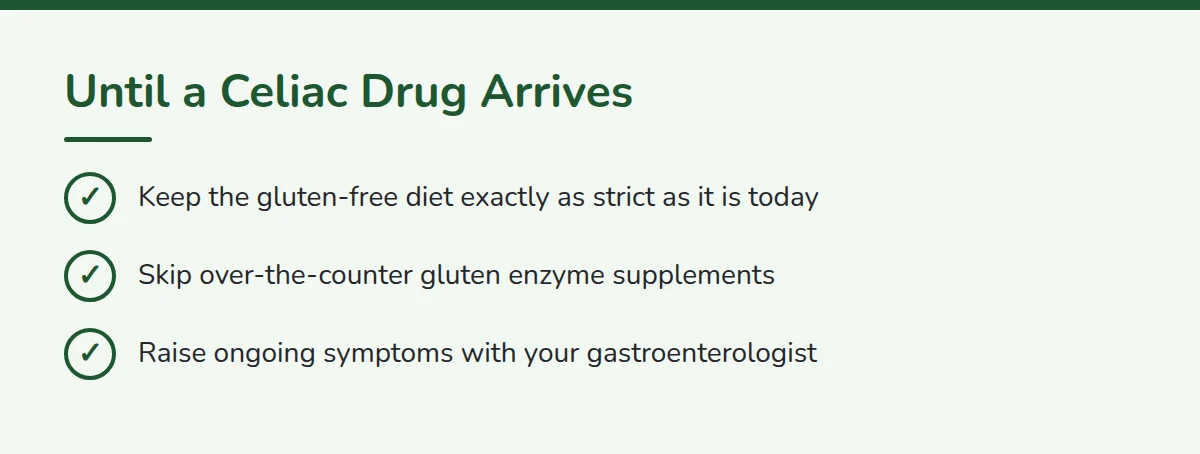
Keep the diet exactly as strict as it is today. Nothing on this list is available, and nothing on it is being tested as permission to eat gluten.
Do not treat over-the-counter enzyme supplements as protection. The evidence above says they do not do what their names imply, and at least one declared wheat on its own label.
If you still have symptoms, or follow-up testing shows ongoing damage despite careful eating, raise it with your gastroenterologist rather than assuming it is simply how celiac disease goes. People in that situation are the group many of these trials recruit, and your doctor can help you judge whether one is worth considering. Studies are listed on ClinicalTrials.gov.
Tighten up the kitchen, since cross-contact is the problem every one of these drugs is chasing. Our gluten-free options guide covers dedicated toasters and colanders, hidden sources of gluten, and ordering at restaurants.
And if what you actually have is a wheat allergy, none of this pipeline applies. Work with an allergist, carry your epinephrine, and see our guide to the anaphylaxis treatment landscape for the options that do exist for food allergy.
Further reading (sources)
- Celiac Disease Foundation for its tracker of celiac therapies in development
- Makharia and colleagues on the global burden of coeliac disease and the limits of the diet
- Francavilla and colleagues with treatment options from the gluten-free diet to novel therapies
- Syage and colleagues on how much gluten people on the diet eat by accident
- US Food and Drug Administration for its draft guidance on drugs used alongside a gluten-free diet
- Buriánek, Gege and Marinković reviewing newer celiac drug targets and the adjunct framework
- Murray and colleagues on the latiglutenase gluten challenge trial
- Pultz and colleagues with early gluten breakdown data for TAK-062
- ClinicalTrials.gov for posted results of the TAK-062 Phase 2 trial
- Celiac.com reporting on Takeda ending its TAK-062 and TAK-101 programs
- Krishnareddy and colleagues, on what over-the-counter glutenase supplements contain and claim
- Serena, Kelly and Fasano with a review of nondietary therapies for celiac disease
- ClinicalTrials.gov on the larazotide Phase 3 trial record
- Celiac Disease Foundation on why the larazotide Phase 3 trial was stopped
- Schuppan and colleagues for the transglutaminase 2 inhibitor trial
- Coeliac New Zealand on the discontinued Nexvax2 Phase 2 trial
- Kelly and colleagues with the TAK-101 nanoparticle tolerance study