The Complete Guide to Food Allergy Advocacy: How Households Turn Frustration Into Policy Change
Published on September 13, 2026

The Distance Between a Bad Day and a Better Law
Most allergy households can name the moment the system failed them. A daycare with no epinephrine anywhere in the building. A relative who was sure a little butter would not matter. A restaurant manager who said the fryer was fine, and it was not. The frustration is real, and for most families it stops at the front door, because nobody hands you a map of what to do with it.
Here is what is worth knowing: almost every protection your household leans on was built out of somebody else’s bad day. Sesame on an ingredient panel, epinephrine stocked in a school office, the right to board a plane early and wipe down a tray table. None of it appeared because a regulator woke up interested. Each one came from families who decided their experience should count for more than a story told at the kitchen table. This guide maps that machinery, from the bipartisan caucus in Congress down to the state bills that move fastest, and ends with a first year of specific things to do.
What Advocacy Has Already Won
The clearest example sits on the back of a package. The Food Allergy Safety, Treatment, Education, and Research (FASTER) Act took effect on January 1, 2023 and made sesame the ninth major allergen that US manufacturers must declare on a label. Sesame did not become more dangerous in 2023. It became legally visible, after years of patient testimony, petitions, and steady congressional pressure.
That carries a lesson worth internalizing. The list of major allergens is a policy artifact, not a fact of nature. It can grow and it can be redrawn, which is also why what counts as a tree nut on a label has shifted under shoppers’ feet as the FDA narrowed its recognized list to nine names.
The same is true of air travel. The Department of Transportation issued an order allowing passengers with life-threatening food allergies to preboard so they have time to clean their seating area, and FARE has spent years pressing individual airlines to actually follow it. And it is true of epinephrine access: the reason a school office near you may have a device on the shelf is that somebody’s state legislature was persuaded to allow it.
The Congressional Food Allergy Research Caucus
The federal center of gravity is the Congressional Food Allergy Research Caucus, a bipartisan group of lawmakers launched in May 2021. It is co-chaired by Representative Ben Cline (R-VA-06) and Representative Doris Matsui (D-CA-07), with Representative Glenn Grothman (R-WI-06) and Representative Ro Khanna (D-CA-17) as vice chairs, and it counted roughly two dozen members in 2026. Its stated priorities are more research funding, better treatment options, and stronger education initiatives.
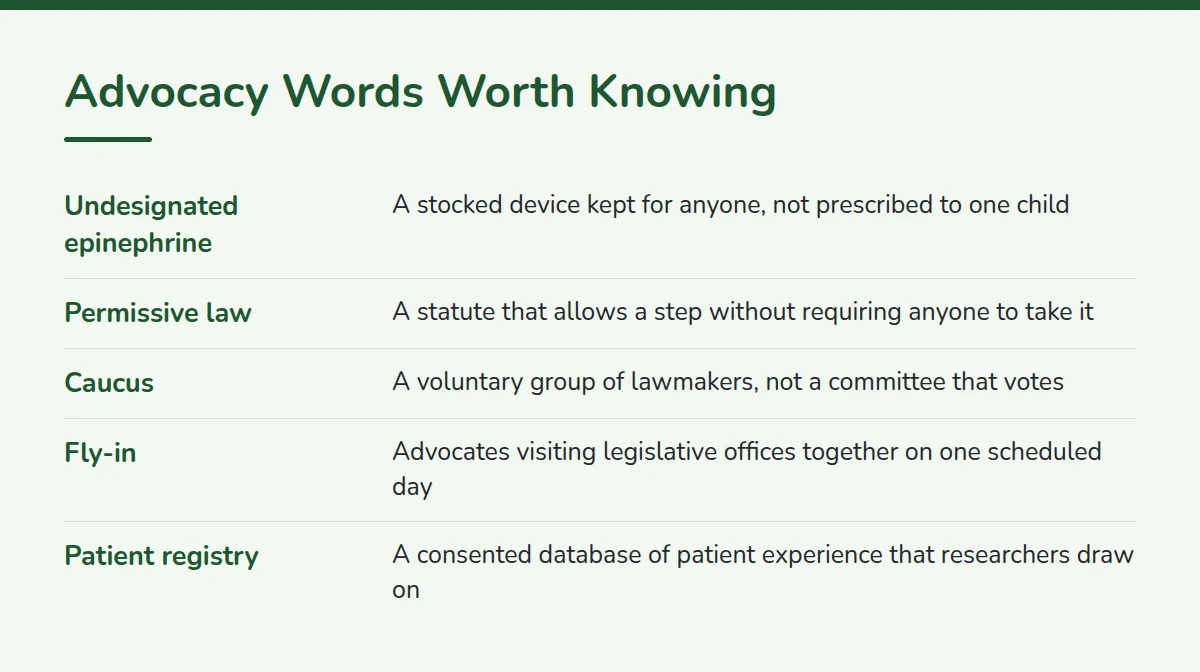
It helps to be clear about what a caucus is not. It is not a committee. It cannot pass a bill, hold a markup, or appropriate a dollar. What it is instead is a standing list of members who have already agreed the issue is real, and that makes it the first place a sponsor goes hunting for cosponsors, the group that signs an appropriations letter, and the members most likely to ask a useful question at a hearing.

That gives an ordinary constituent two clean moves. Look up whether your own representative is on the list. If they are, your ask gets specific: cosponsor this bill, sign that letter, attend this briefing. If they are not, the ask is small and cheap for them to grant: please join the caucus. Joining costs a member almost nothing, and it gives you a reason to call back.
The numbers that travel well in those conversations come from FARE. More than 33 million people in the US live with food allergy, a reaction sends someone to an emergency room every 10 seconds, and the condition carries an estimated $34 billion annual economic impact. Staffers remember figures like those long after they have forgotten which constituent brought them.
How a Bill Moves, and Where a Household Can Push
The path is less mysterious than it looks. A member introduces a bill, it is referred to a committee, it may get a hearing and a markup, it goes to the floor, then through the second chamber, then to the President. Most bills die quietly in committee, never having been voted down by anyone.
That failure pattern tells you where pressure matters. Cosponsors and committee members are the two pieces a constituent can actually move. A representative who sits on the committee of jurisdiction is worth ten who do not, and a bill with a visible bipartisan cosponsor list is far harder for a chair to ignore.
There is also a second lane that does not run through Congress at all. Federal agencies write the rules that decide what a label has to say, and they open public dockets before they do it. Comments from patients become part of the record. The FDA’s ongoing work on how much of an allergen is too much is the live example, and it is the kind of proceeding where a short, concrete account of what an unclear “may contain” warning costs your family is genuinely useful evidence.

States Move Faster Than Washington
If you only have energy for one arena, make it your state capital.
Elijah’s Law is the template. It is named for Elijah Silvera, a three-year-old who died in 2017 after being given a food he was allergic to at his preschool, and it requires childcare programs to have real allergy policies rather than good intentions. Versions have since been adopted in several states, and in 2026 New York moved further, toward requiring childcare settings to keep stock epinephrine on hand and to train staff to use it.
That last detail is the whole fight in miniature. As FARE’s own tracking makes plain, many state laws permit venues and institutions to stock undesignated epinephrine (a device kept for whoever needs it rather than prescribed to one named child) without requiring anyone to do it. Permission is not a program. The next wave of state advocacy is largely about turning “may” into “shall”, and pairing it with funding, staff training, and liability protection so the shall is achievable.
States are also simply easier to reach. Sessions are short, committees are small, a bill can get a hearing within weeks of introduction, and a parent who shows up to testify is often the only patient voice in the room. The evidence backing that testimony is strong: a 2022 FARE survey found only 52 percent of adult patients with a history of severe reaction had ever been prescribed epinephrine, and only 55 percent of those had it within five minutes of reach. Our piece on why epinephrine so often arrives late covers the household side of the same problem.

Alpha-Gal Is the Next Recognition Fight
Watch alpha-gal syndrome if you want to see a recognition campaign in progress. AGS is the tick-driven allergy to mammalian meat, cases are climbing across large parts of the country, and advocates are now pressing to have it named a major allergen alongside the current nine.
FARE has taken on the convener role, running a multi-year initiative toward a national strategy with a stakeholder event scheduled for October 2026. The guest list says a lot about how unusual this condition is: entomologists and vector-borne disease experts, ecologists, agricultural stakeholders and veterinarians, public health officials, and diagnostics companies, alongside the allergy field. AGS does not fit inside a normal allergy framework, so the coalition cannot look like a normal allergy coalition.
Nothing here is settled, and a national strategy is not a labeling law. But this is the stage every recognized allergen passed through first, and it is a useful thing for a newer patient community to watch closely.
Awareness Campaigns and the People Carrying Them
The public-facing half of advocacy is the awareness campaign, and FARE runs several. “Ready to Act” is built around recognizing anaphylaxis and using epinephrine without hesitating, carried by public service announcements featuring actors and athletes including Angela Bassett, Tia Mowry, and Jason McCourty. In July 2026 former NFL quarterback Drew Brees fronted a campaign on severe allergy readiness, built on the idea that every household should have a game plan before it needs one.
Younger advocates are doing the same work with less airtime and often more nerve. Devin Sailer, a food allergy advocate, was named one of America’s Ten Outstanding Young Americans in July 2026, and FARE’s Teen Advisory Group speaks to legislators in their own words about what a cure would change.
This is not celebrity noise, because the gap these campaigns target is behavioral rather than informational. A 2020 survey published in Annals of Allergy, Asthma and Immunology found 34 percent of people whose reactions were severe enough to warrant an auto-injector did not use one, with fear of needles among the leading reasons. A familiar face saying “use it anyway” reaches people no pamphlet will. If you want a ready-made on-ramp, our guide to taking part in Food Allergy Awareness Week lists the free toolkits.
Joining a Registry Is Advocacy With Data
The quietest high-value thing a household can do takes about twenty minutes. The FARE Patient Registry is a confidential database where patients and families answer surveys about their experience: more than 14,000 participants so far, tracking over 200 allergens from acai to zucchini, spanning ages under one to over 80. Identifying details are stripped before researchers see the data, and members can opt to hear about clinical trials.
Registries matter politically as well as scientifically, because policy arguments need denominators. “Families are struggling” is an anecdote. Prevalence, reaction rates, and cost-of-illness figures are findings, and a staffer drafting a bill can cite a finding.
Your First Year as an Advocate
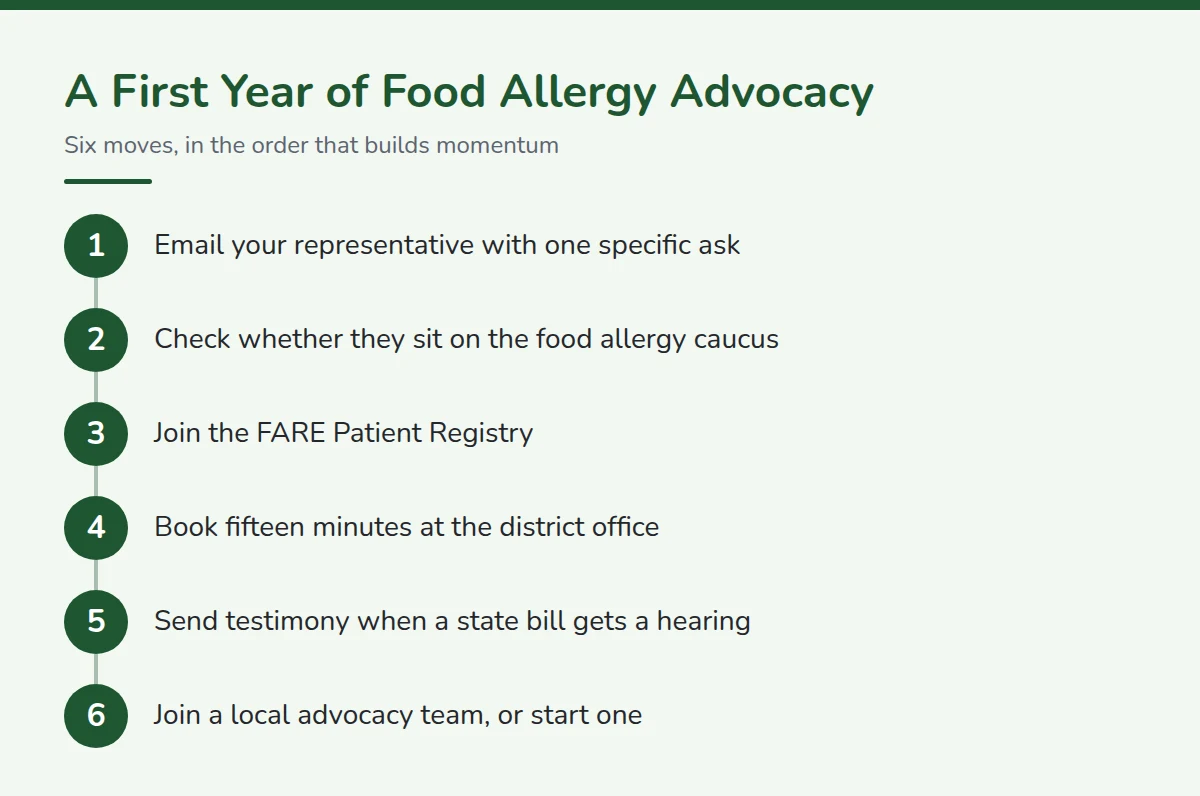
None of this requires quitting your job. A realistic first year looks like this.
- Send one email. Writing to a lawmaker is the quickest way to register an opinion, and it takes a few minutes.
- Check the caucus roster. If your representative is a member, thank them and make a specific ask. If not, ask them to join.
- Join the patient registry. Confidential, online, and it makes your household part of the evidence base.
- Ask for fifteen minutes at the district office. Surveys of legislators and their staff consistently find meetings are the most effective way to express a view, and the district office is far easier to reach than a DC one.
- Track your state’s bills. Stock epinephrine, childcare allergy policy, and school access bills appear most sessions. Written testimony counts even when you cannot attend.
- Find a local team, or start one. FARE supports a national network of community advocacy teams, and coalitions attract attention that individual letters do not.
Once those are habits, a legislative fly-in like FARE’s Courage at Congress puts you in a room with other advocates and a schedule of meetings already booked.
What to Bring to the Meeting
One story, one ask, one page.
The story is yours and it runs ninety seconds. Specific beats dramatic: the call from the school nurse, the label that changed without warning, the ambulance ride and what it cost. The ask is a bill number or a named action, because “support food allergy families” is not something an office can say yes to. The page is a single sheet with the ask, two or three numbers, and your contact details, left behind so the staffer has something to work from later.
Then send a thank-you email within two days. That email is the beginning of a relationship, and relationships are the actual unit of advocacy. The next time that office needs a constituent who understands this issue, you want to be the name they already have.
Frustration Is a Renewable Resource
You do not need a policy background, a title, or a nonprofit behind you. What you have is the one thing professional advocates cannot manufacture, which is a household that lives with the consequences of the current rules. Keep the medical side with a board-certified allergist, carry epinephrine, keep the emergency plan current, and if you are still building the foundations, our complete food allergy guide for 2026 covers labels, cross-contact, and emergency planning.
Then take a small fraction of the energy this diagnosis already costs you and point it outward. The next family’s version of your worst day is still being written, and the rules that shape it are, right now, entirely negotiable.
Further reading (sources)
- Food Allergy Research and Education on the ways an ordinary constituent can reach a lawmaker
- Food Allergy Research and Education for who sits on the bipartisan food allergy caucus
- Allergic Living reporting New York’s move to require stock epinephrine in childcare
- The Boston Globe covering the campaign to make alpha-gal the tenth major allergen
- Allergic Living on the readiness campaign fronted by Drew Brees
- Quality Assurance and Food Safety for the young food allergy advocate named to a national honors list
- US Food and Drug Administration with the toolkit explaining what the FASTER Act changed