Every Free-From Certification Mark Explained: What Each Seal Actually Verifies
Published on September 14, 2026

Walk the free-from aisle and you will pass a dozen small circular logos in about ninety seconds. A crossed grain. A butterfly. A checkmark in a shield. A “V” in a heart. Most shoppers read them the same way: someone official looked at this, so it must be safe. That instinct is reasonable and mostly wrong. Behind those seals sit programs with wildly different rules. Some send an auditor into the plant every year and pull product off retail shelves for laboratory testing. Some review a folder of supplier letters. Some are not certifications at all, just a phrase the brand’s marketing team chose.
The difference matters most to the people with the least margin for error. A mark that guarantees a gluten ceiling of ten parts per million and a mark that guarantees an ingredient list contains no animal products are both printed in the same friendly green, and only one of them is telling you anything about protein that could put you in an emergency room. Here is what each of the common marks actually verifies, who checks, how often, and where each one goes quiet.
Four Questions That Separate a Seal From a Sticker
Before the individual programs, the framework. Any mark on a package or a restaurant door can be interrogated with four questions, and a legitimate program will answer all four in public documentation you can find in about five minutes.
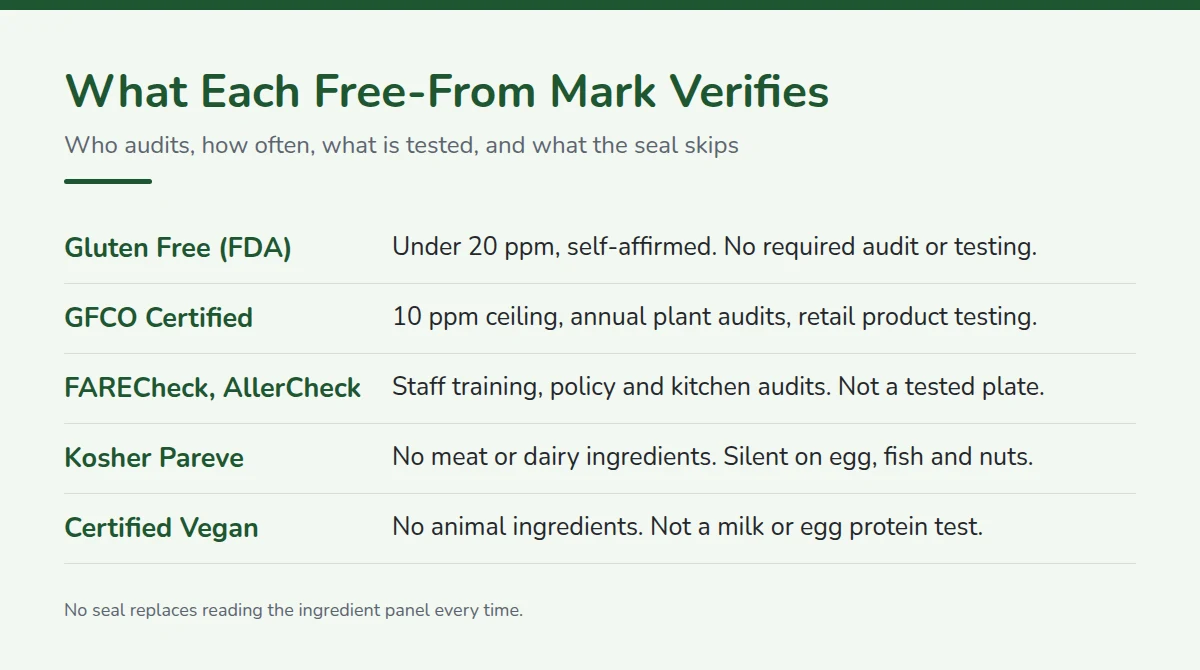
Who audits? An independent certifier, an industry trade group, or the company itself? How often? Annually with unannounced visits, once at enrollment, or never? What is tested? Finished product pulled from retail, samples the company submits, or nothing at all? And the question almost nobody asks: what does the mark say nothing about? Every program has a boundary, and the trouble starts when shoppers assume the boundary is wider than it is.
Gluten-Free Is the Only Free-From Claim With a Legal Number
Gluten is the outlier. In the United States it is the single free-from claim with a binding federal definition: under the FDA’s gluten-free labeling rule, a product carrying that claim must contain fewer than 20 parts per million of gluten. That number is real and enforceable, and the agency runs surveillance sampling to check compliance.
What surprises people is what the rule does not require. There is no premarket approval, no mandatory testing schedule, and no required outside inspection. A manufacturer decides it meets the standard and prints the words. Most reputable brands do test. But the plain words “gluten free” on a package are a self-affirmed claim, which is exactly why gluten-free Cheerios can clear the federal standard on average and still make individual celiacs ill.
Third-party certification is the layer that adds what the rule leaves out. The Gluten-Free Certification Organization, a program of the Gluten Intolerance Group, is the most widely seen of these. GFCO holds certified products to 10 ppm, half the federal ceiling, and backs it with annual facility inspections, ingredient review, and testing of product retrieved from the marketplace rather than only samples the company chose to send. Other programs take different routes to the same goal. The Celiac Support Association has historically used the strictest ceiling in the country at 5 ppm. The Gluten-Free Certification Program, endorsed by celiac organizations in the US and Canada, certifies the management system instead, auditing the process controls that keep gluten out rather than only measuring what came out the end. The Gluten-Free Food Program follows a similar systems-and-audit model and shows up frequently on restaurant doors.
So the practical hierarchy is: an unlabeled product tells you nothing, a self-declared gluten-free label means under 20 ppm on the company’s own word, and a certification mark means a stricter ceiling plus an outsider with the authority to pull the mark. All three are common on the same shelf. Our guide to gluten-free living covers how much that distinction matters if your diagnosis is celiac disease rather than a sensitivity.

The Top Nine Have No Federal Seal at All
Here is the gap almost nobody realizes exists. There is no federal allergen-free standard, no threshold, and no government seal for milk, egg, peanut, tree nut, soy, wheat, fish, shellfish, or sesame. FALCPA requires a company to declare those allergens when it puts them in on purpose. It says nothing about traces that arrive by accident, and the FDA’s February 2026 threshold meeting was the opening of a conversation about fixing that, not a decision.
Into that vacuum stepped private certifiers. The most established for packaged goods is MenuTrinfo’s Certified Free From program, which certifies products as free of the top nine allergens and gluten on the strength of a facility audit, an ingredient and supplier review, and laboratory testing rather than a paperwork exercise. When you see a top-nine-free mark on a box, that is the kind of program worth looking up by name, because the certifier’s own website will tell you its audit frequency and testing protocol. If you cannot find the program at all, you are looking at marketing.
What a Restaurant Door Mark Actually Certifies
Restaurant marks answer a different question than package marks, and reading them as though they are the same thing is the most common mistake in this whole category. A package certification is about a product. A restaurant certification is almost always about a kitchen’s people and processes.
FARE’s FARECheck program is the clearest illustration because it publishes its tiers. Silver is awarded when an establishment reports that at least 90 percent of its workforce has completed food allergy training. Gold adds a monthly on-site audit (or an annual third-party one) plus a documented food allergy management policy. Platinum adds emergency response training and menu transparency on top of that. Read those criteria closely and notice what they describe: training coverage, documentation, and audit cadence. Not a tested plate.
MenuTrinfo’s AllerCheck works the same way at the location level. When Penn State’s Pure dining station earned it in July 2026, the process involved a third-party auditor reviewing documentation, staff knowledge and training, ingredients, recipes, cleaning schedules, and service style. The station also runs a completely separate kitchen with its own utensils, cookware, and dishwashing. That physical separation is what makes the certification meaningful, and it is a fact about that station, not something the logo itself guarantees anywhere else.
AllerTrain sits one level down again. It is a training curriculum, accredited through ANSI/ANAB, and what it certifies is a person who passed a course. A restaurant advertising AllerTrain-certified staff is telling you someone on payroll learned the material. It is a genuine signal and it is not a statement about the line cook working tonight.

Kosher Pareve: A Useful Screen That Fails in Three Ways
Pareve means a food contains neither meat nor dairy, which makes the mark genuinely useful for spotting milk in places you would not expect it. Plenty of dairy-free shoppers use it as a first-pass filter, and that is fair. Just know the three places it breaks.
First, pareve is a religious category, not a testing threshold. Under kosher law, trace dairy can be considered nullified when it falls below a small fraction of the whole, so a product can carry a pareve designation while containing a quantity of milk protein that no allergen program would accept. Second, many certifiers use a “dairy equipment” or “DE” marking for products with pareve ingredients made on dairy equipment. That is a cross-contact disclosure written in a code most allergy shoppers have never been taught to read. Third, and most importantly, pareve says nothing about the rest of the list. Fish and eggs are both pareve. Peanuts, tree nuts, soy, wheat, and sesame are all pareve. A supervising rabbi is verifying compliance with Jewish law, not running ELISA tests for the top nine. Our dairy-free living guide treats pareve the way it should be treated: one input among several, never the deciding one.
Certified Vegan and Non-GMO Project Are Not Allergen Marks
These two appear constantly on free-from shelves and neither is about allergens.
The Certified Vegan logo, administered by the Vegan Awareness Foundation, verifies that a product contains no animal ingredients and was not animal tested, established primarily through ingredient documentation and supplier attestations. The standard asks companies to address cross-contact with animal products, but shared equipment with cleaning between runs is permitted, and there is no routine finished-product testing for milk or egg protein. A Certified Vegan cookie is a reasonable starting point for a milk-allergic household and it is not a dairy-free certification. Vegan food is also frequently built on cashews, almonds, soy, wheat, and sesame, so for most of the top nine the logo is neutral at best.
Non-GMO Project Verified is further away still. The butterfly means inputs from high-risk crops were traced and tested against an action threshold for genetically engineered material. It is a rigorous program about a completely different question. Soy and corn are high-risk crops, so the mark clusters on exactly the products allergy shoppers browse, which is how it picked up a safety halo it never claimed.
The Claims With Nobody Behind Them
Finally, the phrases that look like certifications and are not. “Free from.” “Allergy friendly.” “Made without.” “Produced in a peanut-free facility.” None of these has a federal definition, an auditor, or a revocation process. They can be entirely true. A small brand running a genuinely dedicated facility often has better controls than a certified giant, and many simply cannot afford certification fees. But you are taking the company’s word, so the follow-up is to call and ask what they actually do: dedicated line or shared with changeover, what they test, and how often.

Precautionary statements sit in the same unregulated space from the other direction. “May contain” and “processed on shared equipment” are voluntary, with no rules about when a manufacturer must use them or how to word them. Two products with identical risk can carry opposite warnings. That inconsistency is one of the things organized advocacy is working to change, and the FDA’s threshold work is the first real movement on it in years.
Reading a Seal in Ten Seconds
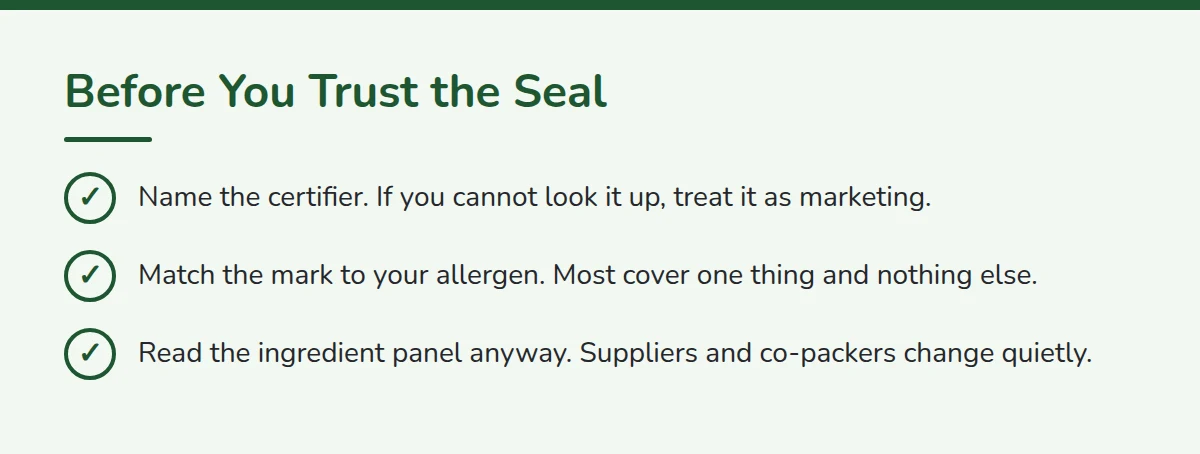
Name the certifier. If the mark does not name an organization you can look up, treat it as marketing copy. Ask what it measures: a number (gluten ppm), a process (audits and training), or an ingredient philosophy (vegan, non-GMO). Check whether it covers your allergen specifically, because most marks cover one thing well and nothing else. And keep the habit that no seal replaces, which is reading the ingredient panel every single time, because formulations and co-packers change without any announcement and a certification renewed last spring does not know about the supplier swap last month.
Certification is a real signal and worth paying for when it matches your allergen. It is a probability improvement, not a guarantee, and anyone managing a severe allergy should build their shopping rules with an allergist rather than from the front of a box.
Further reading (sources)
- Food Allergy Research & Education on what each FARECheck tier requires of a kitchen
- Penn State for how a campus dining station earned AllerCheck certification
- Gluten-Free Certification Organization on the certification standard and the 10 ppm ceiling
- U.S. Food and Drug Administration covering how the gluten-free labeling rule is written and enforced
- Non-GMO Project for the standard behind the butterfly seal
- Vegan Awareness Foundation with the criteria a product must meet to be Certified Vegan