Restaurant Allergen Laws in the US: A State-by-State Guide to What Diners Are Owed
Published on October 30, 2026

A box of crackers in your pantry has to name every major allergen inside it. Crush those same crackers into the crust of a restaurant crab cake, and federal law stops asking. The national allergen labeling law was written for packaged food, not plated meals, so what a restaurant owes you as an allergic diner depends on the state you are eating in, and on which edition of a model food code its health inspectors enforce.
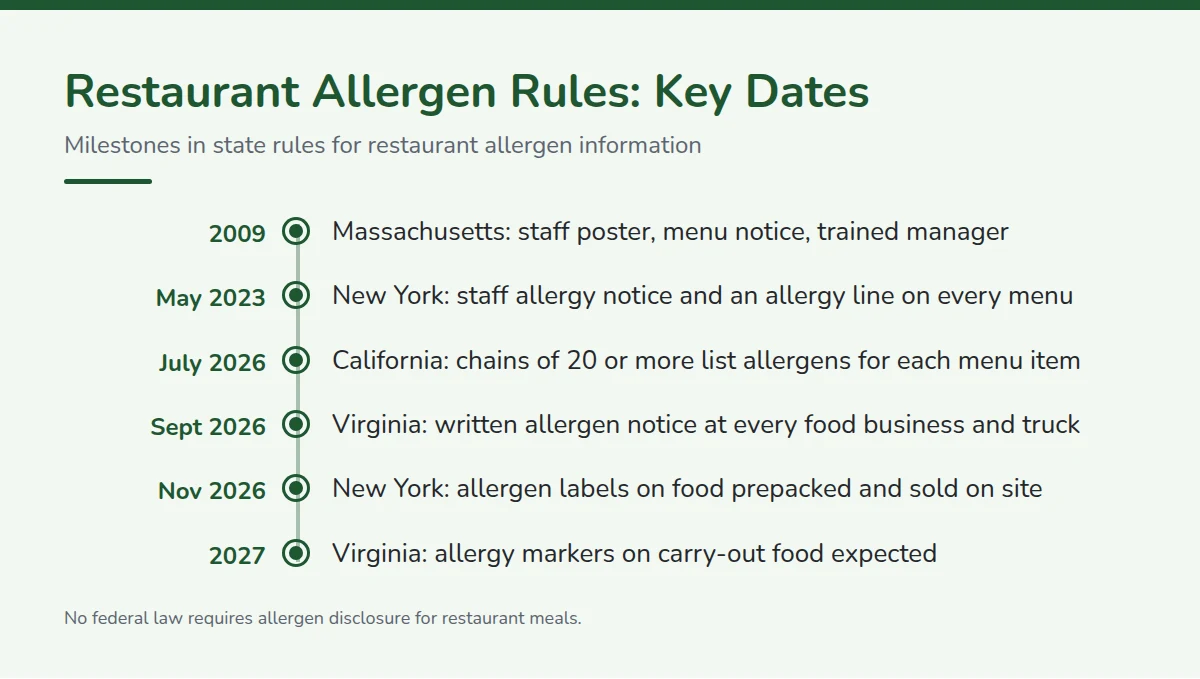
That map changed more in 2026 than in the previous decade. On July 1, California began requiring large restaurant chains to list the allergens in every menu item. On September 10, Virginia began requiring written allergen information from every restaurant and food truck in the state. In November, New York starts requiring allergen labels on food that delis, bakeries, and food trucks pack ahead of time, and bills modeled on California’s are pending in several other states. This guide explains what federal rules cover, what each state with its own law requires of menus and staff, what none of these laws promise, and what to ask for wherever you eat.
Why Federal Law Stops at the Restaurant Door
The Food Allergen Labeling and Consumer Protection Act of 2004, known as FALCPA, requires packaged food to name the major allergens it contains. A plated restaurant meal is not packaged food, and neither is a sandwich wrapped while you wait: the FDA Food Code’s definition of “packaged” excludes food an employee wraps or boxes at the customer’s request. Federal menu labeling rules for chains do exist, but they cover calories, not allergens. No federal law requires a restaurant to tell you what is in a dish.
What fills part of the gap is the FDA Food Code, a model rulebook that state and local health departments adopt and enforce when they inspect restaurants. Two of its provisions matter to allergic diners. One makes the person in charge responsible for making sure employees are trained in food allergy awareness for their duties, which the code defines as knowing the major food allergens and the symptoms they can cause. The other, added in the 2022 edition and kept in the 2026 edition, says the permit holder “shall notify consumers by written notification of the presence of major food allergens” as ingredients in unpackaged food. The code’s commentary lists menu notes, brochures, table tents, and placards, on paper or on a screen, as ways to meet it.
The Food Code binds only where a state or local agency adopts it, though, and each agency adopts new editions on its own schedule. FDA’s latest adoption report counted 14 states where at least one agency had adopted the 2022 edition by the end of 2025, covering about a quarter of the US population. Most other states use an older edition that includes the training duty but not the written notice rule. Our guide to allergen labels on store-packed deli and bakery food covers how the same code treats grocery stores.
One naming note before the state tour. California’s law is often called the ADDE Act, short for Allergen Disclosures for Dining Experiences. Despite the name, it is not a federal act. It is a California statute that applies only in California. A 2023 review by allergy researchers at Stanford, Northwestern, and Harvard argued that restaurant diners need federal rules and outlined what those rules should include. Congress has not enacted any.
California: Allergens on Every Chain Menu Since July 1
Senate Bill 68, signed in October 2025, took effect July 1, 2026. It applies to restaurants that belong to a chain of 20 or more locations doing business under the same name, however each location is owned, which is the same test that triggers federal calorie labeling. Those restaurants must give written notice of the major food allergens they know, or reasonably should know, are ingredients in each menu item, named in plain words such as milk, egg, or sesame.
The notice can sit directly on the menu or in a digital format, such as a QR code that opens an online menu. A digital menu must come with an alternative for diners who cannot use it: an allergen menu, a chart, a grid, a booklet, or other written material. The state health department lists the exemptions: food carts and other compact mobile food operations, nonpermanent food facilities such as event stands, specials sold for fewer than 60 days a year, and items tested for fewer than 90 consecutive days. The law’s sponsor, Senator Caroline Menjivar, described it as the first in the nation to require allergen disclosures on restaurant menus.
Independent restaurants and smaller chains are not covered, and neither is cross-contact. The duty is about ingredients, so a chart can truthfully show no fish for fries cooked in the same oil as battered cod. The list also stops at the nine major allergens, which leaves diners allergic to mustard, celery, or coconut to ask on their own. Coconut is a particular trap now that the FDA no longer counts it as a tree nut, as our article on coconut and the shortened tree nut list explains.
Virginia: Written Notice From Every Restaurant and Food Truck
Virginia went broader. Updated Food Regulations from the Virginia Department of Health took effect September 10, 2026, and require food establishments to disclose the presence of any major food allergen in their food. There is no size threshold, and the rule applies explicitly to mobile food units such as food trucks and to temporary food establishments such as festival stands. The update also added sesame, bringing Virginia’s list to the federal nine.
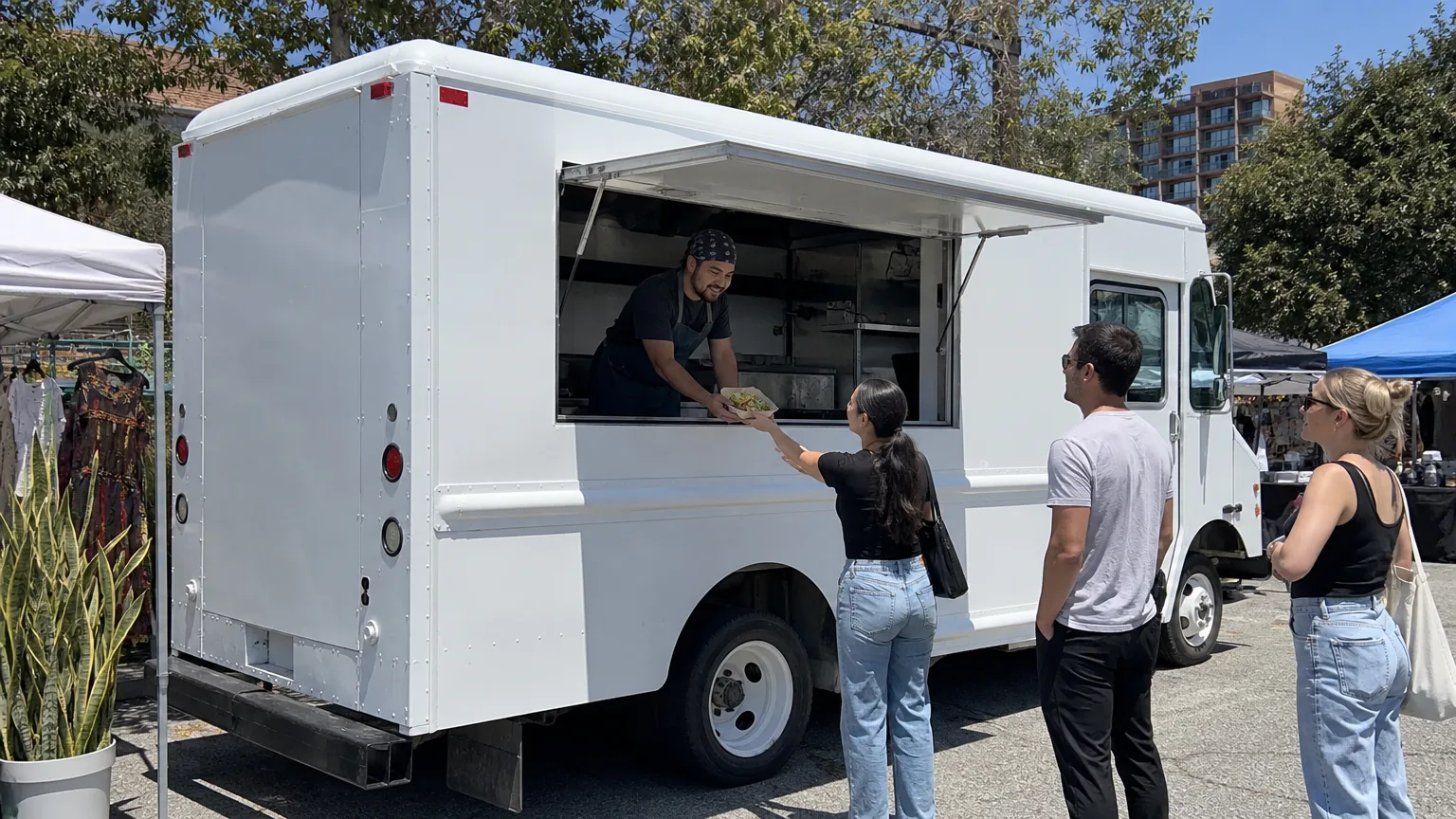
Restaurants do not have to reprint menus. The department’s guidance gives an example as plain as “Cobb Salad: contains wheat and egg” and allows a stand-alone handout instead. Local reporting on the rollout described the other options: words, icons, or numbers with a key on the menu, or a QR code that leads to written allergen information. The person in charge must also make sure food employees are trained to know the nine major allergens and the symptoms of an allergic reaction.
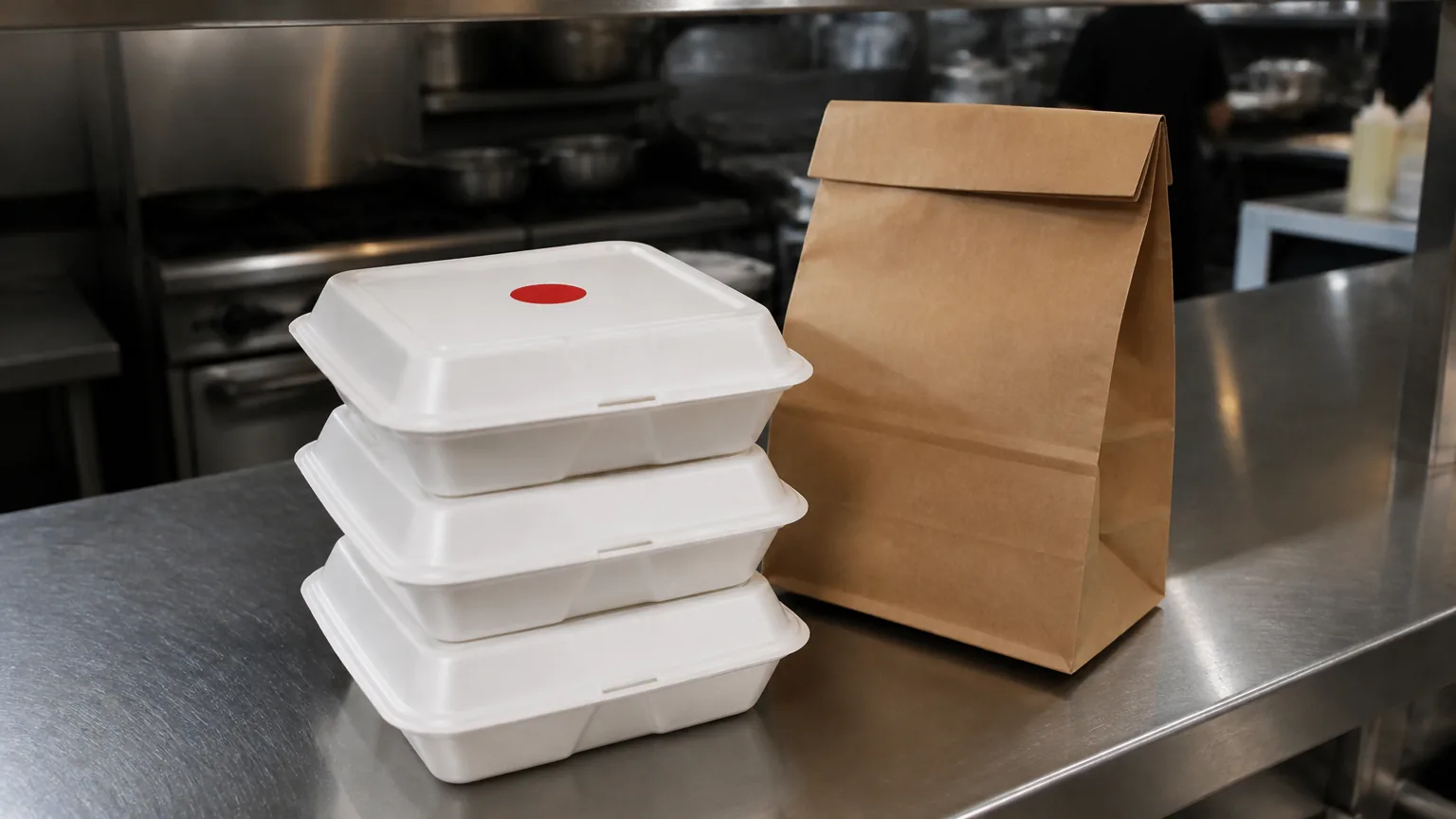
More rules are on the way. The 2026 General Assembly passed bills requiring a food allergy awareness notice (HB 373 and SB 248) and allergy identification on delivery and carry-out food (SB 183). The carry-out law tells the Board of Health to require restaurants that alter or substitute food for a customer’s allergy or sensitivity to put an identifying marker on the item, with a marker for each major allergen and for gluten. The health department says online menus will also need a statement telling customers with allergies to notify the restaurant, plus a way to flag one. None of this is enforced until the department writes the regulations, which it expects to take effect in 2027.
New York: A Staff Notice, a Menu Line, and Labels on Prepacked Food
Since May 20, 2023, New York has required restaurants and catering halls to post a state-issued food allergy notice where every employee who prepares or serves food can see it, in a language each of them speaks when the state offers one. The notice covers what to do when a customer discloses an allergy, how to prevent cross-contact, and when to call 911. Every menu must carry the line “If you have a food allergy or intolerance, please notify us,” or allergen information for each item instead. Online menus for delivery and takeout need an allergy notice plus either a way to flag your allergy or item-by-item allergen information. Each violation carries a civil penalty of up to $125.
That law puts the burden of speaking up on you and asks staff to be ready to listen. Because the one-line request satisfies it, the law does not require a restaurant to tell you what is in the food. A second law, signed November 12, 2025, takes effect one year later. It requires food that is prepared, prepacked, and sold on the same premises, at delis, bakeries, sandwich shops, ice cream parlors, cafeterias, and food trucks, to name any major allergen on the package or an attached label. Food packed after you order, such as a sandwich made while you wait, is not covered. A bill introduced in April 2026, S10116, would go further and require allergen labeling beside every menu item at every food service establishment in the state.
The Earlier Laws, and Where the Food Code Rule Applies
Several states acted years before California, mostly by requiring awareness rather than disclosure: a poster in the kitchen, a line on the menu asking you to speak up, and a manager trained in allergens.
| State | What restaurants must do | Since |
|---|---|---|
| California | Chains of 20 or more list the major allergens in each menu item, on the menu or digitally with a written alternative | July 2026 |
| Virginia | Every food establishment, food trucks included, gives written allergen notice; staff trained on the nine allergens and reaction symptoms | September 2026 |
| New York | Staff allergy notice posted; every menu asks diners to report allergies or lists allergens by item; allergen labels on food prepacked on site from November 2026 | May 2023 |
| Massachusetts | Allergen poster in the employee work area; menu notice asking you to tell your server; a certified manager with allergen training, renewed every five years | 2009 law |
| Rhode Island | Staff-area poster; menu notice; a designated manager knowledgeable about food allergies | 2012 law |
| Illinois | Notice telling diners to share allergies with staff, who must relay them to the manager on duty; manager allergen training within 30 days of hire and every three years | 2017 and 2019 laws |
| Maryland | Food allergy awareness poster in the staff area | March 2014 |
Two details are easy to miss. Massachusetts spells out the menu wording: “Before placing your order, please inform your server if a person in your party has a food allergy.” Illinois added gluten and celiac disease to its required manager training as of January 1, 2026. Michigan, often listed alongside these states, required certified food safety managers to complete allergen awareness training starting in 2017, but that part of the state’s food law expired at the end of 2020.
The Food Code’s written notice rule adds a second layer. According to FDA’s report, the agency that inspects restaurants had adopted the 2022 Food Code by the end of 2025 in Colorado, Connecticut, Delaware, Georgia, Hawaii, Illinois, Indiana, Mississippi, Nebraska, Ohio, Pennsylvania, Rhode Island, and Utah. Oregon’s restaurant rules followed in February 2026, and Virginia’s in September. In those states, ask for the written allergen information and expect the restaurant to have it. One caution: an agency can base its rules on the 2022 code and still omit provisions, and FDA found that about half of state agencies enforce at least one area less strictly than the edition they adopted, so your health department’s version is the final word.
Bills to Watch
Bills that would require written allergen information at restaurants were introduced in at least six more states in 2025 and 2026:
- New Jersey. S3394 would require food service businesses to give written notice of the major allergens in each menu item. In October 2026 it was amended and referred to the Senate Budget and Appropriations Committee.
- New York. S10116, described above, would put allergen labels beside every menu item.
- Illinois. SB 3305 would require every restaurant, not just chains, to show the major allergens in each menu item, on the menu or digitally with an alternative. A House bill, HB 4686, would add precautions against cross-contact.
- Michigan. HB 5402, introduced in December 2025, would require every food service permit holder to give written notice of the allergens in unpackaged food.
- Missouri. HB 3446 would require written notice of the nine major allergens; it had no hearing scheduled as of late May 2026.
- Maryland. HB 181 would have required written allergen disclosure at every restaurant but went no further than a February 2026 committee hearing.
If one of these is your state, our food allergy advocacy guide explains how a bill moves and where a household’s voice counts most.
What None of These Laws Promise
A written allergen list is real progress, but it is a starting point, not a safety guarantee.
- Ingredients are not cross-contact. The laws cover what goes into a dish, not what the grill, fryer, or cutting board carried before it. A May 2026 FDA study found enough fish protein in reused breading to make a plain breaded chicken tender risky for a fish-allergic diner, as our article on fried fish and shared breading describes.
- A label is not a guarantee. In a study of 2,822 people in the FARE patient registry, 26.6 percent of restaurant reactions happened when the allergen was declared on the menu, and 13.7 percent happened when it was declared and staff had also been told. Charts also go stale when a supplier or recipe changes and nobody updates the binder.
- The list stops at nine. Allergens outside the major nine get no column on the chart.
- Nobody has to cook you a safe meal. These laws govern information, not accommodation. A kitchen that declines your order after reading its own chart may be the most honest one on the street, as our guide to restaurants that refuse an allergy order explains.
- Penalties are small. New York’s menu notice rule carries a fine of up to $125 per violation.
What to Ask For, Wherever You Eat
The laws differ from state to state, but the questions do not. These work anywhere.
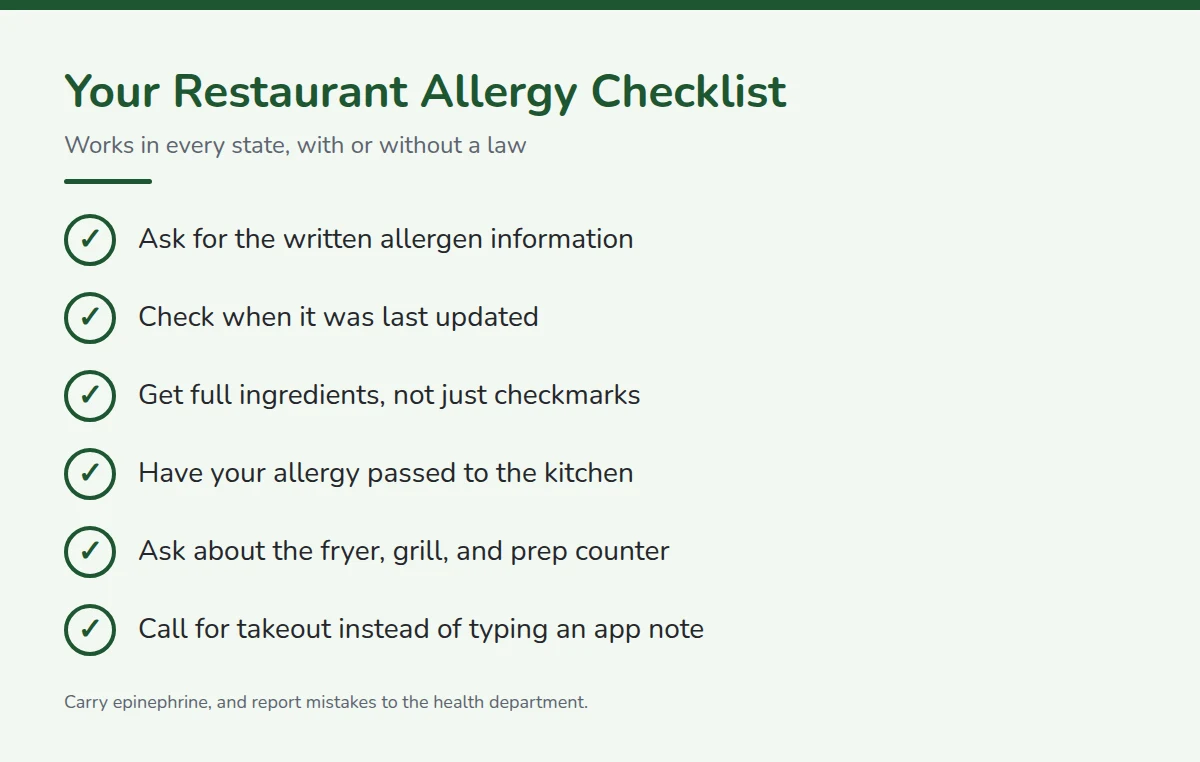
- Ask for the written allergen information before you order. California chains and every Virginia restaurant must have it, and the rules in states on the 2022 Food Code expect it. Many restaurants elsewhere keep a chart even though no law requires one.
- Check the date and the detail. A chart older than the current menu, or a grid of checkmarks with no ingredients, deserves a follow-up. Ask for the ingredient list for your dish.
- Tell your server, and ask that your allergy go to the manager and the kitchen. Illinois writes that handoff into law. Everywhere else, ask for it directly.
- Ask about shared equipment. The fryer oil, the grill, and the prep counter are where a correctly labeled dish picks up an allergen.
- Call for takeout and delivery. A note typed into an app is easy to miss. In New York, a restaurant’s online menu must either let you flag an allergy or list allergens by item, and Virginia’s carry-out markers are expected in 2027.
- Carry your epinephrine. If you react, use it and call 911.
- Report problems. If a restaurant gets it wrong, tell the manager, then the local health department, which inspects restaurants and enforces these rules.
What the Rules Mean for Restaurant Operators
Operators answer to two layers: any state allergen law, and whichever Food Code edition their inspector enforces. A chain with 20 or more locations in California needs allergen information on the menu, or a digital menu with a written alternative on hand. Every Virginia establishment needs written allergen information and staff who can name the nine allergens and the signs of a reaction. In New York, the staff notice and the menu notice are already required, and from November 2026, food a business packs ahead to sell on site needs an allergen label.
The hard part is keeping the information true. An allergen chart is only as accurate as the last recipe or supplier change it reflects, so tie it to the same ingredient records the kitchen orders from, and date it. Train the handoff from server to manager to kitchen, not just the list of allergens. When the kitchen cannot control cross-contact, say so plainly and explain what precautions it can take. A careful “we can’t guarantee it” serves a diner better than a confident yes resting on a stale chart.
The Bottom Line
Restaurant allergen law in the US is still a patchwork, but in 2026 it moved decisively toward putting allergens in writing. At a California chain, anywhere in Virginia, or in a state whose inspectors use the 2022 Food Code, ask for the written list. In New York, say the words the menu asks you to say. Everywhere, treat the list as the start of the conversation, not the end of it. If your allergies are severe, work out your own dining rules with your allergist, including which kinds of restaurants to skip.
Further reading (sources)
- California Department of Public Health on what SB 68 requires of chain restaurant menus
- Office of Senator Caroline Menjivar with the announcement of SB 68 and the ADDE name
- Virginia Department of Health for its September 2026 allergen disclosure rules and the 2026 allergy notice and carry-out bills
- Virginia Acts of Assembly, the 2026 law on allergy markers for carry-out and delivery food
- WSET on how Virginia restaurants and food trucks can show allergen information
- New York State Department of Agriculture and Markets with the 2023 start of the restaurant allergy notice rule
- New York State Senate for the current text of the food allergy notice law, Public Health Law section 1356 and the 2025 law requiring allergen labels on food prepacked on site
- New York State Legislature with the text of S10116, the 2026 menu labeling bill
- Legal Information Institute with Massachusetts’ food allergen awareness rules, 105 CMR 590.011
- Rhode Island General Assembly for the state’s food allergy awareness statute
- Maryland Department of Health on its staff-area food allergy poster requirement
- Maryland General Assembly with the legislative history of HB 181
- Illinois General Assembly for SB 3305, which also shows the current restaurant allergy notice law and the 2025 act adding gluten to manager allergen training
- Michigan Legislature on the lapsed manager allergen training rule, MCL 289.2129
- FAACT with its tracker of statewide restaurant allergy laws
- BillTrack50 for the status of New Jersey’s S3394
- Spencer Fane on the 2026 restaurant allergen bills in Maryland, Michigan, Illinois, and Missouri
- U.S. Food and Drug Administration for the 2026 Food Code’s allergen notice and training provisions and its 2025 report on which states have adopted the code
- Oriel and colleagues on restaurant reactions that happened despite menu labels and warned staff
- Stankovich and colleagues with a review of restaurant allergen rules and the case for federal standards