When a Restaurant Refuses to Serve You Over a Food Allergy: Refusals, Waivers, and the Riskier Yes
Published on October 26, 2026
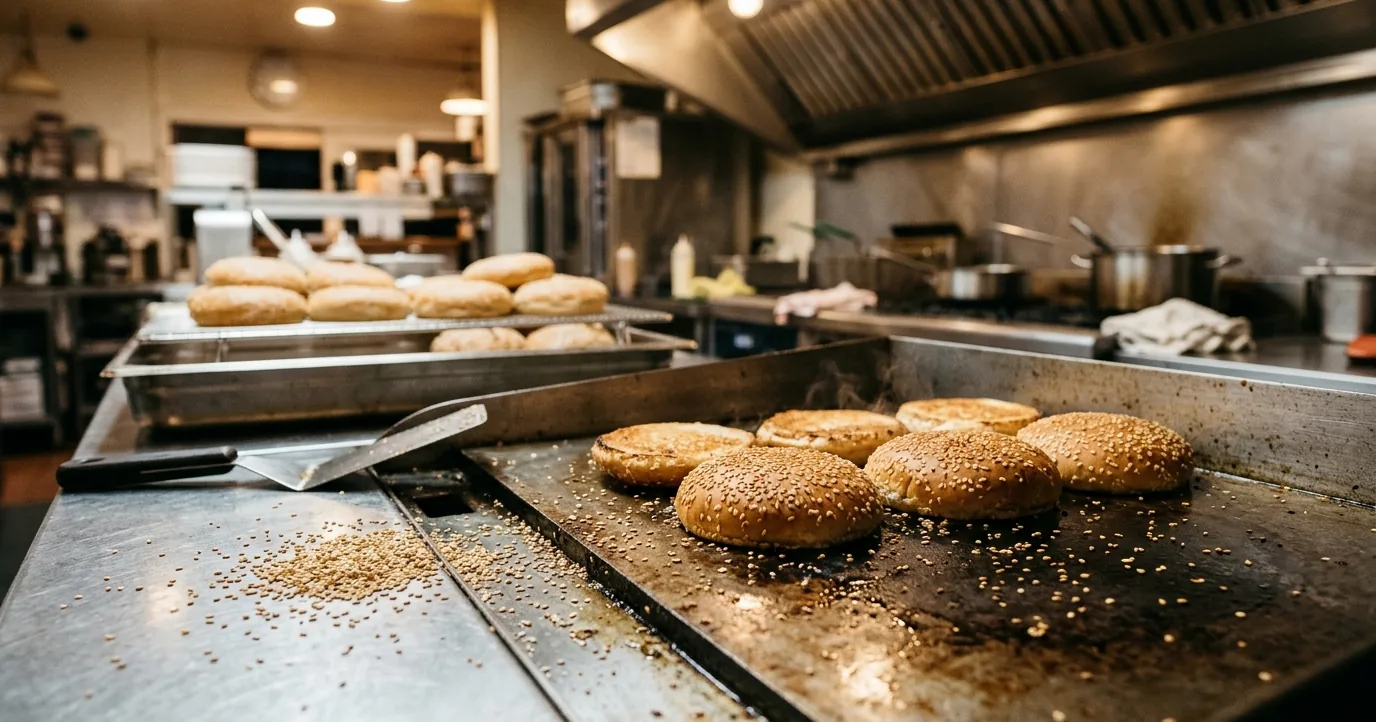
In February 2026, a small burger kitchen that operates out of two pubs in Norwich, England, stopped serving anyone with a gluten, nut, soy, or sesame allergy. Some of the diners it turned away were furious, and one wrote that being refused made them feel as if they had a disease. That spring, a student in Tarrytown, New York, described a very different restaurant experience. Two summers earlier, on a trip to the UK, he had a severe allergic reaction at a restaurant after being told his dish was safe. Unable to get an ambulance, he took a taxi to the emergency room.
The first story drew the angry reviews. The second is the one that should worry you. It is easy to take a refusal personally and file a reaction under bad luck, and that reading is usually backwards. This guide separates the two ways a kitchen can fail you, explains what a sign-this-waiver request does and does not change, sets out what UK and US rules actually require of a restaurant, and shows how to read each answer you get as information about the kitchen behind it.
Two Ways a Kitchen Can Fail You
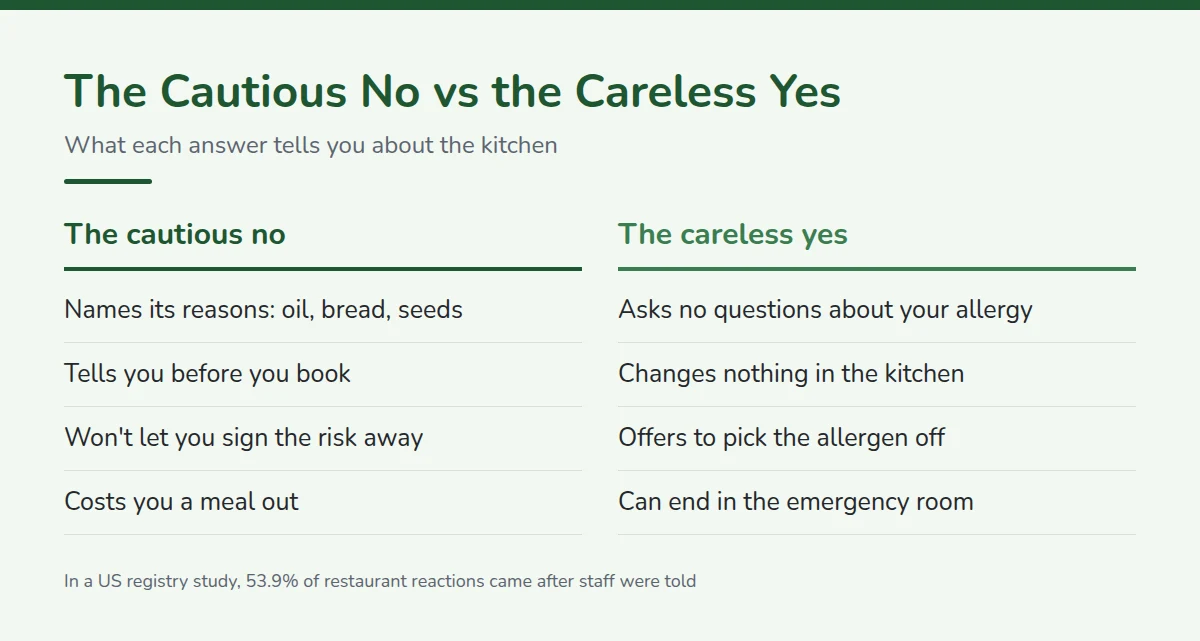
The cautious kitchen fails you at the door. It cannot make a meal it trusts, so it says so, and you leave hungry and annoyed. The careless kitchen fails you at the table, or an hour later. It says yes, changes nothing that matters, and the allergen arrives on your plate. Both are failures, but only one of them can end in an ambulance.
The Norwich kitchen is a clear case of the cautious kind. Its owner told BBC Radio Norfolk that the buns are handmade in a bakery that handles nuts, the oil the kitchen cooks with is soybean oil, and the sesame seeds from the buns “cover the entire kitchen.” The kitchen changed its policy after what it called due diligence found no safe way to rule out cross-contamination completely, and it now states the policy in its booking terms and in a text message sent when customers book. Not everyone accepted that. A diner with a nut allergy wrote that they were refused service even after offering to accept the risk, and a business professor at the University of East Anglia argued that the kitchen should find a way to cater. Simone Miles, chief executive of the charity Allergy UK, said communication on both sides was the key.
The careless kind is harder to spot, because it looks like good service. The Tarrytown student, who has tree nut and shellfish allergies, was told his dish was safe. A gluten-free bakery owner whose son was diagnosed with celiac disease seven years ago told WDET, Detroit’s public radio station, that restaurants “would just push things to the side,” and that her family noticed staff who were not changing gloves or using different utensils. None of those kitchens turned anyone away.
Telling the Server Is Not a Safety System
These are not a handful of unlucky anecdotes. When a team led by Mount Sinai allergists analyzed two years of reports from 2,822 people in the Food Allergy Research & Education patient registry, dining out was the second most common place for a reaction, after home. Many of those restaurant reactions were serious: 28 percent needed one dose of epinephrine and 6.2 percent needed two. More than half, 53.9 percent, happened even though the diner had told restaurant staff about the allergy. The authors concluded that restaurants need staff training and mandatory declaration of allergenic ingredients in meals.
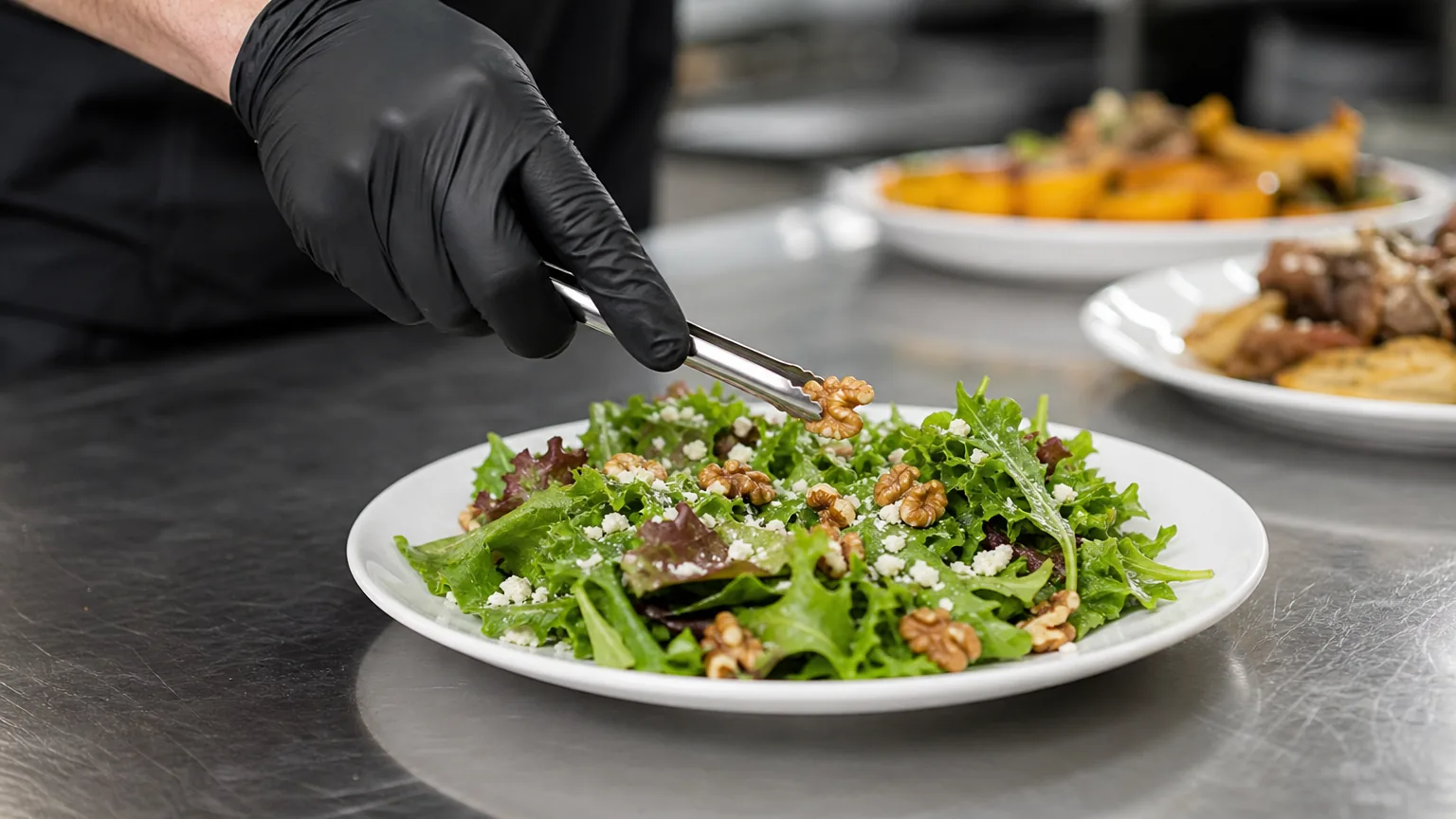
Staff surveys show why telling the server is not enough. In an earlier Mount Sinai survey of 100 restaurant and takeout workers, 72 percent said they were comfortable providing a safe meal for an allergic customer, and 70 percent were comfortable “guaranteeing” one. Yet 24 percent thought a small amount of an allergen would be safe, 35 percent believed fryer heat destroys allergens, and 25 percent thought taking the allergen off a finished meal, such as lifting off the nuts, made it safe. A telephone survey of 90 table-service restaurants in Brighton, England, found the same gap. There, 81 percent of staff were confident they could serve a safe meal, but only a third had any allergy-specific training, 21 percent thought removing the allergen from a finished dish would make it safe, and 12 percent did not know an allergic reaction could kill.
The kitchens themselves are rarely set up for allergy orders. When the CDC’s Environmental Health Specialists Network studied 278 US restaurants, fewer than half of managers (44.4 percent), food workers (40.8 percent), and servers (33.3 percent) had received any food allergy training. Only 19.1 percent of managers said their restaurant had a dedicated set of utensils or equipment for allergen-free food, and 7.6 percent had a separate area of the kitchen for preparing it. In the same project, more than 10 percent of managers and staff believed a person with a food allergy could safely eat a small amount of it.
A yes costs a busy server nothing in the moment. A no costs the restaurant a table and can bring a one-star review. Those incentives all push toward yes, which is why a yes, on its own, tells you so little.
Why a Refusal Usually Means Someone Checked
Saying no for a specific reason takes work. A kitchen has to know where its bread comes from, what its oil is made of, and where loose seeds and flour end up during a busy service. The Norwich reasons are the cross-contact routes a no-problem kitchen tends to miss: a bought-in product made alongside nuts, a shared cooking oil, an allergen that spreads across every surface. The UK’s Food Standards Agency (FSA) lists shared cooking oil among the ways allergens move between dishes, and our look at reused breading and shared fryers shows how much protein a single shared station can carry.
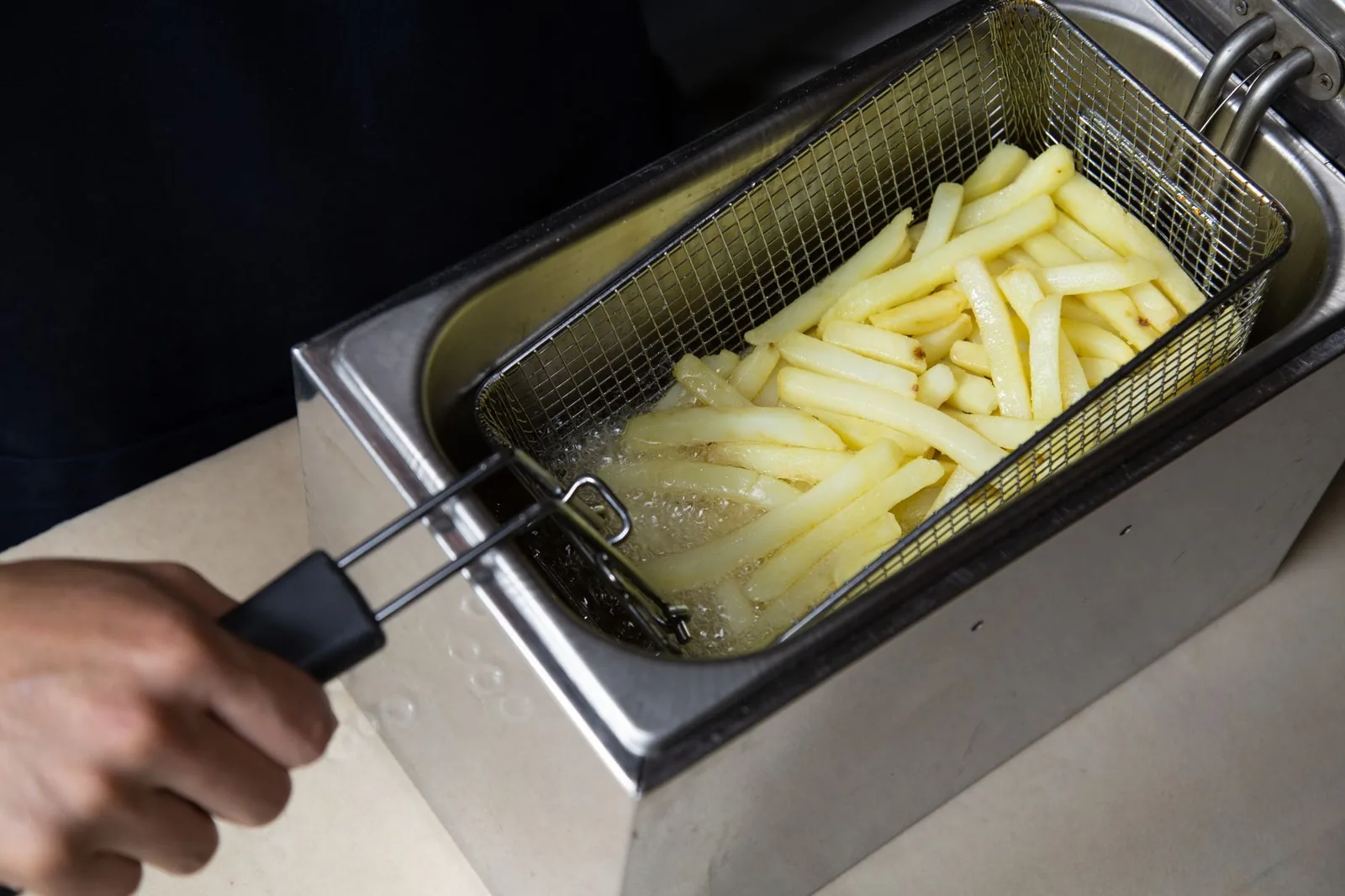
Some of those reasons may be stricter than the evidence requires. In a small double-blind study from 1985, seven people with a history of systemic reactions to soy ate commercial soybean oils without reacting. But a kitchen that errs toward caution is erring in the right direction, and it is not your job to talk it out of that.
Not every no tells you the same amount. A refusal with reasons (“our buns come from a nut bakery and sesame gets everywhere”) is a kitchen showing its work. A flat “we don’t do allergies” may reflect a real audit or plain reluctance, and you cannot tell which. Either way, take it at face value. And do not make the offer the nut-allergic reviewer made, to accept the risk yourself. Your consent does not change what is in the fryer, and a kitchen that has decided it cannot keep you safe is right not to take your word over its own.
The Sign-This-Waiver Moment
Between a refusal and an easy yes sits a third answer: we will serve you if you sign this. It is more common than many diners realize. The FSA commissioned Ipsos UK to survey 964 people affected by food allergy, intolerance, or celiac disease in England, Wales, and Northern Ireland over the winter of 2024 to 2025. In the previous six months, 13 percent of the adults had been asked to sign a disclaimer when eating out or ordering takeout, and 15 percent had been refused service. Among adults whose reactions are severe, the figures were 23 percent and 30 percent.
A waiver does less than it seems to. In the UK, the Consumer Rights Act 2015 says a business cannot use a contract term or notice to exclude or limit its liability for death or personal injury caused by negligence, and that agreeing to such a term does not, on its own, mean you accepted the risk. Scotland’s NHS children’s allergy network puts it more bluntly: restaurant disclaimers “have no legal basis,” and signed or not, the business still has a legal duty to prepare food safely. In the US the answer depends on state law, but courts may refuse to enforce a waiver that is overly broad, violates public policy, or tries to excuse gross negligence.
The legal question matters less than what the request tells you. A waiver manages the restaurant’s exposure, not yours, so answer it with a question: what will the kitchen do differently for this order? If the answer is specific (a cleaned grill, fresh oil, separate utensils, one cook preparing and plating your dish), the waiver is paperwork on top of a plan. If the answer is vague, the waiver is the plan, and you should eat somewhere else.
What the Rules Actually Require
In the UK, food businesses must tell you if any of the 14 regulated allergens is an ingredient in what they serve. For unpackaged food, that information can be written down, on a menu or chart, or given verbally as long as a visible written notice tells you to ask. What businesses do not have to do, as the FSA’s advice to consumers puts it, is “offer you an alternative meal to suit your need.” When cross-contamination cannot be avoided, the agency tells businesses to inform customers that they cannot provide an allergen-free dish. Read that way, the Norwich kitchen did what the guidance asks and moved the conversation to the booking stage. Since 2025, the FSA’s best-practice guidance has also recommended written allergen information supported by a conversation, though that remains guidance rather than law. Our guide to allergen labels around the world compares the UK’s 14 with the US list.
In the US, no federal law requires allergen information for restaurant meals. The packaged-food labeling law, FALCPA, does not apply to food a restaurant wraps or boxes in response to your order. What exists instead is a patchwork. The FDA Food Code, a model code widely adopted by state and local health agencies, expects the person in charge to be knowledgeable about food allergies, and its 2022 edition added a provision for telling customers in writing which major allergens are in unpackaged food. It binds only where a state or county has adopted that edition. Some states go further: since July 1, 2026, California has required chains with 20 or more locations to give written notice of the major allergens in each menu item, as our article on Disney’s tree nut menu change explains. None of these rules requires a kitchen to cook an allergen-free meal on request. They govern what staff should know and what you must be told.
How to Read the Answer You Get
Every response from a restaurant is evidence about its kitchen. Here is how to read the common ones.
- “No, and here is why.” The most useful answer you will get. The kitchen knows its ingredients and its limits. Believe it, thank them, and go elsewhere.
- “We don’t do allergies.” Honest, if not very informative. Do not argue, and do not push for an exception.
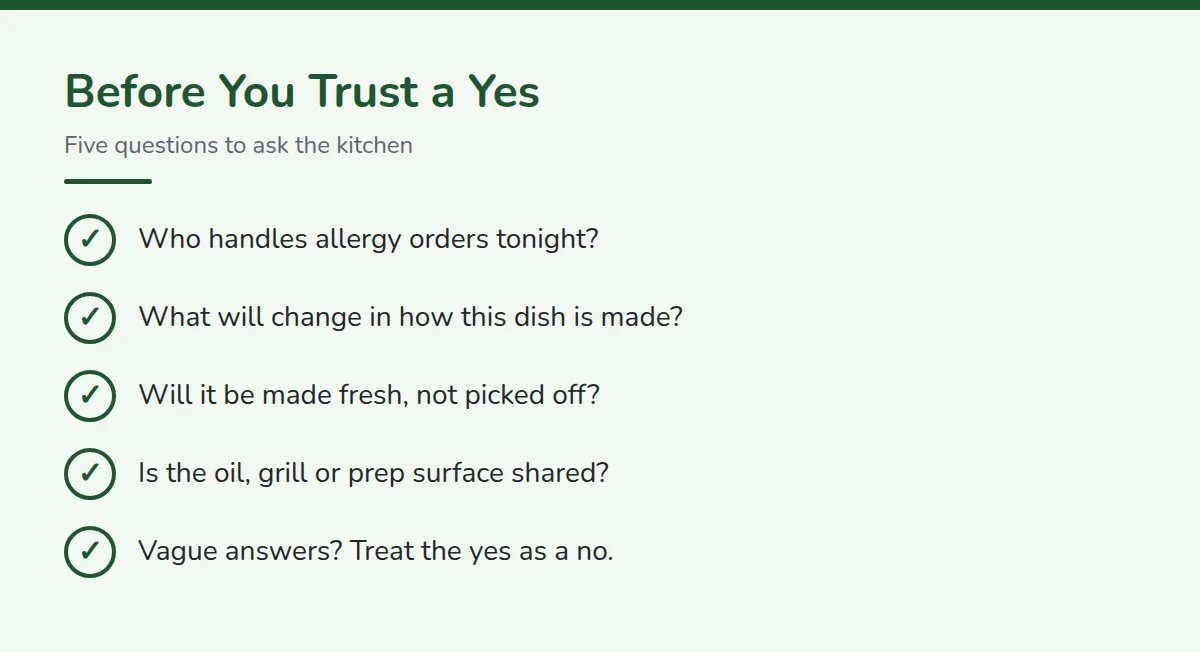
- “No problem!” with no questions back. The red flag. A kitchen that takes allergies seriously asks about yours: which allergen, how severe, whether traces matter. If nobody asks, ask them what will change in how the dish is made, and who will make it. If the answers are vague, treat the yes as a no.
- “We’ll just pick it off.” Leaving an ingredient out of a recipe can work. Removing it from a finished plate does not, because the protein stays behind. Ask for the dish to be made fresh, or order something else.
- “We can try, but we can’t guarantee anything.” Normal, and honest. No shared kitchen can promise zero cross-contact, and FSA guidance treats a free-from claim as a guarantee, so a kitchen that avoids that promise is being accurate, not evasive. What matters is the list of precautions that follows the caveat.
- “Sign this first.” Ask what the kitchen will change. A waiver without a plan is not a plan.
- A notes box on a delivery app. The weakest channel of all. When the Tarrytown student checked about 50 restaurants across a dozen towns in Westchester County, roughly 80 percent had no allergy features switched on across two major delivery platforms, leaving only the general order notes. Anaphylaxis UK advises phoning the business directly and never relying on notes or messages passed through third-party apps, which can be missed.
One positive sign is easy to test. In the CDC network’s study, managers, food workers, and servers all knew more about food allergies at restaurants that had a specific person to answer allergy questions or a plan for handling them. So ask who handles allergy orders tonight. A kitchen with a ready answer has thought about this before you walked in.
When the No Feels Personal
A refusal stings, and it falls hardest on the people with the most at stake. In the FSA survey, adults with severe reactions had been refused service at twice the overall rate, and adults under 35 reported it nearly twice as often as adults overall. Allergy UK’s chief executive told the BBC that many people with food allergies already choose not to eat out at all, because they worry their life could be at risk. Being turned away at the table, in front of friends, can feel like being told you do not belong.
Three habits take most of the sting out:
- Get the no on the phone, not at the table. The FSA’s advice is to check the menu online or call ahead and ask about the restaurant’s allergy policy before you go. A refusal on the phone is information. A refusal at the table is a scene.
- Hear the no as a description of the kitchen, not of you. “We can’t do it safely” is a statement about their bread, their oil, and their space.
- Keep a short list of kitchens that have earned your trust. Dedicated free-from kitchens take away most of the guesswork. At the fully gluten-free pizzeria and bakery in WDET’s report, the fear of cross-contamination is nearly eliminated. Restaurants that have answered your questions well before are worth going back to, and our travel playbook covers the chef cards that make each new conversation easier.
If a Yes Goes Wrong
If you react after a kitchen told you the food was safe, treat the reaction first. Use epinephrine at the first sign of anaphylaxis, such as trouble breathing, throat tightness, or symptoms in more than one part of the body, then call emergency services. Anaphylaxis UK advises carrying two in-date auto-injectors whenever you eat out, and our guide to anaphylaxis treatment covers the options.
Afterward, report what happened. In the UK, the FSA asks you to tell the business first and then, if you think further action is needed, the food safety team at the local council. Scotland’s children’s allergy network suggests freezing the food you were served, in case there is an investigation. In the US, report it to your local or state health department. Reports are how inspectors find the kitchens that say yes and change nothing.
The Bottom Line
A restaurant that refuses your allergy is telling you something true about its kitchen, usually after doing the checking that a casual yes skips. In a US registry study, more than half of restaurant reactions happened after the diner had told staff, so test every yes: ask what will change, who will make it, and whether the allergen will be left out rather than picked off. When the answers are specific, order. When they are vague, or arrive as a waiver instead of a plan, thank them and go somewhere that has earned your trust. If your allergies are severe, work out your own dining rules with your allergist, including which kinds of restaurants to skip entirely.
Further reading (sources)
- BBC News on the Norwich burger kitchen that turns away some allergy diners
- River Journal with a student’s restaurant reaction and his survey of delivery-app allergy settings
- WDET for celiac families on the obstacles of dining out
- Oriel and colleagues on how often restaurant reactions follow telling staff
- Ahuja and Sicherer with what restaurant workers believe about allergen safety
- Bailey and colleagues on staff confidence versus allergy knowledge in Brighton restaurants
- Radke and colleagues, food allergy knowledge and attitudes of restaurant managers and staff
- Centers for Disease Control and Prevention for restaurant food allergy practices at six US sites
- Bush and colleagues on soybean oil challenges in soy-allergic patients
- Food Standards Agency with its consumer advice on eating out with an allergy and its allergen guidance for food businesses
- Food Standards Agency and Ipsos UK on disclaimers, refusals, and near misses reported by allergic diners
- The National Archives for section 65 of the Consumer Rights Act 2015
- Children and Young People’s Allergy Network Scotland on restaurant disclaimers and reporting a reaction
- Legal Information Institute for when courts refuse to enforce a liability waiver
- U.S. Food and Drug Administration on why allergen labeling law skips food made to order and what the 2022 Food Code changed
- Anaphylaxis UK with its top tips for eating out