Wheat Allergy: The Complete Guide to Hidden Wheat, Exercise-Induced Reactions, and Why Gluten-Free Isn't Always Wheat-Free
Published on October 4, 2026

A new wheat allergy diagnosis usually arrives with a piece of advice that sounds efficient: just eat gluten-free. The aisles are stocked, restaurant menus flag the dishes, and the logic seems airtight, since gluten comes from wheat. It is close enough to be tempting and wrong enough to matter. A gluten-free claim is a celiac disease standard built around one family of wheat proteins. It can legally appear on a product made with wheat, and at the same time it strips out barley and rye, grains many wheat-allergic people eat without any trouble.
Wheat allergy is also more than one condition. The classic form shows up in babies and toddlers and is usually outgrown, though more slowly than families are often told. Another form appears in adults and only strikes when wheat is followed by a run, an aspirin, or a drink. A third arrives through the lungs, in bakeries and mills. This guide covers all of them, starting with the one most families meet first.
Three Conditions That All Get Called a “Gluten Problem”
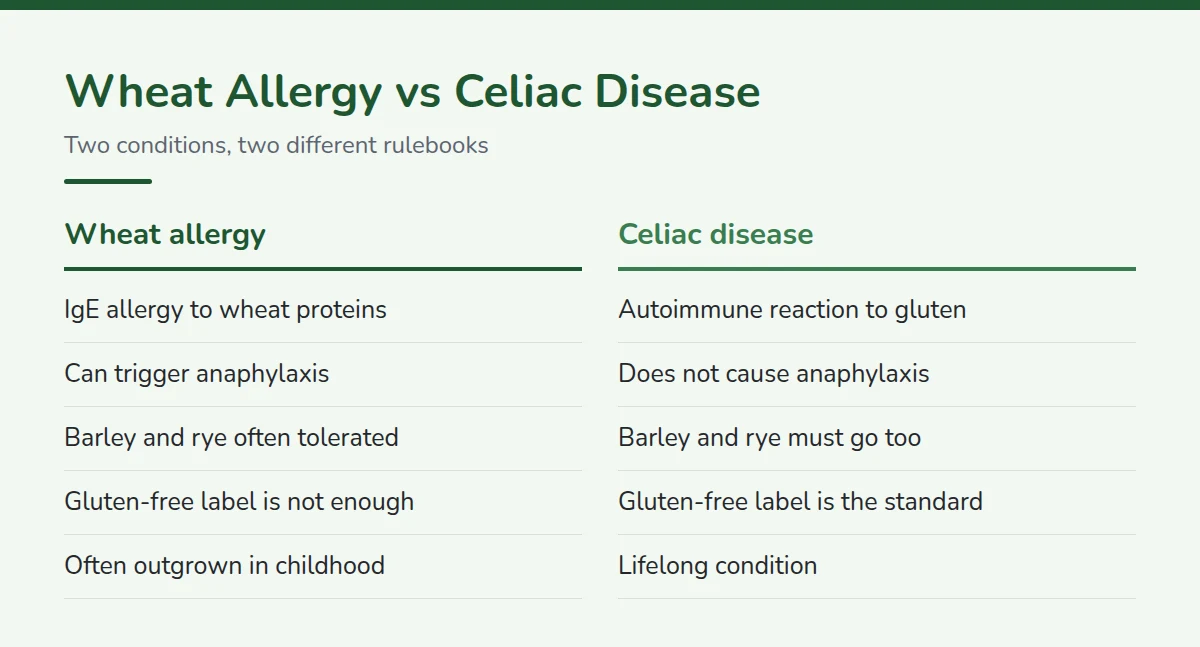
Wheat allergy, celiac disease, and gluten sensitivity get blurred together constantly, and the differences decide almost everything that follows.
- Wheat allergy is an IgE-mediated reaction to wheat proteins. Symptoms usually begin within minutes to a couple of hours of eating and can include hives, swelling, vomiting, stomach cramps, a runny nose, wheezing, and anaphylaxis. It is managed like any other food allergy: avoid wheat, and keep epinephrine within reach.
- Celiac disease is autoimmune. Gluten from wheat, barley, and rye sets off an immune attack on the lining of the small intestine. It does not cause anaphylaxis, but it does cause real damage, sometimes with few obvious symptoms, and it requires avoiding gluten down to trace levels. Our guide to gluten-free options for celiac and allergy households covers that diet in detail.
- Non-celiac gluten sensitivity describes people who feel unwell after eating gluten without the allergy antibodies or the autoimmune damage. The American College of Allergy, Asthma and Immunology is blunt about the terminology: there is no such thing as a gluten allergy, and a gluten intolerance is not an allergy and has no accurate diagnostic test.
Wheat can also drive conditions that do not run through IgE at all, most notably eosinophilic esophagitis, where it is one of the most common food triggers. Those are managed differently, usually with a gastroenterologist involved.
The practical point for the rest of this guide: if your diagnosis is an IgE wheat allergy, the celiac rulebook is the wrong tool. It is too loose for you in one direction and too strict in the other.
Why a Gluten-Free Label Is Not a Wheat-Free Promise
Start with what “gluten-free” means on a US package. Under the FDA’s 2013 rule, a food can carry the claim if any unavoidable gluten stays below 20 parts per million and it contains no gluten grain and no unprocessed ingredient made from one. Then the rule makes an exception. An ingredient derived from wheat that has been processed to remove gluten is allowed, and the regulation’s own example is wheat starch, as long as the finished food still comes in under 20 ppm.
Allergen labeling law treats that ingredient differently. Wheat starch is still a wheat ingredient, so the package still has to declare wheat. The FDA resolved the collision with a required disclaimer: when a gluten-free food lists wheat in its ingredients or in a “Contains” statement, the word must carry an asterisk (or another symbol) pointing to this exact sentence:
The wheat has been processed to allow this food to meet the Food and Drug Administration (FDA) requirements for gluten-free foods.
If you see that sentence, you are holding a wheat product with a gluten-free claim on it. The FDA’s own worked example is soy sauce made with wheat that has been processed to remove gluten, which can be labeled gluten-free and must carry the disclaimer at the same time.
Why would a wheat-allergic person care if the gluten is gone? Because the 20 ppm standard measures gluten and nothing else, and wheat allergy is not limited to gluten proteins. In a study of 22 wheat-allergic patients from Italy, Denmark, and Switzerland, most of them confirmed by double-blind food challenge, the most important wheat allergens were the alpha-amylase/trypsin inhibitors, which turned up in all three of wheat’s main protein fractions, including the one that is not gluten. A lipid transfer protein from that non-gluten fraction mattered too, mainly in the Italian patients. Whether any particular wheat starch product is tolerable for you is a question for your allergist, and a gluten test cannot answer it.
Travel adds a wrinkle. Coeliac UK says that foods containing wheat starch and labeled gluten-free are suitable for all people with coeliac disease. That is true for coeliac disease and says nothing about wheat allergy, so abroad, read for the word wheat, which European and UK rules require to be emphasized in the ingredient list. Our comparison of allergen labels around the world explains how that works.
The gluten-free rulebook is also too strict for most wheat allergies. It removes barley, rye, and any oats that are not certified, and many people with a wheat allergy can eat barley and rye safely. The reverse matters if someone in the house has celiac disease: “wheat-free” is not gluten-free, because US allergen law names wheat, not gluten grains, so barley malt or rye flour can sit in a wheat-free product with no allergen flag.
Where Wheat Hides
On FDA-regulated packaged food, wheat has to be named in plain English, either in parentheses after the ingredient, as in “flour (wheat),” or in a “Contains” statement. What catches people is how broadly the FDA defines it. For labeling purposes, wheat means any species in the genus Triticum, and the agency’s list includes common wheat, durum, club wheat, spelt, semolina, einkorn, emmer, Khorasan, and triticale, a wheat and rye hybrid. Ancient grains marketed as older or gentler strains are still wheat.
Ingredient names worth memorizing, drawn from FARE’s list: bread crumbs, bulgur, couscous, cracker meal, durum, einkorn, emmer, farina, farro, freekeh, graham flour, hydrolyzed wheat protein, matzo, seitan, semolina, spelt, sprouted wheat, triticale, vital wheat gluten, wheat berries, wheat bran, wheat germ, wheat germ oil, wheatgrass, and wheat starch.
Then there are the foods where wheat is doing a job you would not guess. FARE flags breaded and batter-fried foods, sauces, soups, salad dressings, imitation crab, sausages, hot dogs, processed meats, candy, ice cream, potato chips, rice cakes, spice blends, beer, and many Asian dishes, where soy sauce is usually brewed with wheat.
Three places the plain-English rule does not reach:
- Meat, poultry, and egg products regulated by the USDA, and beer and other alcohol regulated by the Alcohol and Tobacco Tax and Trade Bureau. The FDA’s allergen labeling requirements do not apply to them, which is why sausages, deli meats, and beer deserve a closer read.
- Unpackaged food. Bagels in a bin, pastries on a tray, and the bakery case may carry no allergen information at all. Ask, and ask to see the ingredient list the store keeps behind the counter.
- Things that are not food. Play dough and modeling clay, along with cosmetic, hair, and bath products, can contain wheat, and both FARE and ACAAI call them out. A toddler’s hands travel from the dough to the mouth in seconds.
School is where those collide: play dough, pasta art, papier-mâché paste, and the class baking project. Name them in the school plan, and when the class leaves the building, our field trip planning playbook covers the food stop and the chaperone briefing.
In restaurants, ask about wheat, not gluten. “Wheat allergy” tells the kitchen which ingredient matters and that the risk is an allergic reaction, where “gluten-free” can be heard as a preference. Then ask about shared surfaces. FARE’s example is the flattop grill: the surface that cooked French toast at breakfast carries egg, milk, and wheat protein into lunch unless it is properly cleaned.
Testing: Why a Positive Wheat Result Is Not a Diagnosis
Wheat is one of the foods where testing misleads most often, and there is a botanical reason: wheat is a grass. In a Johns Hopkins study of 145 children assessed with skin prick tests and food challenges, children with grass pollen allergy alone made antibodies that bound cereal grains in the lab, yet only 21 percent of the whole group had symptoms when they actually ate a grain under observation. Of those, 80 percent reacted to only one grain, and the authors concluded that removing every grain from a grain-allergic child’s diet was unwarranted.
That is why the reference test is an oral food challenge, done in an allergist’s office or a challenge center where a reaction can be treated immediately. A skin or blood test is a starting point, not a verdict.
Component testing sharpens the picture. The best known wheat component is omega-5 gliadin, also called Tri a 19. In a Finnish study of 40 children, 16 of the 19 who reacted immediately during a wheat challenge had IgE to omega-5 gliadin, and none of the children with delayed or negative challenges did. It is also the key marker for the adult exercise form described below. Ask your allergist whether it fits your situation.
What testing should never be is a mail-order IgG panel. Those kits report “sensitivities” to wheat in people who eat it every day without a problem, and they cannot diagnose an allergy. Our breakdown of why at-home sensitivity tests are not allergy tests explains the difference.
Safe Grain Swaps, and the Barley Question
The upside of a wheat allergy, compared with celiac disease, is that the list of usable grains is long. Rice, corn, oats, quinoa, buckwheat, millet, sorghum, teff, amaranth, and tapioca are all naturally wheat-free, along with flours made from chickpeas, potatoes, and nuts if those are safe for you.
FARE includes barley and rye in its list of grains to look for, and says wheat-allergic patients are rarely allergic to other common grains, with barley as the occasional exception. ACAAI is more cautious: many people with wheat allergy can eat other grains, but not everyone. So treat barley and rye as an allergist question rather than a default in either direction. If they are cleared, they open up rye bread, barley soups, and malted foods that a strict gluten-free diet would take away for no reason.
Three cautions:
- Oats are wheat-free by nature but are routinely grown, harvested, and milled alongside wheat. Certified gluten-free oats exist to solve exactly that problem, and they are the safer buy for a wheat allergy too.
- Buckwheat is not wheat, despite the name, but it is an allergen in its own right, important enough that Japan requires it on food labels.
- Gluten-free breads and baking mixes are the easiest wheat-free shortcut, as long as you still read for the word wheat on every package, every time.
For baking, a blend of rice flour, a starch such as tapioca or potato, and a binder such as xanthan gum or psyllium husk does most of the work wheat flour used to do.
Outgrowing It, and Where Treatment Stands
The best long-term data come from a Johns Hopkins study that followed 103 children with wheat allergy. Resolution reached 29 percent by age 4, 56 percent by age 8, and 65 percent by age 12, and the median age of resolution was about six and a half. Higher wheat IgE levels predicted a slower course, but plenty of children outgrew the allergy even from the highest levels, and a significant minority were still allergic as teenagers.
Two caveats apply. That was a referral population, which tends to skew toward harder cases. And resolution was confirmed by food challenge, which is how your allergist will confirm it too. Retesting on a schedule, then a supervised challenge when the numbers fall, is the path. A trial piece of toast at home is not.
Heat does not open an early door the way it sometimes can for egg. In the European study above, the key wheat allergens were present in raw and cooked wheat alike, and all of them resisted heat.
On treatment, wheat oral immunotherapy is still a research tool. In a multicenter trial of 46 patients, about half of those on vital wheat gluten OIT could eat a large dose of wheat protein after one year, against none on placebo. After two years, 30 percent were desensitized to an even larger dose, and 13 percent stayed protected 8 to 10 weeks after stopping therapy. Omalizumab, an anti-IgE biologic, is FDA approved to reduce reactions from accidental exposure in IgE-mediated food allergy, alongside avoidance rather than instead of it. Our 2026 guide to auto-injectors and immunotherapy compares the options.
Whatever the stage, epinephrine is the treatment for anaphylaxis. Antihistamines may ease skin symptoms, but they must never delay the injection.
Wheat-Dependent Exercise-Induced Anaphylaxis: The Adult Form
Not every wheat allergy begins in a high chair. Wheat-dependent exercise-induced anaphylaxis, usually shortened to WDEIA, is a rare but potentially severe form that often appears for the first time in adulthood, in people who have eaten bread all their lives. Its defining feature is that wheat alone usually does nothing. Australia’s clinical allergy society notes that in most people with confirmed WDEIA, wheat eaten without exercise or another cofactor within two to four hours does not cause symptoms. The reaction comes when wheat meets a cofactor, and exercise is the classic one.

That pattern makes it slow to diagnose. Someone eats a sandwich at lunch, goes for a run, and breaks out in hives or collapses. The next day the same sandwich at a desk causes nothing. It is easy to blame the run and miss the wheat. In a UK study of 132 adults with the condition, 40 percent waited one to five years for a diagnosis and 29 percent waited more than five. The most common cofactors were exercise (80 percent), alcohol (25 percent), and anti-inflammatory painkillers such as aspirin and ibuprofen (9 percent), and 11 percent had no identifiable cofactor at all. The authors recommend omega-5 gliadin testing for every adult with anaphylaxis of unclear cause.
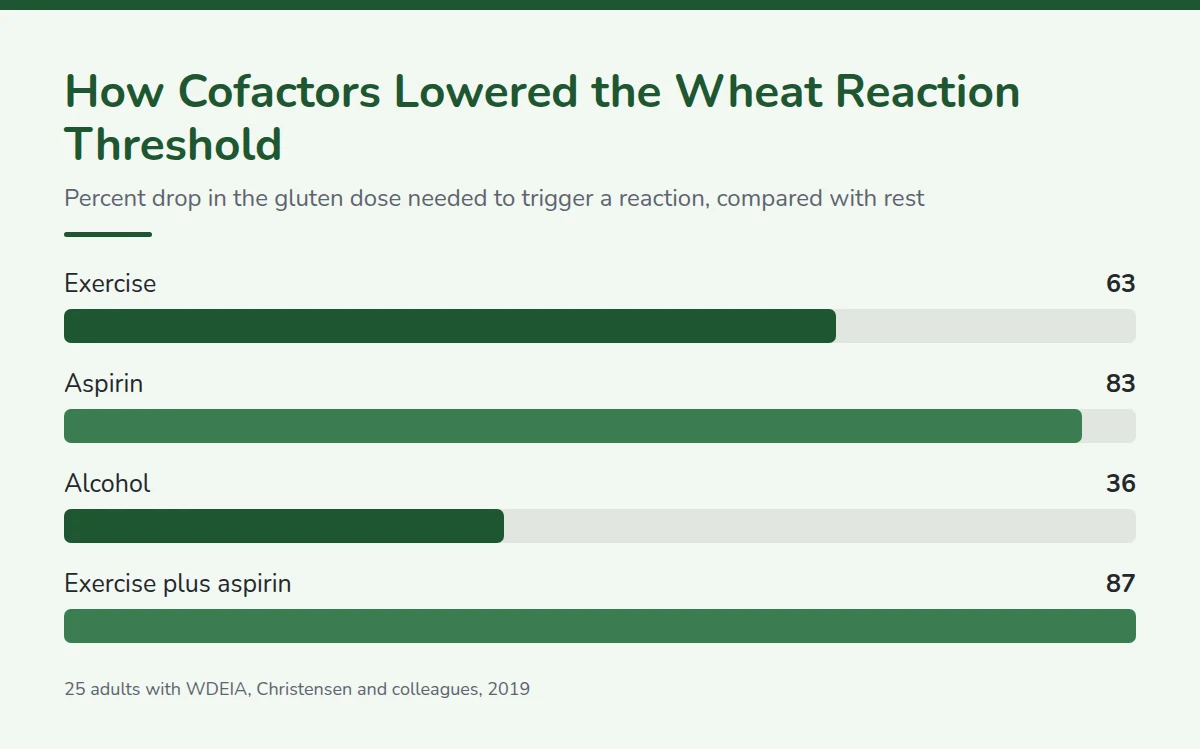
A Danish prospective study put numbers on the cofactors. Researchers challenged 25 adults with WDEIA using gluten, at rest and with each cofactor. Exercise lowered the dose needed to trigger a reaction by 63 percent, aspirin by 83 percent, and exercise and aspirin together by 87 percent. Alcohol lowered it by 36 percent, with less consistent results. Reactions with exercise were more severe, too. And 48 percent of the patients reacted to gluten at rest with no cofactor at all, at higher doses, which is a useful warning against treating wheat as harmless on a rest day.
Management is a plan you make with your allergist. Australia’s clinical allergy society advises keeping at least four hours between eating wheat (including spelt, triticale, and semolina) and exercising, carrying adrenaline and an anaphylaxis action plan at all times, and it adds heat, such as hot baths or hot weather, to the list of cofactors. In the UK cohort, patients who followed a gluten-free diet and those who avoided wheat around exercise saw the biggest drops in later reactions, 67 and 69 percent respectively. This is the one place in this guide where a gluten-free diet is the right tool, because the main culprits are gluten proteins and the reactions in the Danish study took grams of gluten, not traces. Even so, about a third of the UK patients kept reacting despite dietary advice, which is why the epinephrine prescription is not optional.
When Wheat Gets In Through the Skin or the Lungs
The gut is not the only way to become allergic to wheat. Japan offers the clearest example of the skin route. A facial soap containing 0.3 percent hydrolyzed wheat protein was linked to a nationwide outbreak, and a 2012 to 2014 survey confirmed 2,111 patients, 2,025 of them women, none of whom had shown a wheat allergy before using the soap. Symptoms typically started about a year after they began using it. A quarter of the patients went into anaphylactic shock, and most of those with food reactions went on to react to ordinary bread and pasta. Sales of the soap ended in May 2011, yet a follow-up of 110 patients found only 56.1 percent in remission five years after they stopped using it.
The lesson for US readers: hydrolyzed wheat protein turns up in shampoos, conditioners, and skin care, and cosmetics fall outside food allergen labeling law. It appears on cosmetic labels under its ingredient name, so a wheat-allergic household reads those labels too.
The lungs are the third route. Baker’s asthma, a form of occupational asthma caused by breathing in flour, is a common work-related allergic disease. A review of grain-induced asthma lists bakers, confectioners, pastry factory workers, millers, farmers, and grain handlers as the main groups at risk, and notes that fungal alpha-amylase, an enzyme added to baking flour, is an important trigger alongside the grain proteins themselves. Removing the worker from exposure is the cornerstone of treatment.

Here is the surprising part: people with baker’s asthma can often eat bread without trouble. A Spanish hospital reported that all 135 of its asthmatic bakers tolerated eating it. Becoming sensitized by breathing and becoming sensitized by eating are different routes to different diseases, so a baker with flour-triggered asthma does not automatically need a wheat-free diet, and a plan written for one form of wheat allergy does not transfer to another.
What to Do This Month
- Get the diagnosis named precisely. IgE wheat allergy, celiac disease, WDEIA, and baker’s asthma follow different rules. If a doctor said “gluten,” ask which condition they mean.
- Ask about component testing. Omega-5 gliadin testing is worth raising for a child with immediate reactions and for any adult whose reactions follow exercise, painkillers, or alcohol.
- Read for the word wheat, not the word gluten. A gluten-free claim does not end the label check, and the asterisk sentence about wheat processed to meet FDA gluten-free requirements means the product contains wheat.
- Learn the aliases. Spelt, farro, einkorn, emmer, Khorasan, durum, semolina, triticale, seitan, bulgur, and couscous are all wheat.
- Ask about barley, rye, and oats. Most wheat-allergic people do not need to avoid every grain, and the answer decides how much of the gluten-free aisle you actually need.
- Fill two epinephrine devices and write the plan down. For WDEIA, put the four-hour gap between wheat and exercise, and the painkiller rule, into the action plan itself.
- Check the non-food list. Play dough at daycare, wheat protein in shampoo, craft paste at school.
- Retest on a schedule. Most children outgrow wheat allergy, slowly, and supervised testing is the only way to catch it.
Wheat is the allergen most often handed the wrong rulebook. Gluten-free shopping is a useful shortcut for a wheat-allergic family as long as the label check still runs for the word wheat, on every package, every time. The rest is the same unglamorous work as every other allergen: name the diagnosis precisely, read the panel, ask the specific question, keep the epinephrine close, and let the allergist rather than the kitchen decide the next step.
Further reading (sources)
- U.S. Food and Drug Administration on gluten-free claims for foods made with processed wheat, soy sauce included
- 21 CFR 101.91 for the gluten-free rule and its required wheat disclaimer
- FDA guidance for industry with which grains count as wheat, and which foods sit outside allergen labeling
- Food Allergy Research and Education on wheat ingredient names, unexpected sources, and other grains
- FARE for how shared grills and fryers spread allergens in restaurant kitchens
- American College of Allergy, Asthma and Immunology covering wheat allergy symptoms, testing, and the gluten allergy myth
- Coeliac UK on gluten-free foods made with wheat starch
- Australasian Society of Clinical Immunology and Allergy with practical rules for wheat-dependent exercise-induced anaphylaxis
- Keet and colleagues for how many children outgrow wheat allergy, and when
- Jones and colleagues on why a positive grain test rarely means every grain must go
- Palosuo and colleagues with the wheat protein behind immediate reactions in young children
- Pastorello and colleagues for the heat-resistant wheat allergens beyond gluten
- Nowak-Węgrzyn and colleagues reporting the results of a vital wheat gluten oral immunotherapy trial
- Kennard and colleagues on years-long diagnosis delays in adults with the exercise form
- Christensen and colleagues for how exercise, aspirin, and alcohol lower the reaction threshold
- Yagami and colleagues with the soap that sensitized more than 2,000 people to wheat
- Quirce and Diaz-Perales on which workers develop flour-triggered asthma, and why
- Armentia and colleagues for the 135 asthmatic bakers who still ate bread