Field Trips With Food Allergies: A Planning Playbook for Parents, Teachers, and Chaperones
Published on September 20, 2026
The Day the Protocol Leaves the Building
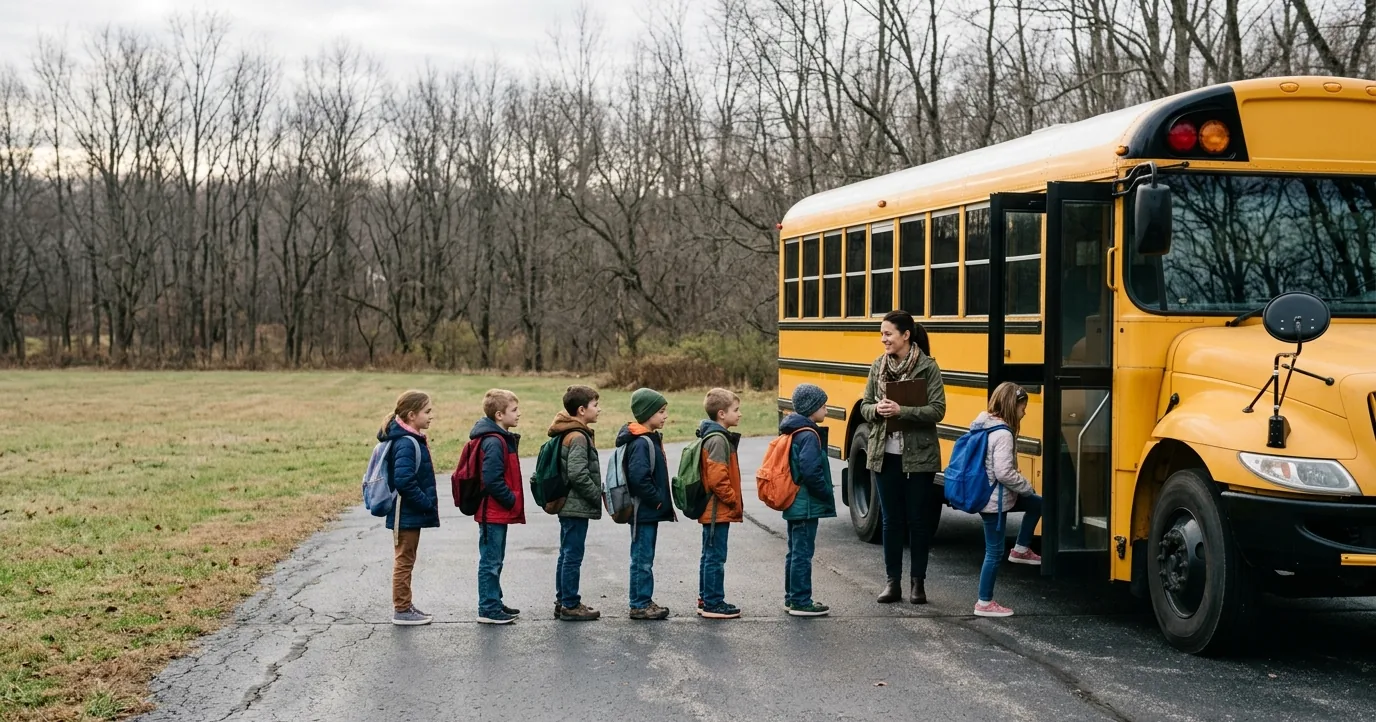
A school building is the one place where a food allergy plan has actual infrastructure behind it. There is a nurse with a name and an office. There is a cabinet where the auto-injectors live. There are teachers who sat through training in August and a kitchen that has been fielding allergy questions since kindergarten. Then a bus pulls up at seven in the morning, forty children climb aboard with sack lunches, and every one of those supports stays behind in the parking lot.
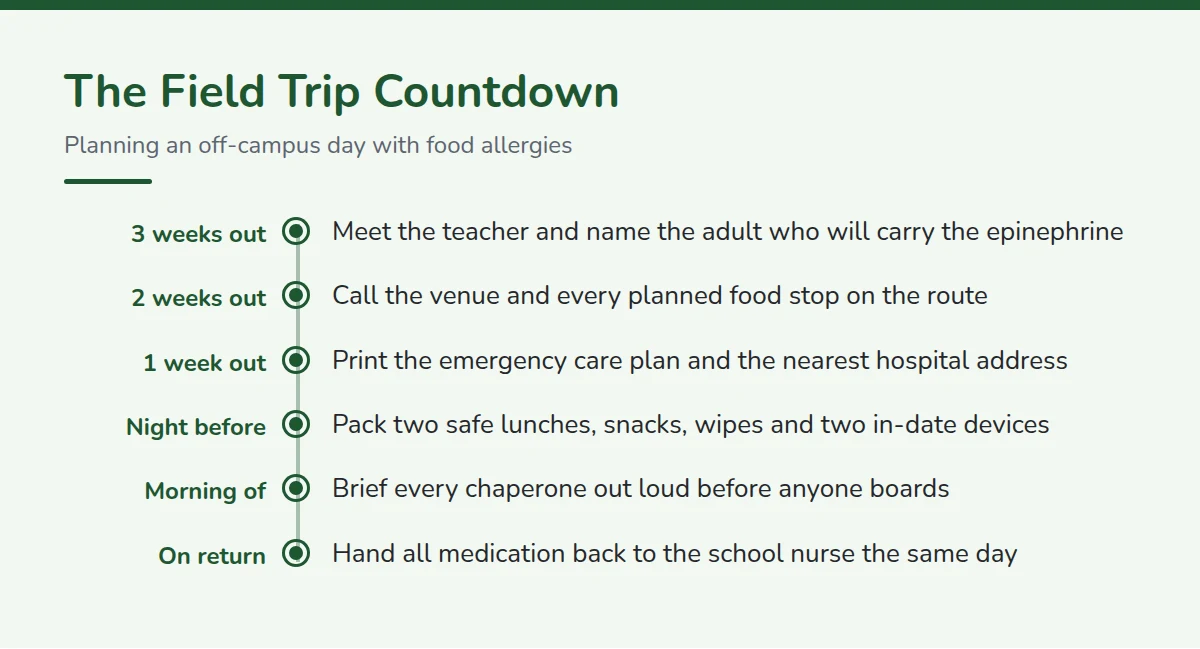
That is why field trips generate more parental dread than any other school day, and the dread is not irrational. It is a correct reading of the situation. The fix is not to keep your child home. It is to rebuild the missing pieces deliberately, in the three weeks before the bus leaves, so that the off-campus day has a named adult, a named device, and a named plan instead of a hope that nothing happens.
The Trip Is Inside the Plan, but the Stock Supply May Not Be
Start with the reassuring part. In February 2024 the U.S. Department of Education’s Office for Civil Rights published a fact sheet on Section 504 protections for students with food allergies, and it names field trips explicitly. Among the modifications a school may be required to provide, the document lists ensuring that eating and learning environments are free of food allergens, “including during field trips and extra-curricular activities where possible.” It also states that schools may need to permit students capable of carrying and using an auto-injector to do so “at school and during school-related events.” A field trip is not a gap in the law. If your child has a 504 plan, it travels.
What does not reliably travel is the school’s undesignated epinephrine. A national review of state stock epinephrine statutes by Volerman and colleagues, published in the Journal of School Health, found that 14 states mandate stock epinephrine in schools while 37 merely permit it, and more to the point, that the laws are written with a geography. Of the 31 states that specify where the policy applies, 28 say “on school property.” Only 21 extend to school-sponsored events. A handful go further and say so out loud: Texas covers a student while in transit to or from a school event, and Vermont names school-provided transportation.
Read that carefully, because it is the single most important thing on this page. In a majority of states, the spare device in the nurse’s cabinet is a school-property medication. Once the bus clears the driveway, the only epinephrine that certainly exists is the epinephrine somebody physically brought. That matters beyond your own child, too. In a 2025 review of food allergy management in K-12 schools, Hoyt and colleagues note that roughly a quarter of school-based anaphylaxis happens in students with no previously known allergy, which is the entire argument for stock supply in the first place.
Three Weeks Out: The Conversation With the Teacher
The CDC’s field trip checklist for teachers and paraeducators is short enough to read aloud, and it is the right agenda for this meeting. It asks the teacher to determine whether the destination is safe for students with food allergies, to tell the school nurse ahead of time, to carry emergency care plans and emergency contact information along with the medication, to know where the nearest emergency medical facility is, and to confirm with the nurse or administrator that a staff member trained to give epinephrine will be on the trip.
Your job in that conversation is to turn each of those into a name. Not “a trained adult will have it” but “Ms. Alvarez has it, in her backpack, and she does not hand it to anyone.” Not “we will find a hospital if we need one” but the actual name of the hospital nearest the venue, written on the emergency care plan. Roles get reassigned on the morning of a trip. Names get remembered.
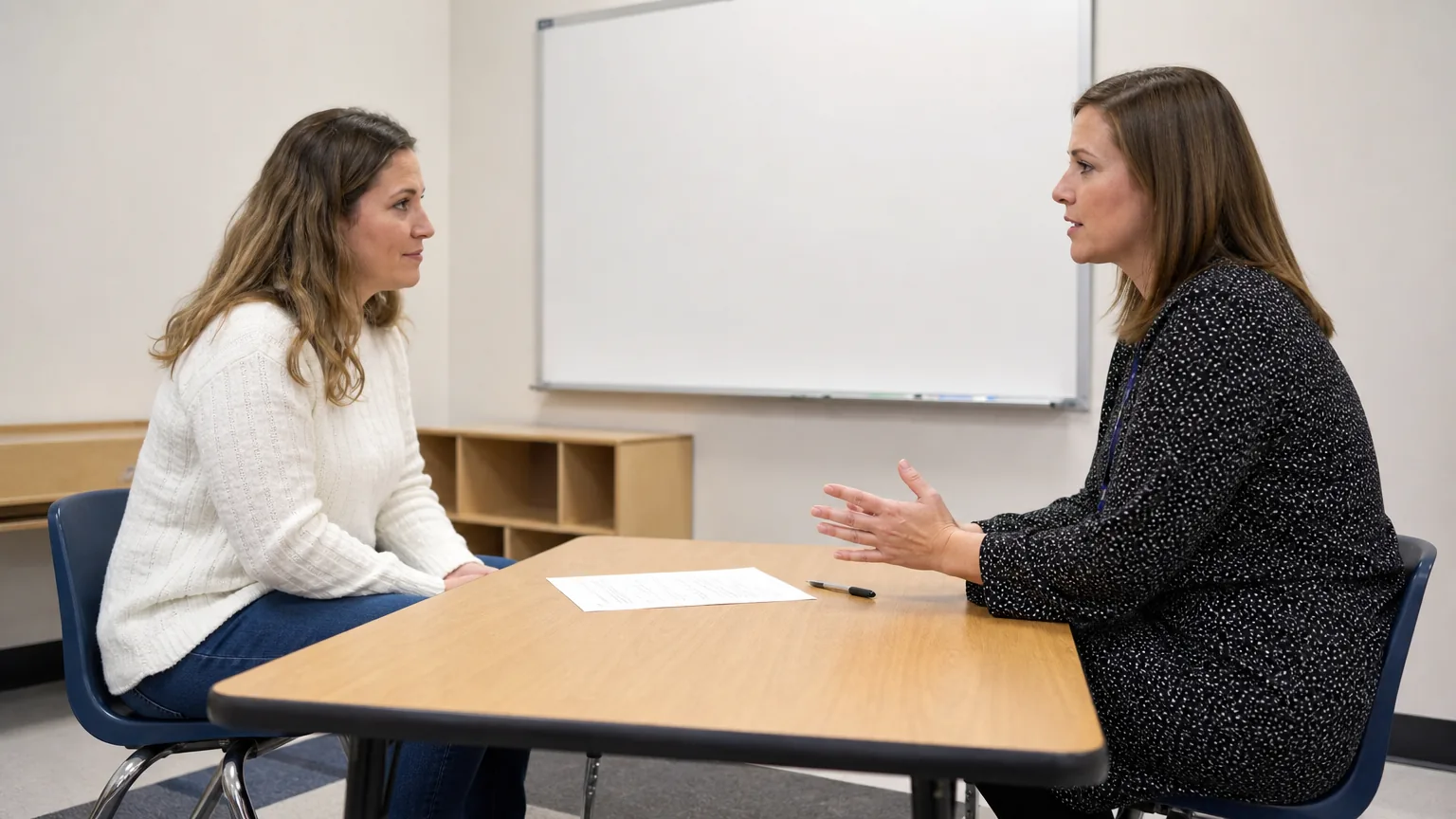
If the school pushes back on any of this, the useful move is rarely to escalate. It is to offer the checklist. Most elementary teachers have never been walked through a field trip protocol and are relieved when someone hands them one.
Epinephrine Custody: Name a Person, Send Two Devices
The CDC is unambiguous about who holds the medication off campus: “Only a trained staff member or parent of an individual student should carry and administer emergency medication on field trips.” A student old enough to self-carry should still have a backup in an adult’s hands, because the failure mode on a field trip is not a missing device, it is a device in a jacket left on the bus.
Two devices go, not one. In a systematic review and meta-analysis of more than 36,000 anaphylaxis cases, Patel and colleagues found that 7.7 percent of reactions were treated with more than a single dose of epinephrine, with the rate climbing higher in healthcare-treated food reactions. On a day when the ambulance may be twenty minutes out on a rural road, a second dose is the difference between managing a reaction and waiting through one.
Heat comes up constantly, usually as a reason to lock the device somewhere. The evidence does not support the panic. A systematic review by Parish and colleagues in Annals of Allergy, Asthma and Immunology found that heat degraded epinephrine only with prolonged exposure, that constant heat did worse than fluctuation, that freezing produced no significant degradation, and that no study of real-world temperature swings detected meaningful loss. The practical translation: a device riding in a chaperone’s shaded backpack is fine. A device left on a parked bus in August sun for six hours is the scenario worth avoiding, and it is avoidable simply by keeping the bag with the adult.
One last piece the CDC checklist gets right and almost every school forgets: the medication goes back to the nurse the moment the trip ends. Devices that spend the weekend in a teacher’s tote are devices nobody can find on Monday.
Vetting the Destination and the Food Stop
The venue is usually the easy part. The food is not. A museum cafeteria, a highway service plaza, a concession stand at a state park, and the pizza that somebody’s parent surprises the class with on the way home are four different risk profiles, and only one of them was on the permission slip.
FAACT’s guidance is to call every destination in advance, including travel stops and restaurants, and to plan the trip around avoiding high-risk locations in the first place. That call is worth making, but set expectations honestly. The 2022 FDA Food Code requires the person in charge of a food establishment to demonstrate knowledge of the nine major food allergens and the symptoms of a reaction, and sesame joined that list effective January 2023. That is a real floor, and it is a floor that sits under one person on one shift, not under the sixteen-year-old working the fryer at 11:40 on a Tuesday.

So the default should be food from home, every time, for the allergic student: a packed lunch, a packed backup lunch in a different adult’s bag, and enough safe snacks that nothing offered on site is tempting. Where a venue meal is unavoidable, the ordering approach is the same one that works on vacation, which our 2026 travel playbook walks through in detail, chef cards included. And if the concern is celiac rather than IgE allergy, it is worth knowing what the cross-contact measurements actually found in shared toasters, shared utensils, and food service kitchens, because the answer changes which fights are worth picking at a buffet line.
The Chaperone Briefing That Actually Works
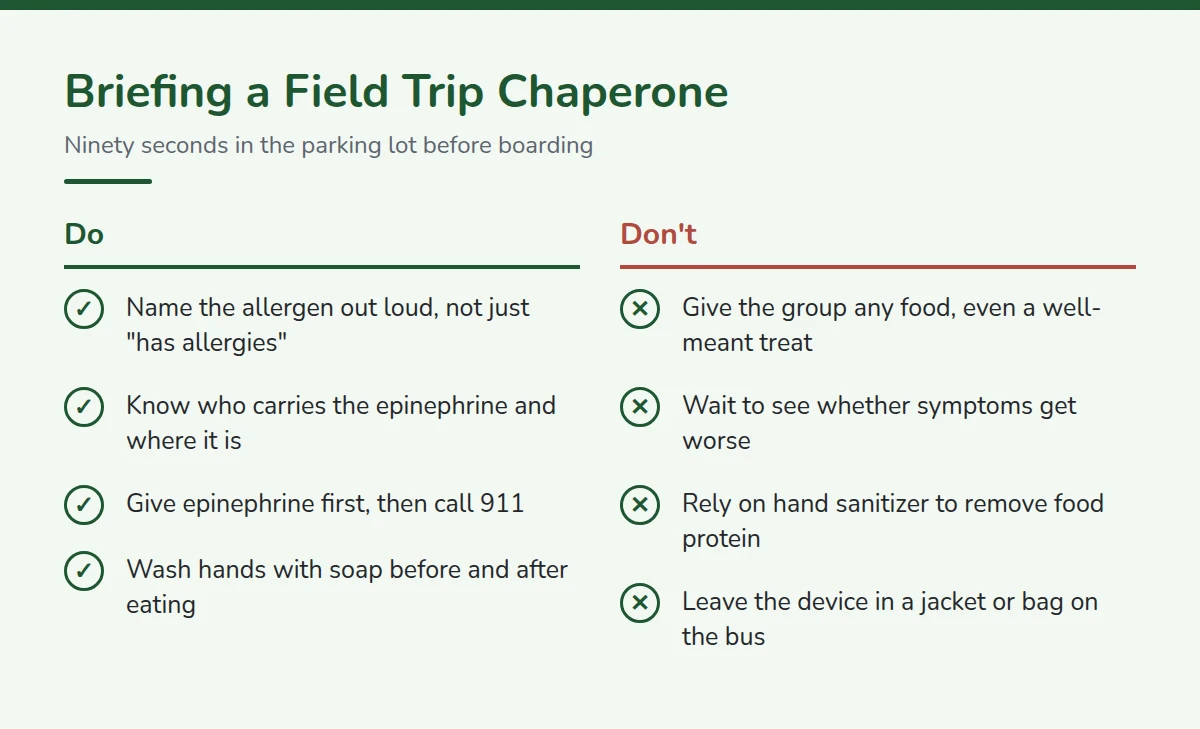
Chaperones are volunteers. Many have never been told anything. A ninety-second briefing, delivered in the parking lot before boarding, covers more ground than any handout:
- Name the allergen out loud. “Jamie is allergic to peanuts and tree nuts.” Not “has allergies.”
- Name the device and its location. “The epinephrine is in this front pocket. It stays on my body all day. If I am not with the group, it is with Ms. Alvarez.”
- Give the rule, not the reasoning. Hives plus any trouble breathing, swallowing, or a change in voice means epinephrine first and 911 second, with no waiting to see whether it progresses. Hesitation is the documented failure, not the device, which is the whole argument in our piece on why children do not get epinephrine in time.
- No food from anyone, including you. FAACT’s field trip guidance leans on a no food or beverage sharing policy and on handwashing with soap before and after eating, using wipes when there is no sink. Hand sanitizer does not remove food protein from skin.
The fourth point is where trips actually go wrong. A well-meaning adult buying the whole group ice cream is a more common exposure route than a contaminated exhibit.
On the Bus
Transportation is the leg with the least supervision and the most sugar. FAACT recommends that districts enforce a no food or beverage policy on buses, that drivers and attendants never hand out food or candy, that all drivers, attendants, and substitutes complete annual food allergy and anaphylaxis training, that emergency plans for students with life-threatening allergies be provided to transportation staff, and that every transport carry a communication device tested before departure.
Ask for two things specifically. First, that the driver has the emergency care plan in hand rather than filed at the depot. Second, that the phone or radio was checked that morning. A trip that loses its comms on a highway shoulder has lost the ability to call for help, and that is the only part of the day that cannot be improvised.
Should You Tag Along?
FAACT states the principle cleanly: encourage, but do not require, parents and guardians of food-allergic students to accompany their child on school trips. The distinction is not a courtesy. A school that makes your attendance the condition of your child’s participation has quietly converted an accommodation into an exclusion, and that is precisely the arrangement Section 504 exists to prevent. If a school says your child can only go if you go, that is a conversation for the 504 coordinator, not a scheduling problem, and our guide to how a 504 plan should change as a child grows covers the document that binds it.
Going yourself is reasonable when the trip is the first of the year, when it is overnight, when the destination has unavoidable food service, or when your child is young enough that no chaperone ratio will produce real supervision. It is a poor idea when it is substituting for staff training the district owes anyway, or when a capable eleven-year-old would benefit more from a day of running their own protocol than from having you three feet away. A generation of allergic teenagers has to eventually manage this alone. The trips are the practice.
What Goes In the Bag
- Two auto-injectors, in date, in an adult’s bag that never leaves their body, plus the student’s own if they self-carry.
- A printed emergency care plan, signed, with the allergens, symptoms, and dosing on one page any adult can follow in ninety seconds.
- Emergency contact numbers on paper, not only in a phone.
- The address and phone number of the nearest emergency department to the venue.
- Antihistamine if prescribed, clearly marked as the second-line medication it is.
- A full safe lunch plus a spare safe lunch, safe snacks, and a drink.
- Wipes for hands and for the table or bus seat.
- A reminder note to the teacher: all medication returns to the nurse on arrival back at school.
Field trips are not the day to improvise, and they are also not the day to opt out. Build the plan three weeks early, put a name on every piece of it, and the bus becomes an ordinary bus again. If your child’s allergies are severe or newly diagnosed, work the specifics through with your allergist rather than with a checklist alone, including whether a nasal option or a second device style belongs in the bag.
Further reading (sources)
- U.S. Department of Education Office for Civil Rights on what Section 504 requires when a student has a food allergy
- Centers for Disease Control and Prevention with the field trip checklist written for teachers and paraeducators
- FAACT for what trip coordinators and chaperones should have in place before departure
- FAACT — training and no-food rules for bus drivers and transportation staff
- Volerman and colleagues on how far state stock epinephrine laws actually reach
- Patel and colleagues for how often one dose of epinephrine is not enough
- Hoyt and colleagues with what food allergy management in K-12 schools looks like in 2025
- Parish and colleagues — what heat and cold actually do to stored epinephrine
- U.S. Food and Drug Administration on the allergen knowledge the 2022 Food Code puts on the person in charge
- Allergic Living for a parent’s view on turning down the field trip anxiety