Egg Allergy: The Complete Guide to Hidden Egg, the Baked-Egg Ladder, and Outgrowing It
Published on September 10, 2026

The Allergy Everyone Says You Will Outgrow
Egg allergy is one of the first food allergies most families meet. It usually shows up in the first year or two of life, often at the first scrambled egg or the first bite of a birthday cupcake, and the reassurance arrives almost immediately: don’t worry, they outgrow this one.
Mostly true. Egg is among the most commonly outgrown childhood food allergies, and a majority of children do leave it behind. But the timeline in the folklore (gone by kindergarten) is considerably faster than the timeline in the research, the path out often runs through a supervised baked egg challenge rather than a spontaneous all clear, and in the meantime egg turns up undeclared in recall notices more often than almost anything else. This guide covers the whole arc: which proteins actually cause the trouble, why a muffin and an omelette are not the same exposure, how allergists structure a baked egg ladder, where egg hides, what the vaccine guidance says now, and what outgrowing it really looks like on a calendar.
Egg White, Egg Yolk, and the Proteins That Decide Everything
Almost all of the allergenic protein in an egg sits in the white. That fact leads a lot of families to a reasonable but wrong conclusion, which is that yolk is fine. Separating a yolk cleanly enough to matter is not achievable in a home kitchen, and traces of white cling to every yolk you pour off. An egg allergy diagnosis means avoiding both parts of the egg.
Within the white, four proteins carry most of the clinical weight, and the differences between them explain nearly everything else in this article.
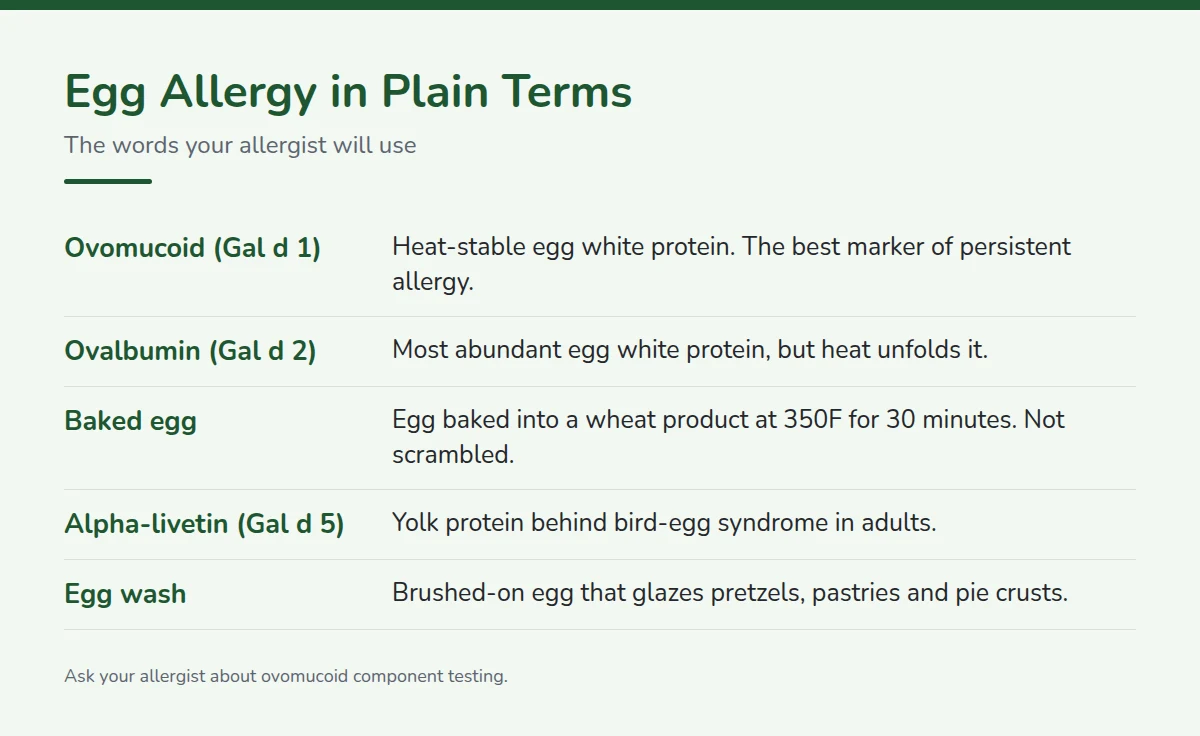
- Ovomucoid (Gal d 1) is the one that matters most. It is heat stable and resistant to digestive enzymes, which means it survives an oven and survives the stomach. Ovomucoid is the strongest marker of persistent egg allergy and the protein most likely to cause a reaction to a thoroughly baked food.
- Ovalbumin (Gal d 2) is by far the most abundant protein in egg white, making up roughly half of it, but it is heat labile. Sustained heat unfolds it, and an unfolded ovalbumin is much less able to trigger the immune response.
- Ovotransferrin (Gal d 3) and lysozyme (Gal d 4) round out the white. Lysozyme is worth knowing by name because the food industry uses it as a preservative well outside the egg aisle.
- Alpha-livetin (Gal d 5) is the yolk protein, and it is the basis of bird-egg syndrome. Adults with heavy exposure to pet birds sometimes become sensitized to feather and dropping proteins first, then react to egg yolk afterwards. It is uncommon, it typically appears in adulthood rather than childhood, and it runs in the opposite direction to the usual pattern.
The practical takeaway is that a standard egg IgE number blends all of this together. Asking your allergist whether component testing for ovomucoid is appropriate gives a much more useful picture, because a child with low ovomucoid IgE and a child with high ovomucoid IgE face very different odds at a baked egg challenge. None of this resembles what a mail-order kit measures, and our breakdown of why at-home sensitivity tests are not allergy tests explains the difference in detail.
Why Some Egg-Allergic Children Can Eat Cake
Roughly two-thirds to three-quarters of egg-allergic children can eat egg that has been extensively heated inside a baked good without reacting. This is not a loophole or a gray area. It is a well-documented phenomenon with a physical explanation, and it has reshaped how egg allergy is managed.
Two things happen inside a baking muffin. Heat unfolds the heat-labile proteins, ovalbumin chief among them, so the shapes the immune system was trained to recognize stop existing. At the same time, the wheat flour matrix physically traps egg protein in a dense network, so less of it survives digestion intact and reaches the gut immune system. Heat alone is not enough. The matrix is doing real work, which is why the research protocols specify egg baked into a wheat-containing product at around 350°F (about 175°C) for a full 30 minutes.
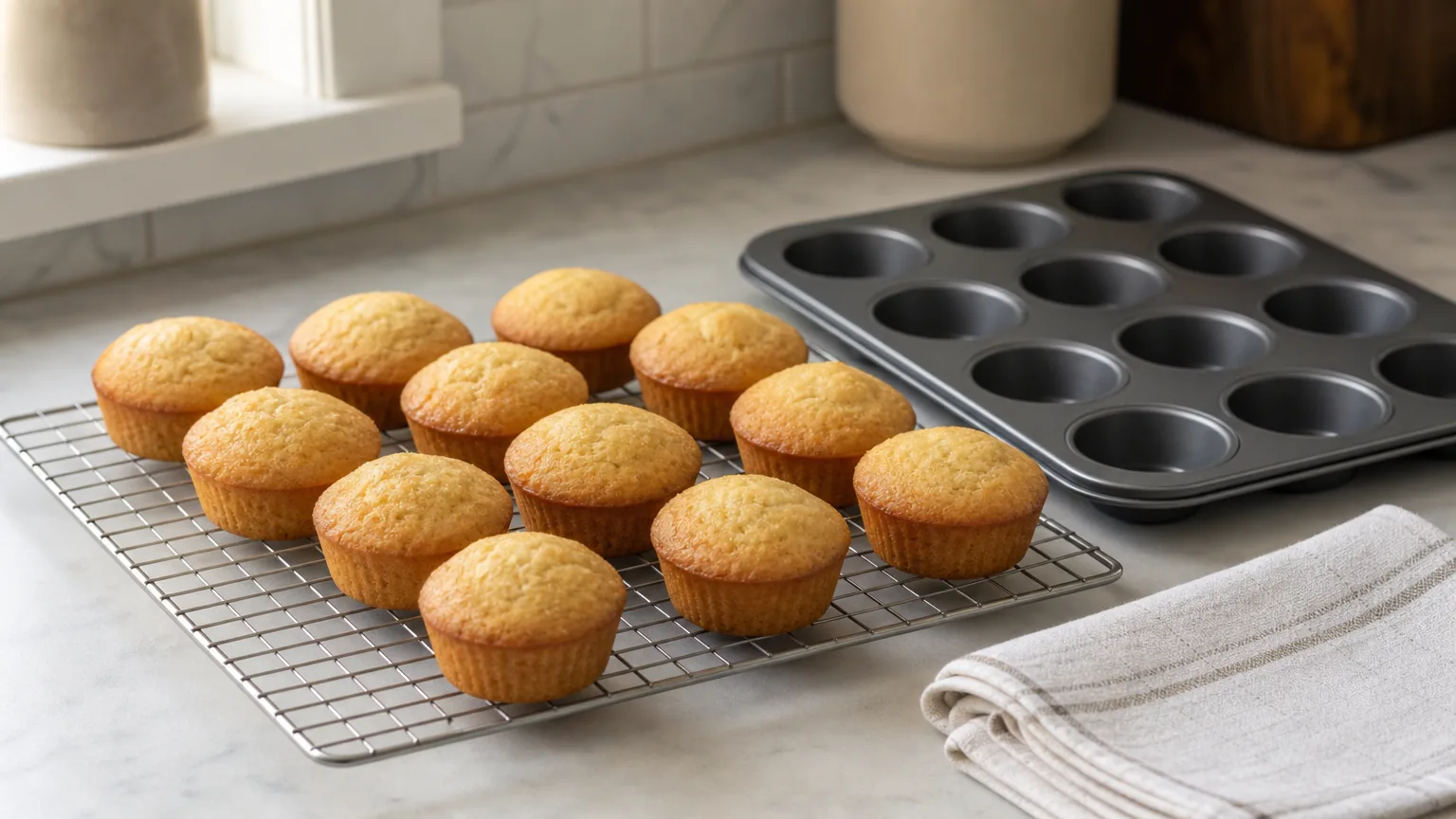
That specificity matters more than any other sentence here. A muffin is baked egg. Scrambled eggs, French toast, pancakes, quiche, fried egg, soft meringue, hollandaise, and lightly cooked custard are not baked egg, no matter how hot the pan felt. The heat is too brief, too wet, or unsupported by a flour matrix. Children who sail through a baked egg challenge routinely react to a scrambled egg, and that is the expected result rather than a contradiction.
The dangerous version of this knowledge is the home experiment. A parent reads that most kids tolerate cake, and tries a cake. Roughly a quarter to a third of egg-allergic children react to baked egg too, some of them severely, and there is no way to identify which group your child is in from the kitchen. The first baked egg exposure belongs in a clinic with epinephrine drawn up and staff watching.
How an Allergist Builds a Baked Egg Ladder
The baked egg ladder is a structured progression from the most processed, least allergenic form of egg toward plain egg, run under medical supervision. The rungs vary by clinic and by country (UK allergy services often use a formal written egg ladder, while US allergists more often describe the same idea as stepwise reintroduction), but the shape is consistent.
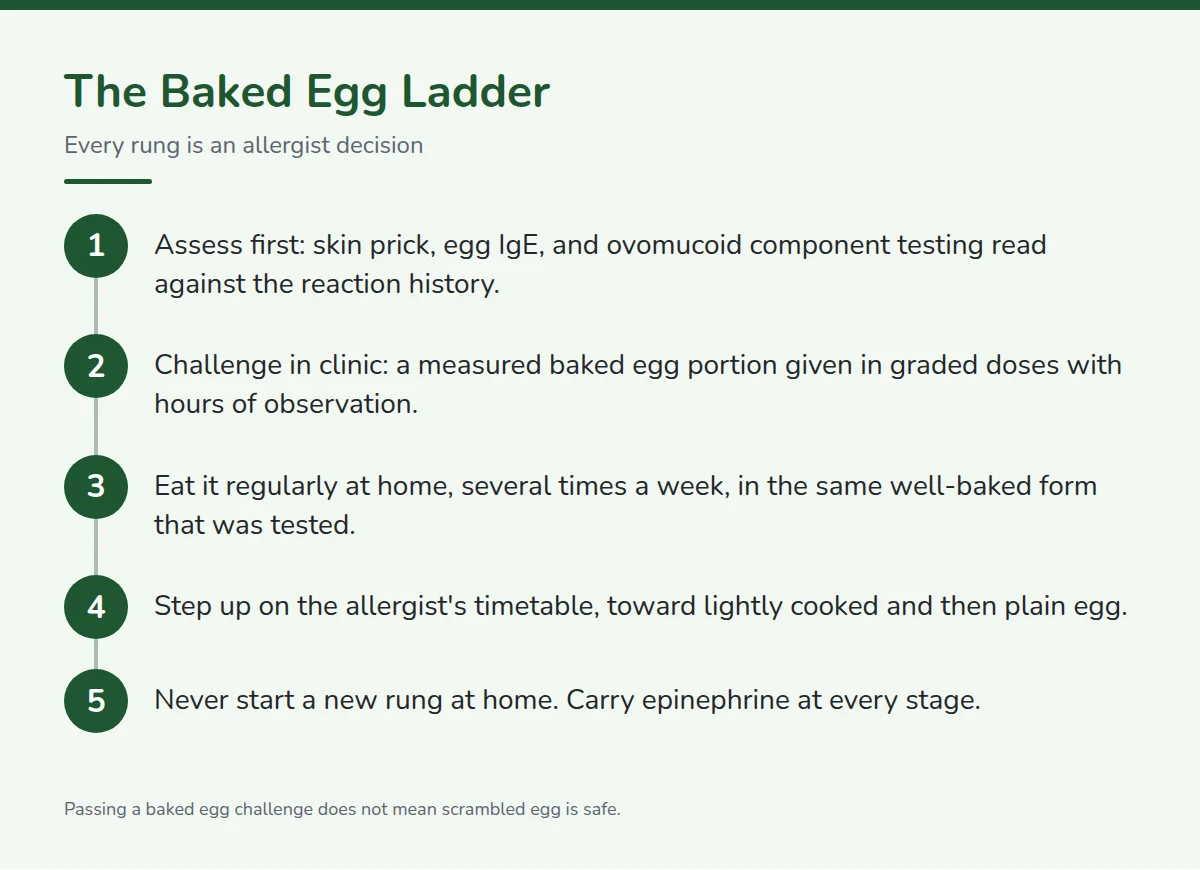
Step one is assessment, not eating. Skin prick testing, egg IgE, and where available ovomucoid component testing, read alongside the reaction history. The allergist is estimating the odds of passing a challenge, not proving anything.
Step two is the supervised oral food challenge. A standardized baked egg portion, most often a muffin containing a measured amount of egg, given in graded doses over several hours with observation between them. Passing means the child tolerated that specific form in that specific amount.
Step three is regular home ingestion. This is the part families underestimate. Tolerance to baked egg is maintained by eating it consistently, usually several times a week, in the same well-baked form that was tested. Sporadic exposure is not the same protocol.
Step four is moving up a rung, on the allergist’s timetable. Well-baked goods first, then more lightly baked items, then lightly cooked egg such as scrambled or French toast, then eventually plain cooked egg. Each step up is a new challenge, and each step up happens in the clinic, not at a birthday party.
One honest caveat about the rationale. An influential 2012 cohort found that children who ate baked egg regularly became tolerant to regular egg considerably faster than those who avoided it entirely, and that finding did a lot to popularize the ladder. It was an observational study, though, not a randomized trial, and researchers still debate how much of the effect is the baked egg accelerating tolerance versus baked egg tolerance simply marking the children who were already on their way out. What is not debated is the immediate benefit: a child who can eat baked goods has a wider diet, a far easier school year, and a household with less anxiety in it. That is worth the challenge on its own.
Whatever rung a child is on, epinephrine goes everywhere with them. Our guide to the 2026 treatment and device landscape covers what to carry and how the newer options compare.
Where Egg Hides
Egg is a technique as much as an ingredient. It binds, it glazes, it emulsifies, it clarifies, and it foams, and in most of those roles it is invisible in the finished food.
-
Breading and batter. Egg wash is what makes crumbs stick to chicken, fish, and vegetables. A breaded item in a shared fryer carries both risks at once.
-
Glazes and shine. Brushed onto pretzels, pastries, pie crusts, bagels, and dinner rolls. Nothing on the finished item looks different.
-
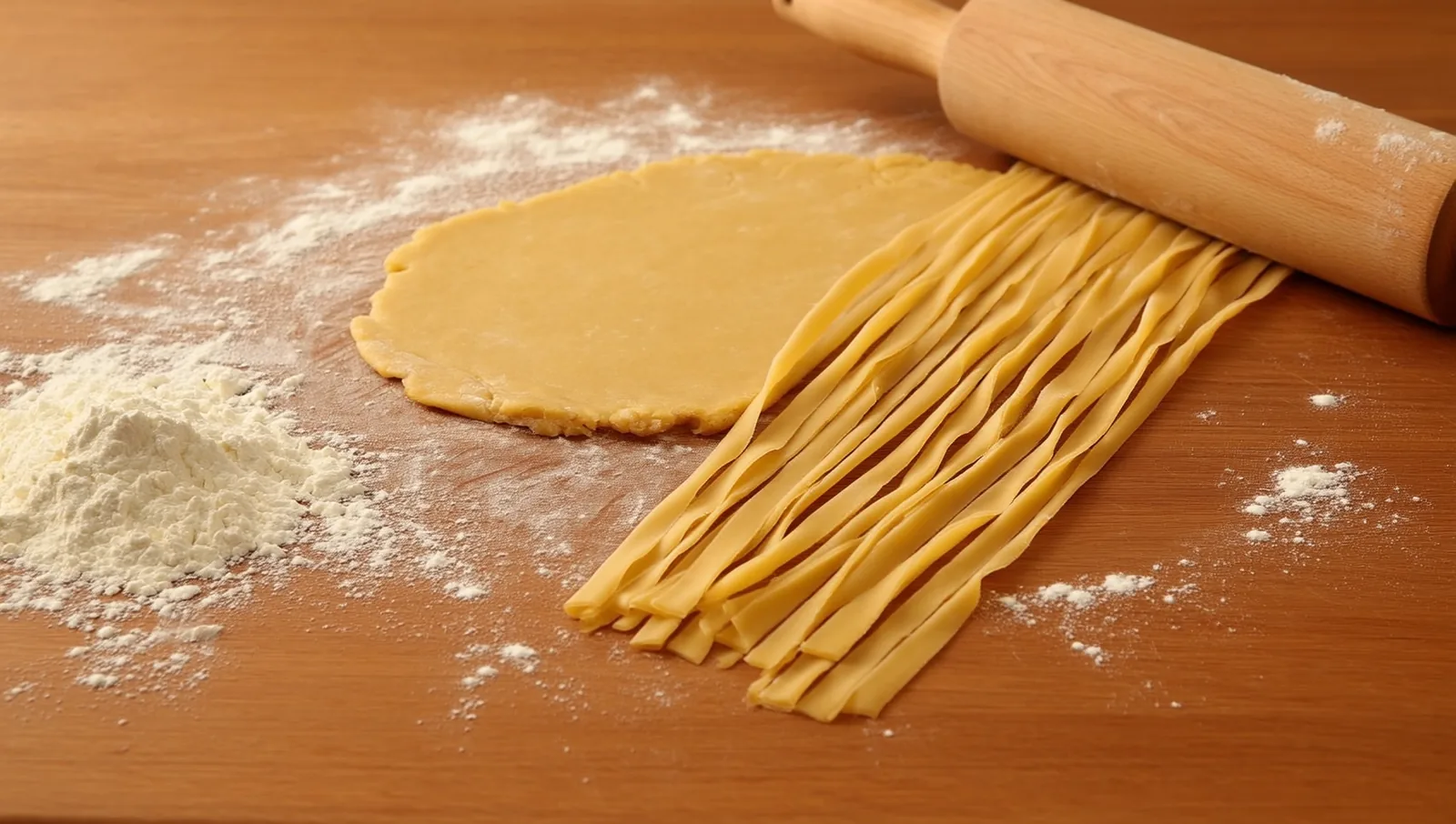
Pasta and noodles. Fresh pasta is usually made with egg, and traditional egg noodles obviously are. Dried semolina pasta usually is not, but the box is the only way to know.
-
Emulsified sauces. Mayonnaise, aioli, hollandaise, béarnaise, tartar sauce, Caesar dressing, and many creamy dressings and dips built on a mayonnaise base.
-
Meat binders. Meatballs, meatloaf, burger patties, sausages, and some deli products use egg to hold structure.
-
Confectionery and desserts. Meringue, macarons, marshmallow, nougat, some marzipan, custard-base ice cream, mousse, and royal icing.
-
Foam on a drink. Egg white gives cocktails and some specialty coffee drinks their foam cap, and it is almost never on a menu.
-
Fining agents in alcohol. Egg albumin is used to clarify wine, and US alcohol labeling is voluntary rather than mandatory, so the bottle often says nothing at all. Our guide to allergens behind the bar and the disclosure conversation covers the drinks side in full.
-
Lysozyme (E1105). Used as a preservative in some hard cheeses and in winemaking. It is an egg white protein, and its name gives nothing away.
Ingredient names that mean egg: albumin or albumen, apovitellin, globulin, livetin, lysozyme, ovalbumin, ovoglobulin, ovomucin, ovomucoid, ovotransferrin, ovovitellin, silici albuminate, simplesse, vitellin, meringue and meringue powder, and surimi. In US packaged food these all have to be accompanied by a plain-English egg declaration, but on imported goods, restaurant spec sheets, and cosmetics, they may be all you get.
If you are rebuilding a weekend routine around all this, egg-free brunch is its own puzzle, and our allergen-free brunch guide works through the substitutions that actually hold up.
Vaccines: What the Guidance Says Now
This is the section where outdated advice does the most damage, because a lot of it is still circulating.
Influenza vaccine. People with egg allergy of any severity can receive any influenza vaccine appropriate for their age and health status, with no additional safety measures beyond those recommended for any vaccine. The Advisory Committee on Immunization Practices removed the extra observation and setting requirements starting with the 2023-24 season, and the current recommendations keep that position. Egg-free options exist too, including a cell-culture vaccine and a recombinant vaccine, but they are no longer required for egg-allergic patients.
MMR. The measles, mumps, and rubella vaccine is grown in chick embryo fibroblast culture, but the residual egg protein is negligible. It is routinely given to egg-allergic children, including those with severe egg allergy, without special precautions.
Yellow fever and some rabies vaccines. These are the genuine exceptions. They are produced in embryonated eggs or chick embryo cells and can contain measurable egg protein. If you need one, this is an allergist conversation in advance, and it can usually be handled with skin testing and graded dosing rather than a flat refusal.
Bring the topic up with your allergist rather than the vaccine clinic front desk, and if a provider is working from the older flu vaccine precautions, it is fair to ask them to check the current recommendation.
Reading the Label, and What the Label Cannot Tell You
Under FALCPA, egg is one of the nine major allergens that must be declared in plain English on FDA-regulated packaged food, either in the ingredient list or in a “Contains” statement. That covers deliberate ingredients. It does not cover the shared mixer, the shared glaze brush, or the shared line.
Precautionary statements (“may contain egg,” “made on shared equipment”) are voluntary in the United States, carry no defined threshold, and are not ranked by severity. A manufacturer that tests every batch and one that adds the phrase to every product for legal cover print the same words.
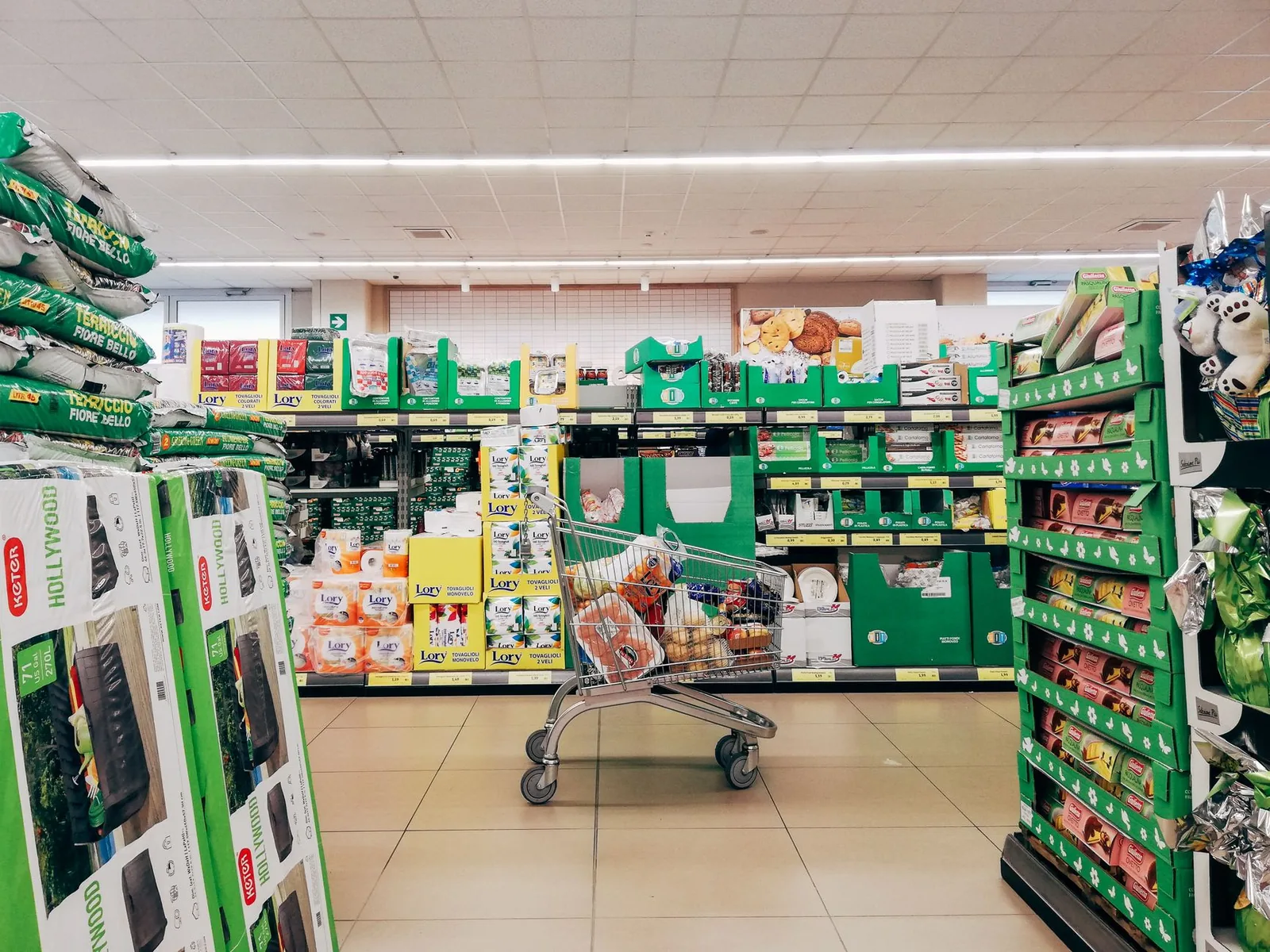
Imported products deserve a second look. In July 2026, Lidl US recalled every unit of a shortbread cookie because the boxes had shipped with foreign-language packaging and no English ingredient, nutrition, or allergen declaration. The undeclared allergens were wheat, soy, milk, and egg. Nothing was wrong with the recipe. The label simply was not there in a form a US shopper could read. If a package in your cart carries text you cannot parse, treat it as unlabeled rather than as probably fine, and if you are unsure whether a given notice even applies to the box already in your pantry, our guide to decoding recalls, alerts, and withdrawals breaks down the notice types.
For a shared facility, the useful questions are about process rather than reassurance. Is egg run on the same line or only in the same building? What is the changeover and cleaning protocol between runs? Do you test finished product for egg protein, and to what limit? Is the precautionary label on this product based on testing or applied across the whole catalog? A company that answers precisely is telling you more than one that answers warmly.
Outgrowing It: The Real Timeline
Here is where the folklore fails hardest. A large US cohort followed 881 patients with egg allergy and found resolution in 4 percent by age 4, 12 percent by age 6, 37 percent by age 10, and 68 percent by age 16.
That was a specialty referral population, which skews toward the more stubborn cases, and broader population studies report faster resolution. Even the optimistic estimates, though, land well past the kindergarten deadline most families are handed.
Read that sequence twice. Most egg-allergic children do outgrow it, but in that cohort the majority were still allergic at age 10, and a meaningful minority never outgrew it at all. A family told “she’ll grow out of it by school age” and still carrying epinephrine in fourth grade has not gone wrong. They are simply where most children are.
The same cohort found that the peak egg IgE level predicted the pace: the higher the number, the slower the resolution. That is why allergists retest periodically, usually annually in younger children, and offer a challenge when the trend line and the history line up. Tolerating baked egg is itself a favorable sign.
If your child is on the slower path, the fundamentals matter more than the forecast. Our complete food allergy guide for 2026 covers label reading, cross-contact at home, and emergency planning across all nine major allergens.
What to Do This Month
- Ask about component testing. Specifically ovomucoid. It sharpens the picture more than a total egg IgE does.
- Ask whether a supervised baked egg challenge is appropriate. If it is, book it. Do not run it at home.
- Fill two epinephrine devices and keep them together. Epinephrine is the treatment for anaphylaxis. Antihistamines may help skin symptoms and must never delay the injection.
- Learn the alias list. Albumin, livetin, lysozyme, ovalbumin, ovomucoid, meringue powder. Read the full ingredient panel rather than only the “Contains” line, because imports and restaurant products may not carry one.
- Put the baked egg status in writing. School, daycare, and grandparents need to know exactly which forms of egg are cleared and which are not, because “he can have cake” is far too vague to be safe.
- Retest on a schedule. Egg allergy changes over years, and the only way to catch the change is to keep measuring.
Egg is the allergen where the news is genuinely good and the timeline is genuinely long. Most children walk out of it eventually, many get a much wider diet years before that through a baked egg challenge, and the vaccine worries that dominated the last decade have largely been retired. Until your own family gets there, the work is unglamorous and reliable: read the panel, ask the specific question, keep the device close, and let the allergist rather than the kitchen decide the next rung.
Further reading (sources)
- Food Allergy Research and Education on why egg white and egg yolk both have to go
- Journal of Allergy and Clinical Immunology for the cohort that tracked how slowly egg allergy actually resolves
- Journal of Allergy and Clinical Immunology with what happens immunologically when egg-allergic children eat extensively heated egg
- Journal of Allergy and Clinical Immunology covering the baked egg cohort that popularized the ladder
- MMWR Recommendations and Reports for the current ACIP position on flu vaccination and egg allergy
- American College of Allergy, Asthma and Immunology on how egg allergy is diagnosed and managed
- FDA with what allergen labeling law does and does not require
- Food Allergy Research and Education for how to work through an ingredient panel
- Food Safety News reporting the imported cookies pulled for undeclared egg and three other allergens