Did Early Peanut Introduction Work? Why Child Food Allergy Rates Haven't Fallen Yet
Published on November 3, 2026

For about a decade, parents have been told to give babies peanut early instead of holding it back. So a Medscape headline at the end of October landed hard: “Child Food Allergies Rise Despite Early Allergen Exposure.” It summarized a new review in Annals of Allergy, Asthma & Immunology by Katherine Caid and Corinne Keet of the allergy division at the University of North Carolina School of Medicine, which found no national drop in parent-reported food allergy among US children.
If you have a baby nearing six months, the obvious question is whether early introduction is still worth the effort. It is. The survey behind the headline counts parent-reported food allergy at every age from birth to 17, and most of the children in its main analysis were born before the advice changed. Data designed to look for prevention in babies tell a more hopeful story, and the trial evidence for your own child has only grown stronger.
What the New Analysis Found
Caid and Keet had shown in earlier work that self-reported food allergy in US children rose from the 1990s into the early 2010s. Their new review asked whether that climb had turned since early introduction became the advice. Of more than 23,000 publications they screened, only one met their criteria, so most of the analysis rests on the National Health Interview Survey (NHIS), the federal household survey that has asked about children’s food allergy nine times since 2011.
What they found:
- Parent-reported food allergy rose from 5.6 percent of children in 2012 to 6.6 percent in 2018, about 1.6 percentage points per decade.
- The NHIS changed its questions and methods in 2019, so the authors treated later years as exploratory. Those years came in at 7.9 percent in 2021 and 7.2 percent in 2024, which they read as a plateau, not a decline.
- The rise was concentrated in children aged 10 to 17, at about 3.3 percentage points per decade. In younger children the rate barely moved.
- The trends were the same across racial and ethnic groups.
The authors concluded that self-reported child food allergy “has not convincingly begun to decrease” in response to early introduction. They had not expected it to. “The early introduction food guidelines did not begin changing until 2015, and it often takes several years for new guidelines to be widely implemented,” Caid told Medscape.
Four Reasons the National Numbers Have Not Dropped
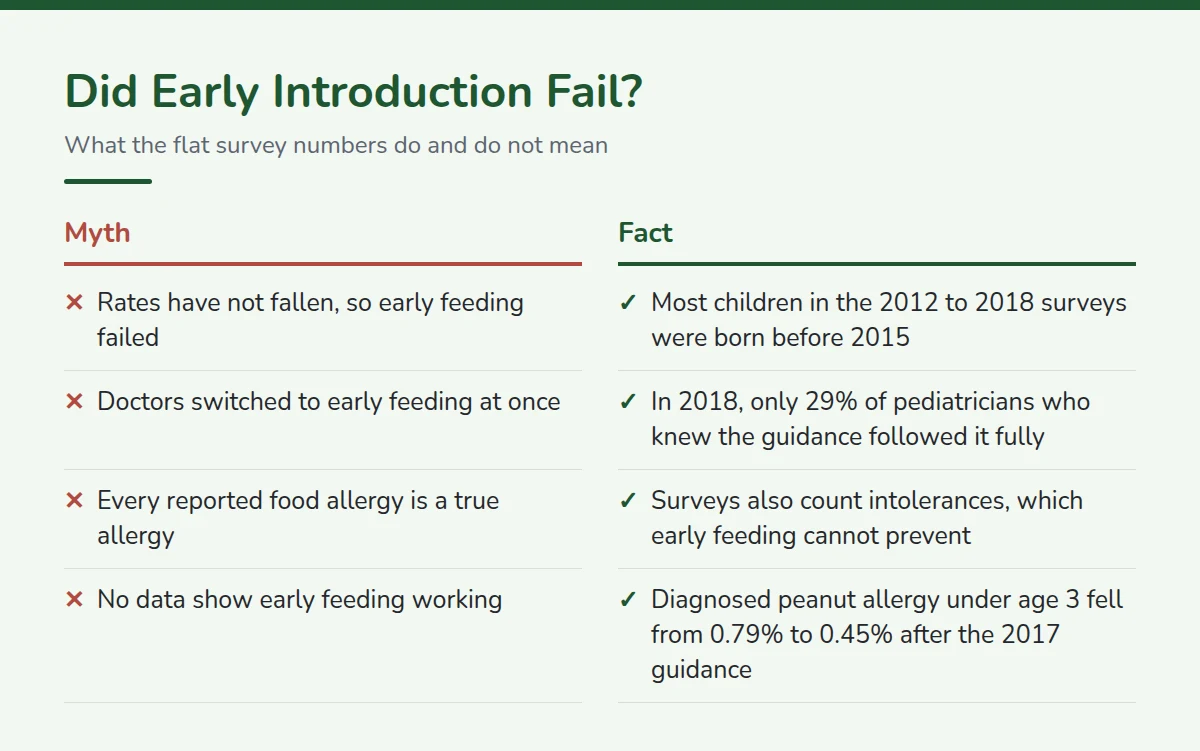
Most of the children counted were born before the advice changed. Early introduction acts on babies. The first US guidance urging early peanut for high-risk infants came in 2015, after the LEAP trial, and formal addendum guidelines from the National Institute of Allergy and Infectious Diseases (NIAID) followed in early 2017. A child who turned one in 2018 could have benefited. A 10-year-old could not. Every child in the 10 to 17 band, where the increase was concentrated, was born before 2015, and that is still true in the 2024 data. Even a strong effect in babies gets diluted across 18 birth years of children.
Doctors were slow to adopt it, and parents were nervous. In a national survey of 1,781 pediatricians in 2018, Gupta and colleagues found that 93 percent knew about the 2017 guidelines, but only 29 percent of those followed them fully. The most common barriers were parents’ fear of a reaction, uncertainty about applying the guidelines, and the logistics of supervised feedings in the office. A companion survey of allergists by Johnson and colleagues found better uptake, with 64.5 percent following the guidelines fully, yet parents’ fear of reactions still topped their list of barriers. The 2017 rules were complicated, too. They sorted babies into three risk groups and steered the highest-risk group toward testing first. The 2021 consensus from three North American allergy societies simplified the message: peanut and egg for all babies around six months, not before four months, with no screening required.

“Food allergy” on a survey is a wide net. The NHIS records what a parent reports. “It’s common for any uncomfortable symptom that occurs following food consumption to be considered and possibly labeled as a food allergy,” Caid told Medscape. The counting rule moves the number. Food Allergy Research and Education (FARE), summarizing a 2015 to 2016 national survey of more than 38,000 children, puts food allergy at nearly 8 percent of children but physician-diagnosed food allergy at 4.7 percent. A parent’s yes can cover IgE-mediated allergy (the kind that causes hives and anaphylaxis, and the only kind early introduction is designed to prevent), food-triggered diseases that work differently, such as eosinophilic esophagitis, and intolerances such as lactose intolerance, which involve no immune reaction at all. Our Food Allergy 101 guide sets out the difference.
Allergies travel with each generation of children. Many of today’s teenagers were babies while US advice told parents of high-risk infants to delay the top allergens, an approach FARE now says was not well grounded in evidence. The rest were born before anyone recommended feeding allergens early. Food allergy among US children rose by half between 1997 and 2011, according to CDC figures FARE cites, and self-reported peanut or tree nut allergy in children more than tripled between 1997 and 2008. Those are allergies that only a minority of children outgrow, as our guide to which food allergies children outgrow explains, so they move up through the age bands with the children who have them. The survey cannot say whether that explains the teenage increase, but it is one reason the oldest children in the data are the last place to look for a benefit.

What Data Built to Find Prevention Show
Stanislaw Gabryszewski, an allergist at Children’s Hospital of Philadelphia who was not involved in the review, told Medscape he would be cautious about reading it as proof that prevention is failing. If early introduction prevents new allergies, he said, the benefit should show up first in young children, and a national survey of caregiver reports across all ages “may not have been optimally designed” to catch it.
His team’s own study, published in Pediatrics in 2025, was built for that job. Using electronic health records from a multistate network of pediatric primary care practices, the researchers tracked new diagnoses of IgE-mediated food allergy in children up to age three, comparing children who entered care before the 2015 guidance with those who entered after it and after the 2017 addendum. Diagnosed peanut allergy fell from 0.79 percent before the guidelines to 0.45 percent after the addendum, a relative drop of about 43 percent. Any IgE-mediated food allergy fell from 1.46 percent to 0.93 percent. The study is observational, so it cannot prove that early feeding caused the drop, and its newest group entered care by early 2019, before the simpler 2021 advice. But it found exactly the kind of signal a broad national survey would miss.
Australia offers a second view. Its 2016 infant feeding guidelines told parents to introduce peanut before 12 months for all babies, and the EarlyNuts study found that the share of Melbourne babies eating peanut by their first birthday rose from 28 percent in 2007 to 2011 to 89 percent in 2016 to 2018. Yet when the same research group tested 1,933 one-year-olds in 2018 and 2019, using skin prick tests and oral food challenges, peanut allergy stood at 2.6 percent against 3.1 percent a decade earlier, a gap too small to rule out chance. Within the newer group, though, earlier peanut was linked to a much lower risk of allergy among babies of Australian ancestry. The link was not significant among babies of East Asian ancestry, a higher-risk group that made up a larger share of the newer sample.
The lesson is not that early feeding failed in Australia. Near-universal early introduction moved the population figure only a little in its first years, even though many of the babies who started early fared far better. Early introduction lowers the odds of allergy. It does not erase them.
Why Early Introduction Still Matters for Your Baby
A national average and your child’s odds are different numbers, and the case for early introduction rests on randomized trials, not surveys.
In the LEAP trial, 640 babies aged 4 to 11 months with severe eczema, egg allergy, or both were assigned to eat peanut regularly or to avoid it until age five. Among the 530 whose skin prick test was negative at the start, 13.7 percent of the avoiders had peanut allergy at five, against 1.9 percent of the eaters. Among the 98 who already showed mild sensitivity on the test, the figures were 35.3 percent and 10.6 percent. The LEAP-Trio follow-up, published in 2024, retested most of the same children at age 12, after years of eating or skipping peanut as they pleased. Peanut allergy affected 15.4 percent of the original avoiders and 4.4 percent of the original eaters, a rate about 70 percent lower. The protection lasted into adolescence.

What that means at home, following the 2021 consensus:
- Start around six months, not before four. Offer peanut and well-cooked egg once your baby is eating solids, and bring in the other common allergens around the same time. Most babies need no testing first.
- Keep it going. LEAP children ate peanut regularly for years. One taste is not the intervention, and our guide to introducing allergens when someone at home is allergic covers forms, amounts, and cleanup.
- Use baby-safe forms. Smooth peanut butter thinned with warm water or stirred into a purée, or peanut powder mixed into food. Never whole peanuts or spoonfuls of thick peanut butter, which are choking hazards.
- Check first if your baby has severe eczema or a known food allergy. Babies with severe eczema, egg allergy, or both were the highest-risk group in the 2017 guidelines. Talk to your pediatrician and see an allergist if advised, but do not let it turn into an open-ended delay.
- Know the warning signs. Hives, vomiting, or swelling after a new food mean stop and call the doctor. Trouble breathing, or a baby who turns pale and floppy, means call 911.
What to Watch Next
Better measurements are on the way. Keet told Medscape that the 2025 to 2026 cycle of the National Health and Nutrition Examination Survey (NHANES), the federal survey that pairs interviews with physical exams and lab work, will again measure food-specific IgE antibodies in blood, about 20 years after it last did. A blood test shows sensitization rather than proven allergy, but it does not depend on a parent’s memory or on how a symptom got labeled. The review’s authors also want future research to check self-reported trends against objective measures such as skin prick tests and blood IgE.
Time will help as well. The first babies born under the 2017 guidelines were only seven in 2024, the most recent NHIS year, so they still sit in the youngest age bands. If early introduction is lowering allergy in babies, that is where it should show up first, and it is exactly where the clinic records already point.
The Bottom Line
The headline is accurate about what it measured: parent-reported food allergy across all US children has not fallen. It does not show that early introduction failed. The children who could benefit are still young, too few doctors followed the advice in its first years, and a survey yes counts more than true allergy. Where researchers looked at the right ages and the right kind of allergy, rates were already falling. For your own baby, the evidence has not changed: peanut and egg around six months, kept in the diet, with your pediatrician’s help if your baby has severe eczema. If someone in your family already has peanut allergy, our complete peanut allergy guide covers that side of the house, and an allergist can help you plan for both children.
Further reading (sources)
- Caid and Keet on trends in self-reported food allergy among US children since 2011
- Medscape Medical News with interviews with the review’s authors and an outside allergist
- Gupta and colleagues for how many pediatricians fully followed the 2017 peanut guidelines
- Johnson and colleagues on guideline uptake and barriers among US allergists
- Food Allergy Research and Education with its roundup of US food allergy facts and statistics and its page on early introduction and the old advice to delay
- Gabryszewski and colleagues for IgE food allergy diagnoses in young children before and after the guidelines
- Soriano and colleagues on how quickly Melbourne babies started eating peanut after Australia’s 2016 guidelines
- Soriano and colleagues covering peanut allergy in Melbourne one-year-olds tested a decade apart
- Du Toit and colleagues with the LEAP trial of eating versus avoiding peanut in high-risk infants
- Du Toit and colleagues on whether LEAP’s protection lasted to age 12
- Fleischer and colleagues for the 2021 North American consensus on preventing food allergy through infant feeding
- Togias and colleagues covering the 2017 NIAID addendum guidelines and their three risk groups