Introducing Allergens to a New Baby When Someone at Home Is Allergic: Prep, Cleanup, and Who Feeds
Published on November 1, 2026
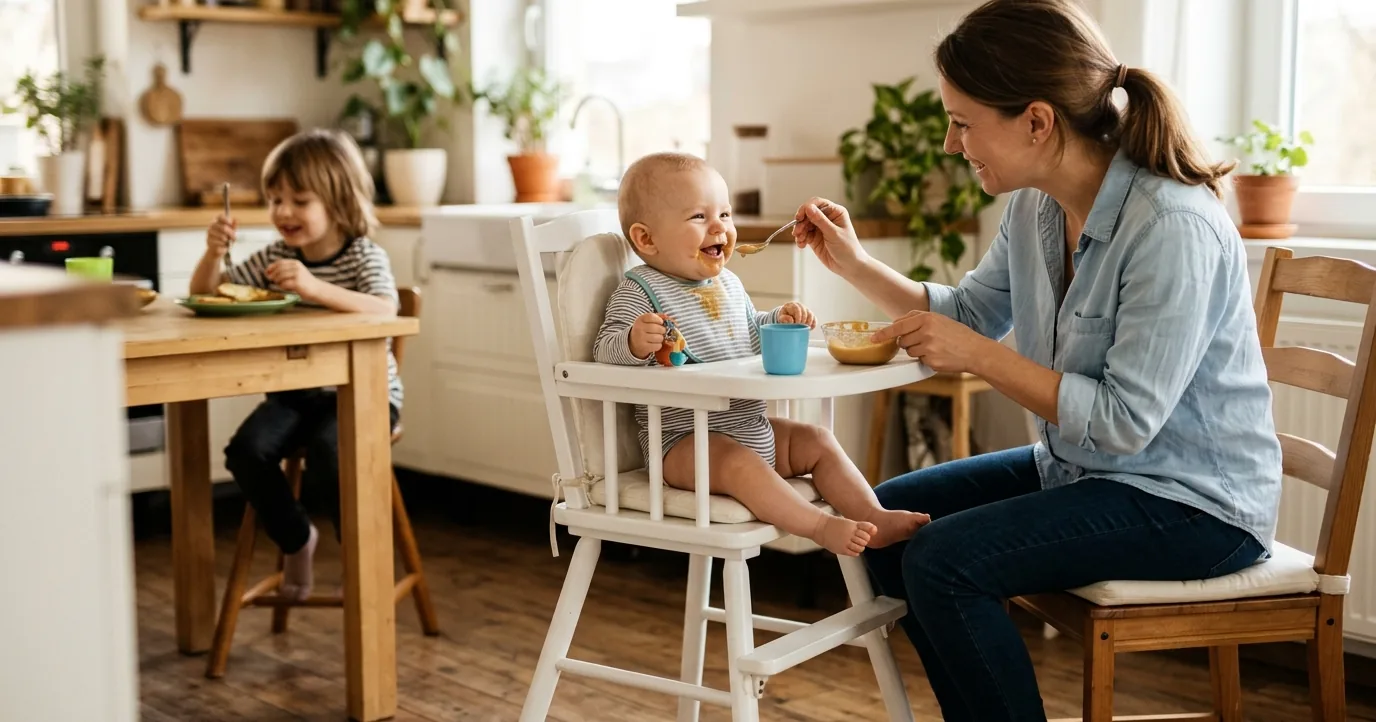
Every allergy household has its routines. The peanut butter never comes through the door, the bakery box gets read twice, and the kitchen runs on the assumption that the food simply does not exist. Then a new baby arrives, the pediatrician raises early allergen introduction at a checkup, and the advice sounds like a contradiction: feed this baby the very food the family has spent years keeping out, and keep feeding it for years.
Food Allergy Research and Education (FARE) built an October 2026 webinar, Parallel Paths, around that collision, pairing a pediatric allergist from Mass General for Children with a registered dietitian and an allergy cookbook author to work through the logistics for families already managing an allergy. This guide covers the same ground: why the baby still needs the food, and how to run one kitchen where one person eats an allergen and another must never get it in their mouth.
Why the Baby Still Needs the Food the House Avoids
The current North American advice comes from a 2021 consensus of three allergy societies: the American Academy of Allergy, Asthma and Immunology (AAAAI), the American College of Allergy, Asthma and Immunology, and the Canadian Society of Allergy and Clinical Immunology. It tells parents to introduce peanut and cooked egg to every infant at around six months of age, though not before four months, usually at home and without screening tests first. It also says not to hold back milk, soy, wheat, tree nuts, sesame, fish, or shellfish, and that once a food is in the diet it should stay there regularly.
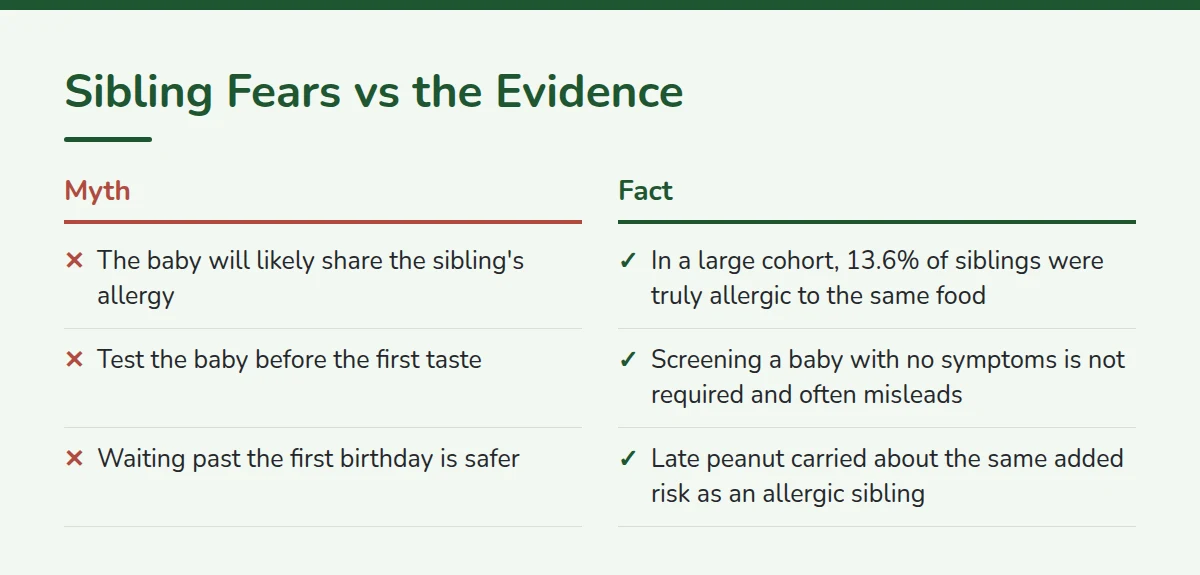
Parents of an allergic child tend to assume the baby is next in line. The evidence says the risk is real but smaller than the fear. Gupta and colleagues studied 1,120 food-allergic children in Chicago who had at least one biological sibling. Only 13.6 percent of those siblings were both sensitized and clinically reactive to the same food, while 53 percent had a positive skin or blood test and no symptoms at all. The authors concluded that testing symptom-free siblings was unjustified, because it invites misdiagnosis and needless avoidance.
A 2026 meta-analysis in JAMA Pediatrics by Islam and colleagues, pooling 190 studies, put a figure on the family link: a sibling with food allergy was associated with about 2.4 times the odds of developing one, roughly six additional cases per 100 children. In the same analysis, introducing peanut after the first birthday carried a risk of about the same size. The family history is fixed. The timing is not.
The consensus panel addressed siblings directly. It found no clear evidence that a younger sibling of a peanut-allergic child inherits a higher risk, noted that earlier sibling studies never accounted for families putting peanut off, and warned that hesitant parents can create the risk by delaying. Its advice: give these babies peanut early like any other baby, and help families with an allergic child plan around the hesitation.
New research from the team behind LEAP, the trial that reversed infant feeding advice, sharpens the point. In findings presented at the AAAAI annual meeting in early 2026, younger siblings of LEAP participants who skipped peanut in their first year while living with family members who ate it had a higher risk of peanut sensitization and allergy, especially if they had eczema. Eating peanut in the first year significantly lowered that risk, whatever the rest of the household ate. The researchers read it as support for the dual-allergen exposure idea: a food met first through the skin tends to sensitize, while one met through the gut tends to build tolerance. The results are preliminary, but the message for an allergic household is clear. Once peanut is in the house, the goal is to get it into the baby, not onto the baby.
Decide First Whether You Can Keep It Going
Early introduction is not a one-time taste test. In LEAP, high-risk babies assigned to eat peanut kept eating it until age five, and 3.2 percent developed peanut allergy, against 17.2 percent of those who avoided it. The 2021 consensus says no exact dose has been proven and that regular exposure over several years matters more than any fixed amount. As a reasonable target it suggests 1 to 2 teaspoons of peanut butter or egg, or an equivalent, at least once a week, and more if the child enjoys it. Allergy & Anaphylaxis Australia, which publishes advice specifically for families feeding a baby when a relative has food allergy, suggests about twice a week and says plainly that an occasional feed is not enough.
So the first decision belongs to the whole household: can you sustain that routine safely, week after week? Many families manage with a handful of rules. Others, especially when the allergic person has reacted to tiny exposures before, move most feeds to a relative’s home, and our guide to briefing the grandparents who help covers that handover. Either way, settle it before the first spoonful, and tell the allergist if the honest answer is no.
Choose a Form That Stays Where You Put It
Babies should never get whole peanuts or lumps of peanut butter, which the consensus authors flag as choking hazards for children under five. The forms they list are smooth peanut butter thinned with hot water and cooled, peanut flour or peanut powder mixed into other foods, and peanut puffs. Egg must be cooked through. The consensus rules out raw egg products, and its parent guidance suggests starting with egg baked into low-sugar muffins or pancakes rather than soft-boiled or poached egg, which caused reactions in young infants in earlier studies. Our egg allergy guide explains why baking changes the way egg protein behaves.
In an allergic household, the form is also a cross-contact decision. Peanut powder stirred into oatmeal or fruit purée stays in the bowl. A smear of peanut butter travels to fingers, hair, and highchair straps, and Allergy & Anaphylaxis Australia warns that it can bake onto dishes in the dishwasher unless they are rinsed first. Puffs crumble, and a toddler sibling finds the crumbs on the floor an hour later. Puffs were the snack used in LEAP, but the consensus prefers thinned peanut butter or peanut flour as an everyday weaning food anyway. Buy small packages, so less of the allergen sits in the house at any one time.
Storage: One Labeled Bin, Out of Reach
Give the baby’s allergen foods a single home. Allergy & Anaphylaxis Australia recommends sealed, labeled containers. In practice that means one lidded bin on a high shelf, well away from the allergic child’s snacks, holding everything that contains the allergen: the powder, the jar, the baked egg muffins in a marked freezer bag. Nothing gets decanted into unmarked jars, where peanut powder can pass for flour or protein powder. Leftover purée gets a lid and a label of its own in the fridge.
Anyone who helps out, from a babysitter to a visiting aunt, learns one rule: food from the bin goes to the baby, in the highchair, and nowhere else.
Prep and Feeding: Who, Where, and When
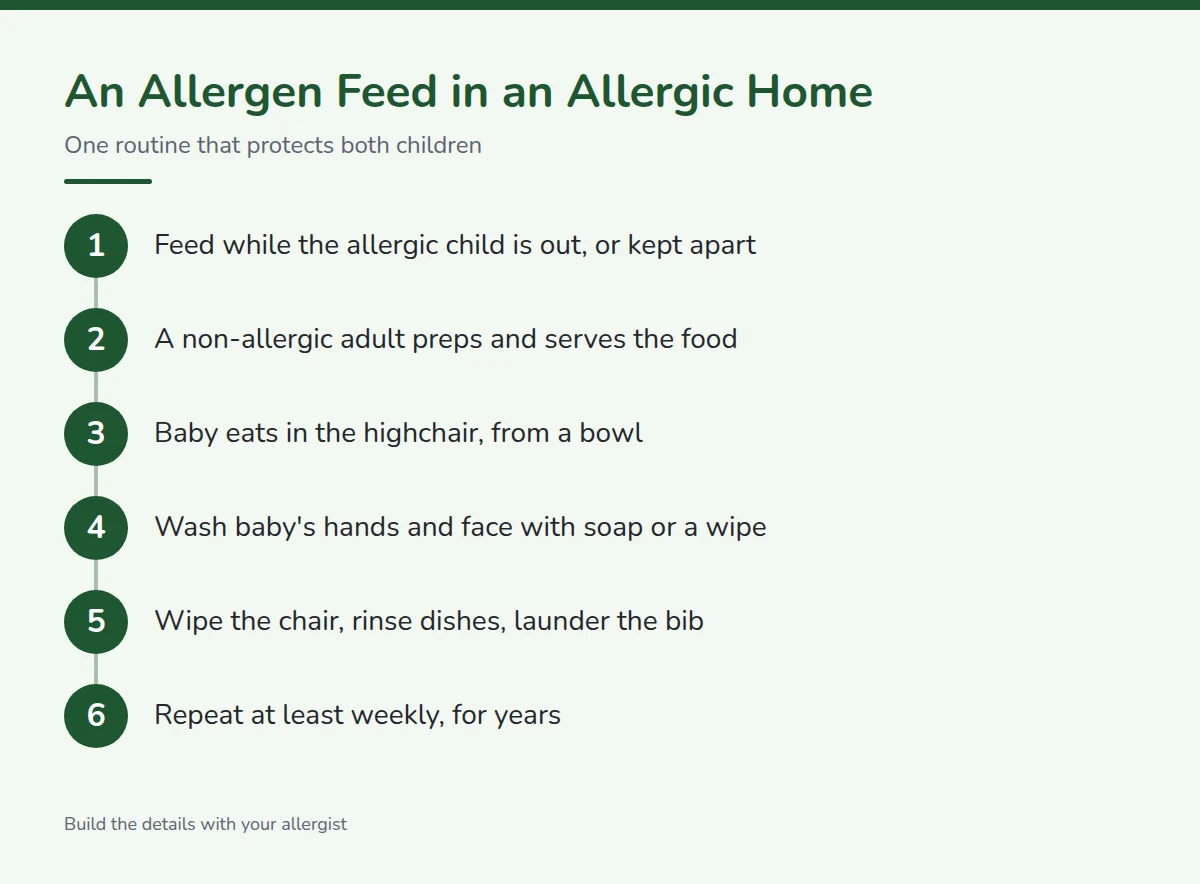
Who. A non-allergic adult makes and serves the allergen meal. When the allergic person is a parent, Allergy & Anaphylaxis Australia suggests handing those feeds to the other parent or another relative, or having the allergic parent wear gloves to prepare the food and clean up, which may cut down on skin reactions. An allergic parent should also drop the habits parents follow without thinking: testing the spoon’s temperature with their lips, finishing the leftover purée, or kissing a messy face.
It helps to know where the real danger sits. In blinded tests at Mount Sinai, Simonte and colleagues put peanut butter on the skin and under the noses of 30 highly peanut-allergic children. None had a systemic or breathing reaction; a few got redness, itching, or a hive where it touched, and the authors cautioned that larger exposures and forms like flour were not tested. Eating is the main hazard, so house rules should target whatever can carry the food to the allergic person’s mouth: hands, spoons, cups, toys, and crumbs.
Where. The highchair, every time. Not the couch, not a lap, and not the allergic child’s seat at the table. A bib that goes straight into the laundry afterward saves a lot of wiping.
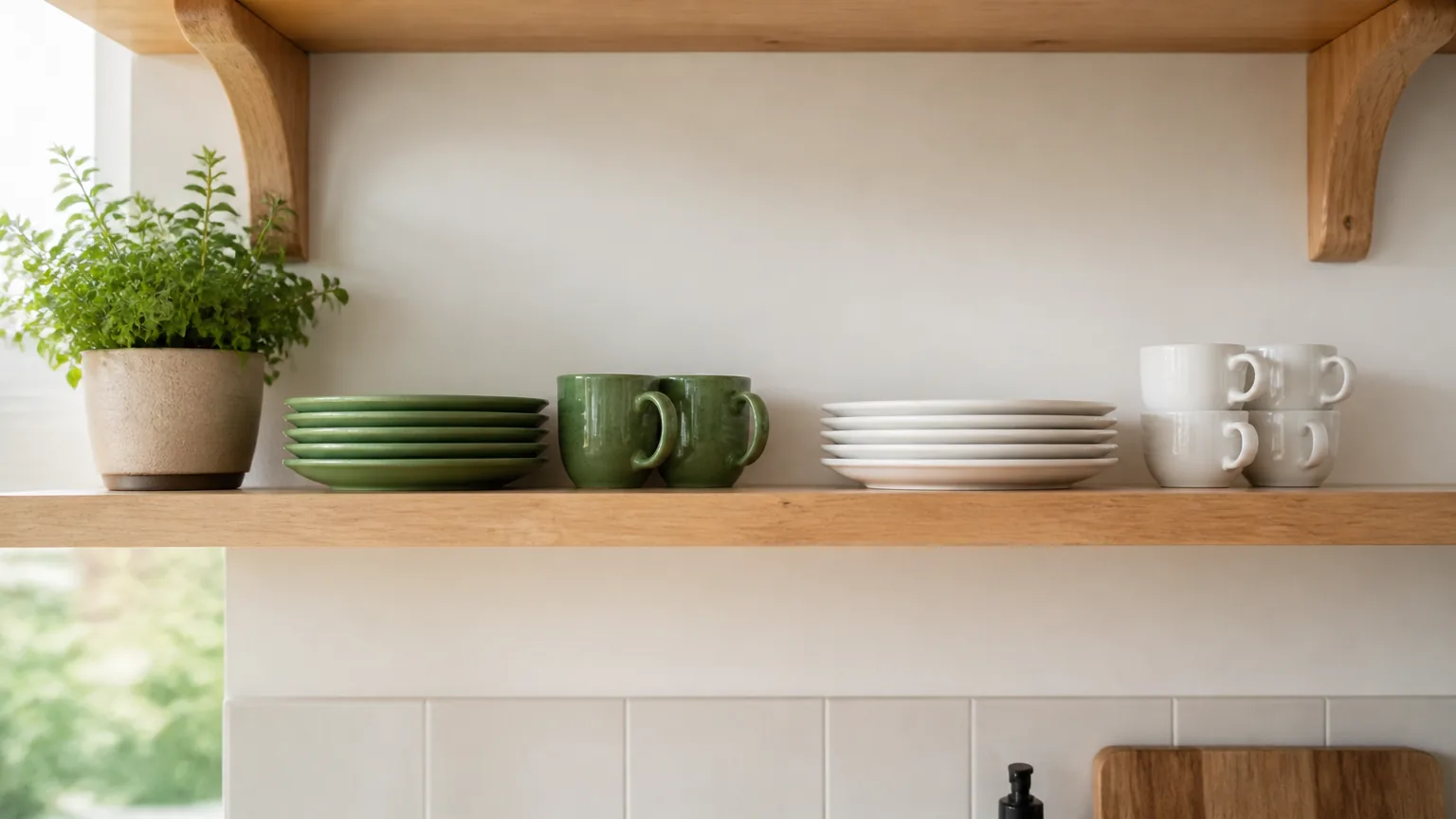
When. For sibling households, the Australian group’s first suggestion is to feed the baby while the allergic child is out, at school or child care. Pick a time when someone can watch the baby for a few hours afterward, since each first taste is also the baby’s first chance to react. When the allergic child is home, they need to know not to touch the baby’s food, or the baby, until the meal is over and the baby is clean. A few standing house rules help: no sharing food or drinks, no self-serving for small children, everyone sits down to eat, and the allergic child’s plates and cups come in a set color.
For the first few feeds, two adults make life much easier: one watches the baby, the other keeps the older child busy in another room.
Cleanup Is Where Cross-Contact Happens
Cleanup is where the research is most useful. Perry and colleagues at Johns Hopkins measured how much of the main peanut allergen survived common cleaning methods. Liquid soap, bar soap, and commercial wipes all left hands with no detectable peanut. Hand sanitizer did not do the job: 6 of 12 hands still carried the allergen afterward, as did 3 of 12 rinsed with plain water. On tables, ordinary household cleaners worked, but dishwashing liquid left traces on a third of them. The team could not detect peanut allergen in the air while people ate peanut butter or peanuts, which points the cleanup at hands and surfaces rather than the kitchen air.
A cleanup routine built on those findings:
- Wash the baby’s hands and face with soap and water, or a wipe, before the baby leaves the chair.
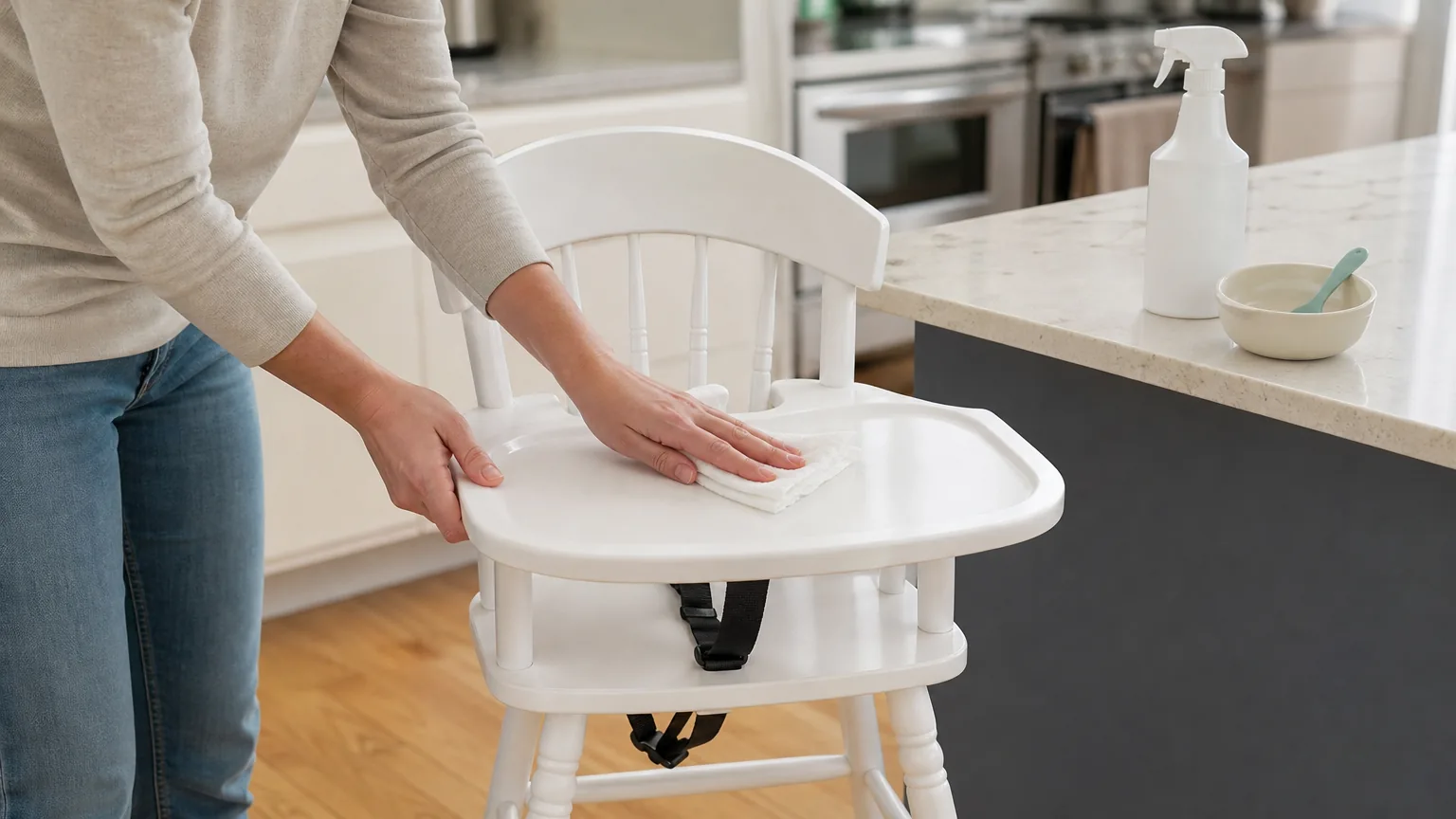
- Wipe the tray, straps, and seat with a household cleaner and paper towels or disposable wipes. A cloth goes straight into the wash rather than back over the tap.
- Rinse the bowl and spoon right away, then wash them in hot soapy water or the dishwasher.
- Check the floor under the chair, and change the bib and any smeared clothes.
- Everyone who handled the food washes with soap. Sanitizer does not count.
Saliva is the part families forget. Maloney and colleagues at Mount Sinai had 38 adults eat two tablespoons of peanut butter and tracked peanut protein in their saliva. Right after the meal, some samples held enough to set off a reaction. Most people were clear within an hour, and none were several hours later after a peanut-free lunch, while brushing, rinsing, or gum lowered levels without reliably clearing them. The study measured adults, but a baby who just ate peanut carries it the same way, in drool, on fingers, and on anything mouthed. Wash pacifiers, teethers, and highchair toys before they rejoin the shared pile, keep the baby’s spoon and cup away from the allergic sibling, and save kisses until the baby’s face is clean.
The cleanup protects the baby too. If the dual-allergen exposure idea holds, peanut sitting on a baby’s skin, especially skin with eczema, is the wrong route in, so a quick wash after every meal serves both children.
When to Bring In the Allergist
Most families with an allergic child already have an allergist, which is an advantage. Bring the baby’s plan to the older child’s next appointment, and ask before the first feed rather than after in these situations:
- The baby has severe eczema or has already reacted to a food. The 2017 US guidelines from a panel sponsored by the National Institute of Allergy and Infectious Diseases sort babies into three risk levels and reserve an allergist’s assessment before peanut for the highest: babies with severe eczema, egg allergy, or both. A peanut-allergic sibling is not one of their risk criteria.
- The household is too anxious to start at home. The consensus says testing and an in-office first feed are not required, but remain an option for families who would rather not introduce the food at home. A supervised first taste is far better than a delay.
- The allergic family member reacts to tiny amounts or to contact. The allergist can help set house rules that fit, including whether feeds should happen somewhere else.
- The baby reacts. Stop the food and call the doctor about mild signs such as a few hives around the mouth. Breathing trouble, repeated vomiting, swelling of the face or tongue, or a baby who turns pale and floppy is an emergency, so call 911. Ask ahead of time what the plan for the baby is. The epinephrine already in the house was prescribed for someone else at their dose, so that question needs an answer before the first spoonful, not during a reaction.
What not to do is test a baby with no symptoms just to feel safer. Gupta’s data show how often those tests come back positive without a real allergy. The consensus authors also summarized a cost-effectiveness analysis in which home introduction without screening came out ahead for younger siblings of peanut-allergic children, unless the sibling’s chance of allergy topped 11 percent, every positive test was confirmed with a supervised food challenge, and the family placed a very high value on avoiding a reaction at home. Mail-order kits are worse still, since they measure something other than allergy.
The Same Plan Works for Other Allergens
Peanut and egg carry the strongest evidence, but the system above applies to whichever food your household avoids. If peanut is the one, our complete peanut allergy guide covers the allergic side of the house.
- Milk. If a sibling has milk allergy and the baby takes standard formula, the allergen is already in the bottle, because most standard formula is made from cow’s milk. Mix it away from the sibling’s food, wipe up spilled powder, and wash bottles and scoops on their own.
- Tree nuts. Thinned smooth nut butters or finely ground nuts in purée follow the peanut rules. Introduce one nut at a time, and give each its own labeled spot in the bin.
- Sesame. The consensus suggests tahini or hummus mixed into other purées. Tahini is as clingy as peanut butter, so it gets the same cleanup.
- Fish and shellfish. Cooking itself can be the exposure, since steam from cooking fish can reach sensitive people. If a family member reacts to cooking smells, use fish that needs no cooking at home or save fish for meals in another kitchen. Our fish and shellfish guide explains why kitchen steam matters.
Two Children, One Kitchen
None of this asks a family to choose between its children. The allergic child or parent needs a home where the food stays contained, and the baby needs that same food often enough, and early enough, for the best chance of never needing the precautions their sibling lives with. The structure that serves both is unglamorous: one bin, one chair, one feeder, soap instead of sanitizer, and a calendar that keeps the feeds going for years. Because every household’s allergies, and every baby’s skin, are different, build the details with your allergist.
Further reading (sources)
- Food Allergy Research and Education on its Parallel Paths webinar for households already managing a food allergy
- Fleischer and colleagues for the 2021 AAAAI, ACAAI and CSACI consensus on preventing food allergy through infant feeding
- Gupta and colleagues with how often siblings of food-allergic children are sensitized versus truly allergic
- Islam and colleagues on risk factors for childhood food allergy across 190 studies
- American Academy of Allergy, Asthma and Immunology reporting the LEAP siblings findings on household peanut and early introduction
- Allergy & Anaphylaxis Australia covering feeding a baby when a family member has food allergy
- Togias and colleagues for the 2017 NIAID addendum guidelines that sort infants by peanut allergy risk
- Perry and colleagues on which cleaning methods removed peanut allergen from hands and tables
- Simonte and colleagues with skin contact and smell tests in highly peanut-allergic children
- Maloney and colleagues on how long peanut protein lingers in saliva after a meal