Eosinophilic Esophagitis and Food: How Elimination Diets Work, From Six Foods Down to One
Published on October 15, 2026

Eosinophilic esophagitis rarely announces itself the way a food allergy does. There are no hives after lunch and no scramble for the epinephrine. A toddler refuses food and slips down the growth chart. A school-age child keeps having stomachaches and vomiting. An adult learns, without quite noticing, to cut food small and keep a glass of water close, until the day a bite of meat lodges in the chest and will not go down. Food drives most of it, yet the skin and blood tests used to diagnose food allergy are close to useless at finding the culprit.
That is why diet treatment for EoE looks unlike anything else in allergy care. Removing the right foods can put the esophagus back into remission, but the right foods are found with an endoscope, not a skin test. This guide explains how the diets compare, from the six-food plan that started it all to the milk-only diet that two recent trials moved to the front of the line, and what the process costs in endoscopies, groceries, and daily life.
What EoE Is, and Why It Is Neither an Allergy Nor an Intolerance
Eosinophils are white blood cells involved in allergic inflammation. In eosinophilic esophagitis they build up in the lining of the esophagus, the tube that carries food from the throat to the stomach. The inflammation causes the symptoms, and over time it can scar and narrow the esophagus, which is why food starts to stick. The American Partnership for Eosinophilic Disorders (APFED) describes EoE as a chronic disease that needs ongoing monitoring and puts its US prevalence at roughly 1 in 700 people.
Symptoms shift with age. APFED notes that infants and toddlers often refuse food or fail to grow properly, school-age children tend to have recurring abdominal pain, trouble swallowing, or vomiting, and teenagers and adults most often have difficult or painful swallowing. In one US study of 50 adults with EoE, 96 percent had trouble swallowing and 74 percent had experienced food getting stuck.
If food gets stuck and will not go down, treat it as an emergency. APFED describes a food impaction as a medical emergency that may need a doctor to remove the food. Go to an emergency department rather than waiting for it to pass.
There is no blood test for EoE. The American Academy of Allergy, Asthma and Immunology (AAAAI) says the only way to diagnose it is an endoscopy with biopsies of the esophagus. International criteria agreed in 2018 require symptoms of esophageal dysfunction plus at least 15 eosinophils per high-power field, a standard microscope view, once other causes have been ruled out.

A classic food allergy runs on IgE antibodies, and reactions start within minutes to a couple of hours. EoE does not appear to work that way. In a placebo-controlled trial, Clayton and colleagues gave adults with EoE omalizumab, a drug that blocks IgE, for 16 weeks, and it made no difference to symptoms or eosinophil counts. What the researchers did find was a different antibody, IgG4, at 45 times the level seen in esophageal tissue from people without the disease. They concluded that adult EoE is associated with IgG4 and is not an IgE-induced allergy.
EoE is not an intolerance either. An intolerance, such as lactose intolerance, is a problem digesting a food. EoE is an immune reaction that leaves visible inflammation in the tissue. That has practical teeth: the trigger is the food’s protein, so lactose-free milk is still milk to an esophagus that reacts to milk. And plenty of people with EoE also have classic IgE food allergies, which a 2019 review of dietary treatment calls common. That overlap matters later.
Why Allergy Tests Rarely Find the Trigger
The intuitive approach is to run skin prick or blood IgE tests and cut whatever comes back positive. It works poorly. That 2019 review, by Cotton, Durban, and Dellon, found that both tests have sensitivity and positive predictive value under 50 percent, and that their results matched the foods later proven to trigger EoE 13 percent of the time or less. As the authors put it, if an allergy test is positive, the food is most likely not the cause, and if a food is the cause, its allergy test will most likely be negative.
Other studies agree. In the study of 50 adults mentioned above, skin prick testing predicted only 13 percent of the foods later linked to their EoE. An Australian team tested adults five ways at once (skin prick tests, skin patch tests, blood IgE, a basophil activation test, and food-specific IgG) and found that none could predict which foods actually triggered the disease. Removing foods and adding them back, with biopsies, was the only method that worked. The IgG4 finding above is research, not a reason to trust the IgG food panels sold to consumers, which failed in that comparison like everything else; our explainer on why at-home food sensitivity tests are not allergy tests covers those kits.
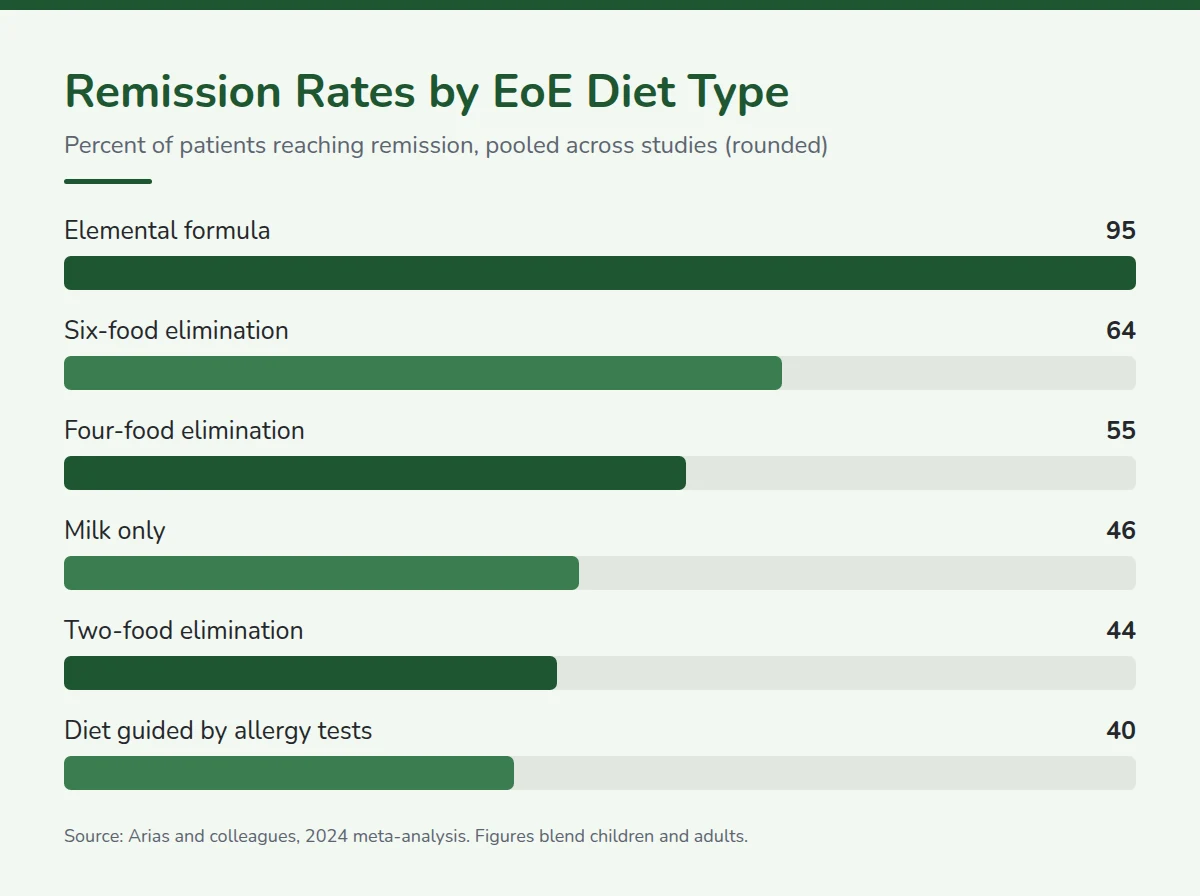
Pooled across 16 groups of patients in a 2024 meta-analysis, diets built on allergy test results put 39.5 percent of patients into remission, the lowest rate of any dietary approach. The 2020 guideline from the American Gastroenterological Association (AGA) and the allergists’ Joint Task Force still rates a test-based diet as better than no treatment, but notes that because the tests have limited accuracy, patients may prefer other options. Allergy testing keeps one important job in EoE: telling you which foods could cause an immediate, dangerous reaction. It just cannot tell you what is inflaming your esophagus.
The Diet Ladder, From Formula to a Single Food
Because testing cannot find the trigger, most EoE diets are empiric: they remove the foods most often responsible and let biopsies sort out the rest. In the research below, remission means fewer than 15 eosinophils per high-power field on a follow-up biopsy.
- Elemental formula. Nothing but a formula of free amino acids, corn syrup solids, and vegetable oils, with no intact protein left to react to. It is the most effective diet, at 94.5 percent remission in the 2024 meta-analysis, and the hardest to live on. The 2019 review lists poor taste, a feeding tube for some patients, high cost (only a minority of states require insurers to cover these formulas), and a long process of adding foods back from nothing. The AGA guideline adds social isolation and, in young children, possible interference with developing oral motor skills.
- Six-food elimination diet. Milk, wheat, egg, soy, peanuts and tree nuts, and fish and shellfish. Kagalwalla and colleagues first described it in children in 2006 as an easier alternative to formula: esophageal inflammation fell to a low level in 74 percent of 35 children, against 88 percent of 25 on formula. A Spanish study of 67 adults reached 73 percent remission, and the pooled rate is 63.9 percent. Counting peanuts, tree nuts, finned fish, and shellfish separately, the AGA notes, it is closer to eight groups.
- Four-food elimination diet. Milk, wheat, egg, and soy in US studies, or milk, wheat, egg, and all legumes in Spanish ones. The first studies found 54 percent remission in adults and 64 percent in children, and the pooled rate is 54.7 percent.
- Two-food elimination diet. Milk and wheat, or milk and all gluten-containing grains in the Spanish version. Pooled remission is 44.3 percent.
- One-food (milk) elimination. An early study found remission in 11 of 17 children (65 percent) who cut cow’s milk alone, and the pooled rate across seven studies is 46.4 percent.
Broadly, the more foods removed, the higher the remission rate, though the milk-only and two-food figures overlap. Treat the pooled numbers as a rough guide: they blend children and adults, older and newer studies, and US and European versions of each diet, and results ran better overall in children than in adults.
Why Milk Moved to the Front of the Line
Milk is the most common EoE trigger. When Lucendo and colleagues put 67 Spanish adults on a six-food diet and then reintroduced the foods one by one, with a biopsy after each, milk was a trigger for 61.9 percent of those who completed reintroduction, followed by wheat (28.6 percent), egg (26.2 percent), and legumes (23.8 percent). About a third had one trigger, a third had two, and a third had three or more. The order is not universal: in the US study of 50 adults, wheat (60 percent) edged out milk (50 percent). But the 2019 review notes that milk was the only trigger in more than half of the cases identified after a six-food diet.

Two randomized trials then tested how much is lost by starting with milk alone.
In adults, Kliewer and colleagues randomly assigned 129 people aged 18 to 60, at ten US research centers, to remove either all animal milk or all six food groups for six weeks. Remission came to 34 percent on the milk-only diet and 40 percent on the six-food diet, a gap small enough that it could have been chance, though the six-food diet cleared eosinophils completely in more people. Quality-of-life scores changed little on either diet. Of 21 people who did not respond to removing milk and moved up to six foods, 9 went into remission, and 9 of 11 who did not respond to six foods went into remission on a swallowed steroid. The authors concluded that removing animal milk alone is an acceptable first diet. “Animal milk” meant goat and sheep milk too, because their proteins can cross-react with cow’s milk.
In children, the same research group randomly assigned 63 patients aged 6 to 17 to remove either milk or four foods (milk, egg, wheat, and soy) for 12 weeks. Remission rates were 44 percent with milk alone and 41 percent with four foods. The four-food diet improved symptom scores more, but 32 percent of the children assigned to it withdrew, against 11 percent on milk alone. The authors called milk elimination a reasonable first choice for children.
Not everyone reads these trials the same way. The Spanish group behind much of the earlier diet research points out, in its 2024 meta-analysis, that 40 percent is one of the lowest remission figures ever reported for a six-food diet, and that 9 of the 21 adults who failed milk elimination did reach remission on six foods. The group suspects participants did not follow the strict diet fully, despite the 97 percent adherence the trial reported. Both readings point to the same starting move: begin small, and add foods only if needed.
Stepping Up: Start Small, Add Foods Only if Needed
The step-up idea was tested before those trials. In the 2-4-6 study, Molina-Infante and colleagues started 130 children and adults at 14 centers on a six-week diet removing milk and all gluten-containing grains. That alone put 43 percent into remission, with no difference between children and adults. Among those responders, milk was the only trigger for 52 percent, gluten grains for 16 percent, and both for 28 percent. Nonresponders moved up to four foods (adding egg and legumes), then six (adding nuts and fish or seafood). Of the 60 people who responded at two or four foods, 55 had just one or two triggers, and compared with starting everyone on six foods, stepping up cut endoscopies and the time to identify triggers by 20 percent.
The 2019 review adds two points. People who respond only to the full six-food diet tend to have more triggers, which can make a long-term diet hard to sustain. And triggers are not limited to the big six: a pooled analysis cited in the review found beef, corn, chicken, potato, pork, and rice to be the most common biopsy-proven triggers after them.
What counts as wheat varies, too. US centers usually remove wheat alone, while European centers commonly remove barley and rye as well, and a dietary work group cited in the review recommends gluten-free oats because ordinary oats are often contaminated with wheat. A gluten-free label is not a wheat-free promise, as our wheat allergy guide explains, so ask your dietitian how to treat products made with processed wheat starch, and read ingredient lists for the word wheat.
Reintroduction: Where All Those Endoscopies Come From
An elimination diet for EoE is a diagnostic tool as much as a treatment. The 2019 review is explicit that the goal is not to keep anyone on a highly restricted diet indefinitely, but to reach remission, then add foods back one at a time to find the triggers and settle on the least restrictive diet that keeps the disease quiet.
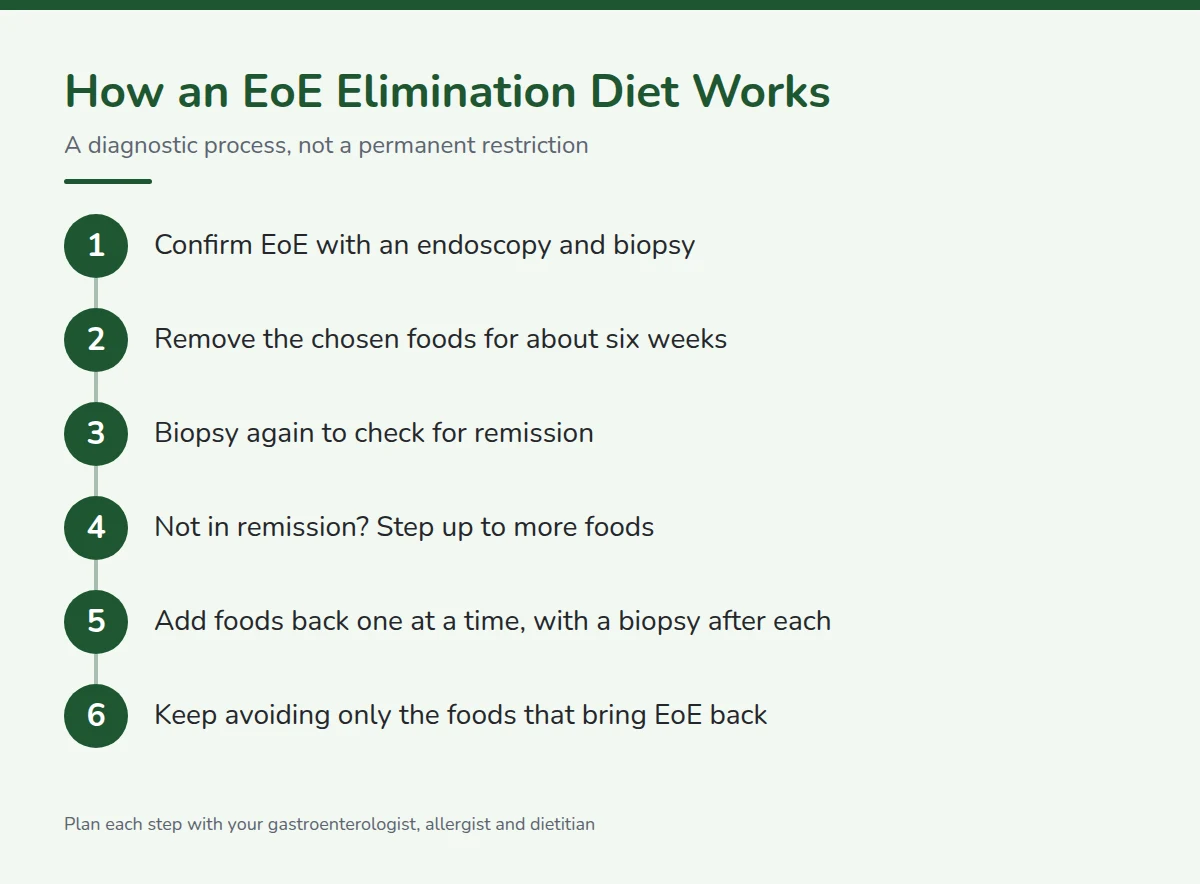
The usual rhythm is about six weeks on the diet, then an endoscopy with biopsies. If the esophagus is in remission, one food comes back, and after roughly another six weeks, another endoscopy shows whether the eosinophils have returned. A food that brings them back is a trigger and comes off the menu again. For a six-food diet, those six-week blocks can add up to most of a year, and the review describes some patients who needed another six to twelve weeks of elimination before they responded.
Why biopsies instead of symptoms? Because symptoms are an unreliable guide. In the US study of 50 adults, symptom scores fell for 94 percent of people on the six-food diet, while 70 percent reached 10 or fewer eosinophils per field. Gentler options are emerging. Transnasal endoscopy passes a thin scope through the nose in an office, without sedation, and can still take biopsies. A swallowed capsule on a string, which opens into a small sponge and collects cells as it is pulled back out, has been used in a small study to guide an elimination diet. Ask whether either is available where you are treated.
One risk deserves its own warning. There are reports of people developing a new, immediate IgE allergy, including anaphylaxis, to a food they had avoided for EoE, once it was reintroduced. The 2019 review judges the risk small, mostly limited to case reports and probably to people already sensitized to the food. The AGA guideline advises using any elimination diet for as short a time as it takes to treat the EoE, and calls consultation with a board-certified allergist a strong consideration. In practice, check with your allergist before adding back any food that has tested positive or has ever caused hives, swelling, or vomiting soon after eating, and ask whether the first exposure should happen under supervision.
How Strict Is Strict? Cross-Contact and Dose
Food allergy households live by trace amounts, because a crumb of peanut can set off anaphylaxis. EoE is murkier. The 2019 review lists dosing among the field’s open controversies: nobody knows how much of a trigger food it takes to keep EoE active, so nobody knows how much cross-contact needs to be avoided. It also counts inadvertent contamination among the possible reasons a diet fails.
Practically, ask your dietitian for a clear rule on precautionary “may contain” labels and shared equipment, then follow it consistently, so that each biopsy is testing the diet you think you are on. A “free-from” claim on a package is not a promise of zero cross-contact. And if you also have an IgE allergy to the same food, the strict food allergy rules apply no matter what the EoE plan allows. Milk, the likeliest trigger, is also one of the best at hiding, under names such as casein, caseinate, and whey; our dairy-free living guide lists the label names and covers shopping and eating out without it.
The Costs: Groceries, Nutrition, and Daily Life
The 2019 review is frank about the money. A six-food diet can raise grocery costs by up to $660 a year and require shopping at several stores, costs the authors call hidden, because insurers do not reimburse them and cost analyses done for insurers leave them out. Even so, the review cites an analysis finding diet therapy cost-effective compared with long-term swallowed steroids, mainly because the steroids are expensive to stay on.
Nutrition is the other cost. Milk, wheat, and egg supply a large share of the protein, calcium, and fortified vitamins in a typical diet, especially a child’s, so replacing them is a planning job, not an afterthought. The review describes successful diet therapy as a team effort, with the gastroenterologist working alongside an allergist and a registered dietitian.

Then there is daily life. Studies with up to six years of follow-up, summarized in the 2019 review, found that sticking with a trigger-free diet kept EoE in remission, but only about half of patients managed to stick with it. In a survey of 42 adults who had finished a six-food diet and identified their triggers, Wang and colleagues found 57 percent still following their prescribed diet. Every one of those who had stopped said social situations made the diet hard, compared with 67 percent of those still on it, and diet-related anxiety was three times as common among those who had stopped (64 versus 21 percent). Even so, most people in both groups would recommend diet therapy to other patients.
For adults, the social test often comes at catered lunches and client dinners, which our guide to managing food allergies at work covers. For children, a milk-free trial only works if every caregiver follows it, so briefing the grandparents and other relatives who babysit matters as much for EoE as for any food allergy.
Diet or Medication? Deciding With Your Gastroenterologist
Diet is one of several first-line options, not a required first step. The American College of Gastroenterology’s 2025 guideline lists proton pump inhibitors, swallowed topical steroids, empiric diet elimination, a biologic, and esophageal dilation as recommended treatments.
- Proton pump inhibitors are acid-suppressing pills. Across 23 observational studies reviewed for the 2020 AGA guideline, about 42 percent of patients responded on biopsy, and given their long safety record and ease of use, the guideline notes that patients may prefer to start with them.
- Swallowed topical steroids work directly on the lining of the esophagus, and the AGA guideline gives them a strong recommendation. In February 2024 the FDA approved a budesonide oral suspension, the first oral therapy approved for EoE, for patients 11 and older, taken twice daily for 12 weeks.
- Dupilumab is an injected biologic that blocks IL-4 and IL-13, two signals that drive allergic inflammation. In 2022 it became the first treatment the FDA approved for EoE, for patients 12 and older who weigh at least 40 kilograms, and in January 2024 approval was extended to children aged 1 to 11 who weigh at least 15 kilograms.
- Dilation stretches a narrowed esophagus. It relieves the sticking but does not treat the inflammation underneath, so it is used alongside one of the other options.
What diet offers that none of these do is a treatment aimed at the cause, with no medication; the 2024 meta-analysis calls it the only therapy that specifically targets what triggers the disease. What it asks in return is weeks of restriction, repeated endoscopies, and lasting vigilance. The 2019 review noted that no study had compared diet head to head with steroids or acid-suppressing pills, and that successful diet therapy requires a patient who is engaged, motivated, knows how to avoid the eliminated foods, and has the time and money to follow through.
Whichever route you take, plan for the long term. The AGA guideline notes that EoE tends to persist when it is untreated or treatment stops, and that spontaneous remission is uncommon. On the diet side, everyone in the Spanish adult study who kept avoiding their trigger foods stayed in remission for up to three years.
Questions to Bring to Your First Diet Appointment
- Is the diagnosis confirmed? EoE needs symptoms plus a biopsy showing at least 15 eosinophils per high-power field, with other causes ruled out.
- Where should we start, and why? Ask whether milk alone, or milk and wheat, is a reasonable first step before a six-food diet.
- Do I also have IgE food allergies? Ask which foods need an allergist’s input before you avoid them or add them back.
- Who is my dietitian? Ask how you will replace the protein, calcium, and vitamins you are removing.
- What exactly counts? Wheat alone, or barley and rye too? Gluten-free oats? Goat milk? Products with “may contain” labels?
- What is the calendar? How long is each phase, when is each endoscopy, and is transnasal endoscopy available?
- What if it does not work? Remove more foods, extend the trial, or switch to medication?
The Bottom Line
EoE sits in an awkward spot between allergy and digestion, and its diet treatment reflects that. The trigger is usually food, most often milk and then wheat, yet the tests that diagnose food allergy cannot find it. What works is slower and more methodical: take foods out, confirm remission with a biopsy, and put them back one at a time. The newest evidence makes the first step easier, since removing milk alone puts roughly a third to nearly half of patients into remission and is far easier to live with than six foods. Whether to go that route or start with medication is a decision to make with a gastroenterologist, ideally with an allergist and a dietitian involved, and it is one you can revisit.
Further reading (sources)
- Cotton, Durban and Dellon on the open controversies in dietary treatment of EoE
- American Partnership for Eosinophilic Disorders with EoE symptoms by age, food impaction, and prevalence
- American Academy of Allergy, Asthma and Immunology for how EoE is diagnosed and treated
- Dellon, Liacouras and colleagues on the 2018 international diagnostic criteria
- Clayton and colleagues for the anti-IgE trial that pointed to IgG4 instead
- Gonsalves and colleagues on the six-food diet and food reintroduction in adults
- Philpott and colleagues, who found that five kinds of allergy test could not predict EoE triggers
- Kagalwalla, Sentongo and colleagues for the first six-food diet study in children
- Kagalwalla, Amsden and colleagues on removing cow’s milk alone in children
- Lucendo and colleagues with the trigger foods identified in 67 adults
- Molina-Infante and colleagues for the 2-4-6 step-up diet study
- Kliewer, Gonsalves and colleagues on the adult trial of milk-only versus six-food diets
- Kliewer, Abonia and colleagues with the pediatric trial of milk-only versus four-food diets
- Arias and colleagues for pooled remission rates for every type of EoE diet
- American Gastroenterological Association and the Joint Task Force on the 2020 guideline covering diets, drugs, and dilation
- American College of Gastroenterology with its 2025 diagnosis and management guideline
- Wang and colleagues on why adults stop following their elimination diet
- U.S. Food and Drug Administration for recent pediatric approvals, including both EoE drugs