Food Allergies at Work: Office Kitchens, Client Dinners, Business Travel, and Your Accommodation Rights
Published on October 9, 2026

Most food allergy advice is written for a parent packing a lunchbox. The school nurse, the 504 plan, the peanut-free table: the whole system assumes a child and an adult watching over them. Then you take a job and spend more of your waking hours at work than anywhere else. You share a refrigerator with forty people you did not choose, eat whatever the vendor brought for the quarterly meeting, and sit across from a client at a restaurant someone else booked. Nobody convenes a team on your behalf.
This is not a niche problem. A nationally representative survey of more than 40,000 US adults, led by Ruchi Gupta’s team at Northwestern, estimated that 10.8 percent of American adults have a convincing food allergy, which is more than 26 million people. Nearly half of them developed at least one of those allergies as adults. About half had experienced a severe reaction, and only about one in four said they had a current epinephrine prescription. Plenty of the people in your meetings are managing this, and many of them are working it out as they go.
This guide follows the working day from the shared kitchen to the client dinner, then covers who to tell, what the law can require of your employer, and how to keep epinephrine at work and teach a colleague to use it.
The Shared Kitchen Is a Residue Problem, Not a Smell Problem
The office kitchen is where most of your daily exposure risk lives, and the research on it is more reassuring, and more specific, than the folklore.
Smell is not the threat it feels like. Researchers at Mount Sinai ran a double-blind study with 30 children whose peanut allergy was severe, many of whom had reported reacting to touch or fumes before. They held peanut butter about a foot from each child’s face for ten minutes and pressed a dab of it onto intact skin. Nobody had a systemic or respiratory reaction. Some children developed redness or itching where the peanut butter touched the skin, and only there. The authors were careful to say the result does not stretch to larger exposures, or to peanut flour and roasted peanuts. Cooking fish or shellfish is also a different case, because steam and spatter can carry the protein itself. But a coworker eating a peanut butter sandwich at the next table is not, by itself, an airborne emergency.
Residue is the threat. A Johns Hopkins team measured what actually removes peanut protein. Liquid soap, bar soap, and commercial wipes cleared it from hands completely. Plain water left it on 3 of 12 hands, and antibacterial hand sanitizer left it on 6 of 12. On tabletops, ordinary household cleaners did the job with one exception: dishwashing liquid left peanut protein behind on 4 of 12 tables. The same team could not detect any airborne peanut allergen while people ate peanut butter or peanuts nearby.
That translates into a short set of kitchen habits:
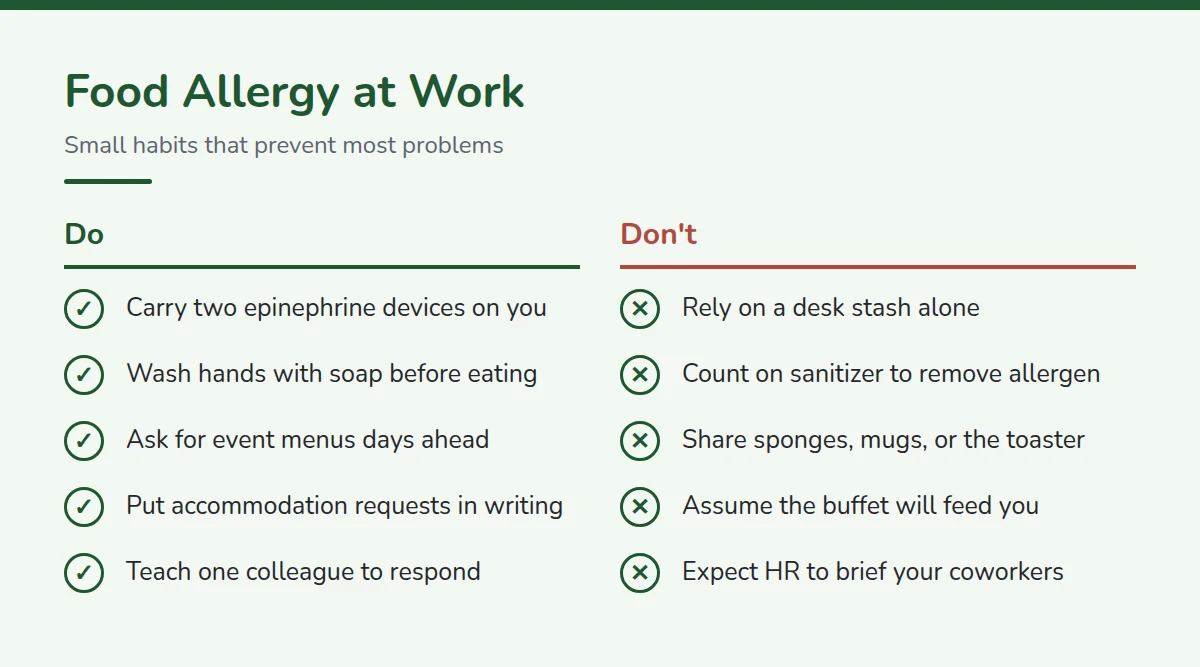
- Wash with soap before you eat, not sanitizer. Gel kills germs. It does not reliably remove protein.
- Wipe before you use. A cleaning wipe across the microwave turntable, the door handle, and your patch of counter takes ten seconds. Cover your food in the microwave so nothing spatters onto it.
- Keep your own sponge, mug, and utensils. The communal sponge is where every lunch in the building gets redistributed.
- Top shelf, sealed containers. Store your food above everyone else’s so nothing drips onto it, in containers with lids.
- Skip the shared toaster and the open snack bowls. A toaster full of wheat crumbs cannot be wiped clean, and a bowl of nuts has been handled by everyone who walked past it.
If the shared kitchen is unworkable, a designated shelf, a labeled set of dishes, or a mini fridge at your desk is a standard request. FARE lists separate storage for food and utensils among the accommodations to raise with HR, and the Job Accommodation Network includes mini fridges, permission to eat at your desk, and moving a workstation away from trigger foods in its list of ideas for food allergy.
Catered Lunches, Pizza Fridays, and the Birthday Cake
Work food arrives with little notice and no labels: a tray of sandwiches for a training session, a stack of pizza boxes on Friday, a sheet cake for someone’s birthday. Bringing your own lunch every time is safe. It is also a quiet way of being left out of the part of work where relationships get built.
The legal backdrop is clearer than most people expect. The Job Accommodation Network points out that employer-sponsored social and recreational activities fall under the ADA’s accommodation duty, so a company event is not exempt just because it is a party. JAN’s own example is a pizza party for a team that includes an employee with celiac disease: the pizza stayed, and gluten-free dishes were added alongside it. The duty does not reach events the company does not sponsor, such as an after-work dinner where everyone pays their own way, though you can still raise your needs with whoever is organizing.
Practical moves that work:
- Get on the organizer’s radar. Ask whoever orders the food, usually an office manager or an executive assistant, to share the vendor and menu a couple of days ahead. FARE suggests handing them a short list of restaurants you already trust, even before anyone asks.
- Ask for your meal to be ordered separately, sealed, and labeled with your name, rather than picked off a shared tray.
- Serve yourself first at potlucks and buffets, before serving spoons start migrating between dishes.
- Ask colleagues to label what they bring in, and to check with you before planning a celebration built around food. Suggesting one built around something else, like trivia or a team outing, is a fine answer too.
- Treat a food ban as a supplement, not a shield. A nut-free floor is something you can request, but JAN is candid that food restriction policies are not fail-safe. They reduce exposure. They do not end it, and you still read every label.
The Client Dinner You Did Not Plan
The client dinner is the hardest setting at work, because three things you normally control go missing at once. Someone else picked the restaurant. The table is full of people you are trying to impress. And there is usually alcohol.

Take back whatever control you can, starting well before the evening.
- Offer to book it. FARE’s advice for work meals is to volunteer to make the reservation, which lets you choose a place you know and talk to the kitchen in advance. Hosts rarely turn down someone offering to handle logistics.
- If you cannot choose, call ahead anyway. Phone during a quiet afternoon hour and ask what you would ask in person: shared fryers, sauces, and what the kitchen does with an allergy order.
- Eat something safe beforehand, so hunger is not making decisions at nine o’clock.
- Order simply and privately. A quiet word with the server, or a chef card handed over discreetly, keeps it from becoming the topic of the evening. Shared plates and family-style platters are where control slips away, so ask for your portion to be plated separately before the table digs in.
- Have one plain sentence ready. “I have a food allergy, so I keep restaurant orders simple” is a complete explanation. Clients do not need your medical history, and an unapologetic tone tells them this is routine.
- Watch the drinks. Alcohol is a recognized cofactor that can lower the amount of allergen it takes to trigger a reaction, and being tipsy looks a lot like the early signs of anaphylaxis. Our guide to nightlife and dating with food allergies covers what is in a cocktail and why drinking changes the math.
- Suggest an easier format. FARE points out that coffee is easier to manage than a meal out. A breakfast meeting at a place you trust builds the same relationship at a fraction of the risk.
Conferences, Hotels, and Work Trips
Conference catering is planned months ahead and served at volume, and FARE warns that large events may not be able to accommodate special requests. Treat the dietary field on the registration form as the start of the process, not the end of it.
- Email the organizer directly once you register. Name the allergen and ask whether the venue can prepare a plated meal separately and label it with your name. Then reintroduce yourself in person on the first day, to the event’s catering contact or the banquet captain, because the person who read your email may not be the one in the kitchen.
- Treat buffets as cross-contact by design. Spoons migrate between trays, guests reach across dishes, and the labels, when there are any, describe the recipe rather than what dripped into it.
- Be wary of the reception. Passed appetizers come without ingredient lists, and even a cheese board is not the safe harbor it looks like for egg allergy, since some aged cheeses are made with egg white lysozyme.
- Pack a fallback. A bag of safe food whose labels you have already read is cheap insurance against a lunch you cannot eat, and it beats skipping the afternoon sessions.

For the trip itself, book lodging that lets you control food. FARE recommends hotel rooms with a refrigerator and microwave, or an extended-stay property with a kitchen, plus a grocery run on arrival. If your employer’s travel policy steers you into rooms without either, a room with a refrigerator is on JAN’s list of accommodation ideas for employees who travel. Keep your epinephrine in your carry-on and on your body, never in checked luggage or a rental car, and see our 2026 travel playbook for airline policies, pre-boarding, and hotel kitchens.
Manager, HR, or Nobody: Deciding Who Knows
Disclosure is your choice, with one catch that FARE spells out for new employees: you can keep your allergy private, but you have to disclose it to request an accommodation. Nothing obliges you to raise it in a job interview, and the ADA limits the medical questions an employer can ask before making an offer. Many people bring it up after the offer, or in their first week.
Each audience needs something different:
- HR, or whoever handles accommodations where you work, receives the formal request and any documentation from your allergist. Under the ADA, medical information an employer collects has to be kept confidential, on separate forms and in separate medical files.
- Your manager gets the operational version. The law lets an employer tell supervisors about necessary work restrictions and accommodations, and tell first aid and safety staff when a condition might need emergency treatment. That is exactly what a manager needs: what you are allergic to, what not to order for the team, where your epinephrine is, and what to do if you react.
- Coworkers are yours to tell. EEOC guidance says an employer may not tell coworkers that someone is receiving an accommodation, because that usually reveals a disability. So if you want the people around you to know, and with an anaphylactic allergy the people within earshot are your fastest responders, the telling has to come from you.
A plain conversation with your supervisor can itself count as an accommodation request under EEOC guidance. Follow it with a short email anyway, so there is a dated record of what you asked for and when.
What the ADA Can and Cannot Make Your Employer Do
Title I of the Americans with Disabilities Act covers private employers with 15 or more employees, plus state and local governments. Federal employees are covered by the Rehabilitation Act, which applies the same standards.
Whether a food allergy counts as a disability is decided case by case, but the 2008 amendments to the ADA made the answer yes far more often. Eating and breathing are listed major life activities, and the functions of the immune system count as a major bodily function. A condition that comes and goes qualifies if it would substantially limit one of those activities when active. The question is also asked without regard to mitigating measures such as medication, so your own vigilance should not count against you. The Justice Department’s guidance after its 2012 agreement over a university meal plan puts it directly: some people with food allergies have a disability under the ADA, particularly those with severe reactions. If you grew up with a 504 plan at school, the definition has not changed. The difference at work is that you start the process yourself, not a parent or a school coordinator.
What an employer can be required to do is provide a reasonable accommodation that lets you do your job safely, unless it would cause undue hardship, which the EEOC defines as significant difficulty or expense. For food allergy, the typical accommodations are the modest ones already covered in this guide: separate food storage, a desk away from the kitchen, advance notice of catered food, and lodging with a refrigerator on work trips. Add flexible time for allergist appointments, keeping your medication with you at all times, and a short training session for your team. Some employers will also consider remote work.
What it cannot be made to do matters just as much before you ask:
- It does not have to give you the accommodation you prefer. If several would work, the employer has the final choice among effective options, though EEOC guidance says your preference should get primary consideration.
- It does not have to guarantee an allergen-free building. A food restriction policy is a possible accommodation, not an entitlement.
- It does not have to accommodate events it does not sponsor.
- It can ask for documentation when the disability or the need is not obvious. That means reasonable documentation of the condition and your functional limitations, not your full medical record.
Two protections sit behind all of this. Asking for an accommodation is protected activity, and the EEOC treats retaliating against someone for asking as unlawful. And if you believe you have been discriminated against, the deadline to file a charge with the EEOC is generally 180 calendar days, extended to 300 days where a state or local agency enforces a similar law. Federal employees have just 45 days to contact their agency’s EEO counselor.
State law often goes further. California’s Fair Employment and Housing Act applies to private employers with five or more employees and to all public employers, and it asks whether an impairment limits a major life activity, where the ADA asks whether it substantially limits one. Check with your own state’s civil rights agency, because its law may reach a smaller office than the ADA does. None of this is legal advice for a specific dispute. The Job Accommodation Network, funded by the US Department of Labor, answers questions about particular situations for free, for employees and employers alike, and an employment lawyer is the right call once a dispute has started.
Putting the Request in Writing
Neither federal law nor California’s requires a written request, and neither requires magic words. You do not have to cite the ADA or say “reasonable accommodation.” Write it down anyway. A written request is a dated record, it forces you to be specific, and it does what California’s guidance asks of every request: it explains the connection between your disability-related need and what you are asking for.
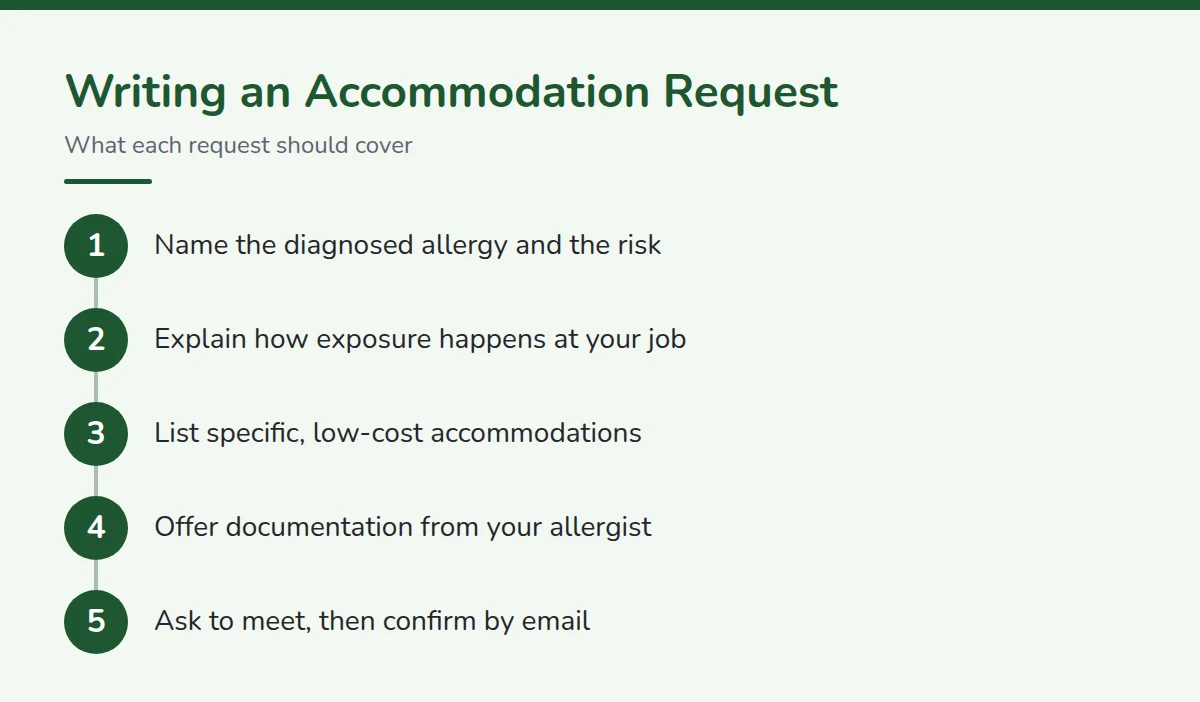
A request along these lines covers it:
I have a physician-diagnosed allergy to peanuts and tree nuts. Exposure, including residue on shared surfaces, can cause anaphylaxis, a life-threatening reaction. To do my job safely, I am requesting these reasonable accommodations:
- A labeled shelf in the office refrigerator, or a small refrigerator at my desk, for my food.
- The vendor and menu for catered team events at least two business days in advance.
- Permission to keep my epinephrine with me at all times, with a backup set in my desk.
- A fifteen-minute briefing for my team on recognizing a reaction and responding to it.
My allergist can provide documentation of the condition and these needs. Could we meet this week to discuss it?
Keep every item concrete and cheap to grant. A request for “a safe environment” gives HR nothing to approve, while a request for a refrigerator shelf is easy to say yes to. If the answer is no, ask what the employer proposes instead. The process is meant to be a conversation, and a counteroffer that genuinely works is a reasonable outcome.
Epinephrine at Your Desk
Keep two devices on your body, and treat a desk set as a backup, never a substitute. Reactions do not wait until you are back at your desk. They happen in the elevator, in the cafeteria line, and at the offsite lunch. A second set in a drawer covers the day your bag stays home, and it lets a colleague grab a device without digging through your things.
A few details make the desk set useful:
- Room temperature, out of the sun. Auto-injectors are labeled for room-temperature storage, so a drawer is fine. The windowsill, the space heater, and your car in the parking lot are not.
- One recognizable pouch. Keep the devices, a copy of your emergency care plan, and an emergency contact together in a pouch someone else can spot at a glance.
- Tell people where it is. A backup only you can find is a backup only you can use, at a moment when you may not be able to.
- Calendar the expiration dates. A drawer is where devices quietly expire. If an expired device is the only one within reach during a reaction, allergists advise using it anyway and calling 911.
- Ask facilities whether the building keeps its own. Several states let businesses stock undesignated epinephrine, though those laws permit it rather than require it.

Medical identification is worth considering too, and FARE’s guidance for employers asks them to support staff who wear it.
Training the Colleague Who Sits Next to You
The most valuable accommodation in this guide costs nothing: one or two people near you who know what anaphylaxis looks like and will act without hesitating. Fifteen minutes is enough, and it is worth asking your manager to make it a team briefing rather than a personal favor. Cover five things.
- What it looks like. Any severe symptom, such as trouble breathing, throat tightness, or fainting, or milder symptoms in more than one part of the body, means epinephrine now.
- Where the devices are and how they work. Practice with the manufacturer’s trainer, never a live device. One run-through makes the real thing far less frightening. If needles are a sticking point, ask your allergist about the nasal spray; our guide to the anaphylaxis treatment landscape explains the options.
- Epinephrine first, then 911. Tell the dispatcher it is anaphylaxis. A second dose can be given about five minutes after the first if symptoms are not improving.
- Get them lying down. Flat with legs raised, sitting up if breathing is hard, or on their side if they are vomiting. Do not let them stand up and walk off to the bathroom or outside for air.
- The hospital is not optional. Even if symptoms fade, the person goes to the emergency department, and FARE advises at least four hours of observation because symptoms can return.
Give that colleague permission to overrule you, too. Someone early in a reaction may insist they are fine, so agree in advance that the device gets used anyway. FARE’s free online anaphylaxis response course is a good link to send around after the briefing.
Set It Up Once
None of this has to make you the office allergy project. Most of it is set up once: a written request, a labeled shelf, a pouch in a drawer, two trained colleagues, and a list of safe restaurants in the office manager’s inbox. After that it runs in the background, and your attention goes back to the work.
Build your own version with an allergist, particularly if you have asthma or have reacted to small amounts before. And no “free from” label, caterer’s promise, or restaurant assurance guarantees zero cross-contact. The epinephrine on your body is the plan for when something slips through.
Further reading (sources)
- Food Allergy Research and Education on its workplace resources for office kitchens, work lunches, and business trips
- Food Allergy Research and Education for what a bystander should do during a severe reaction
- Job Accommodation Network with accommodation ideas for employees with food allergy
- Job Accommodation Network on which employer events carry an accommodation duty
- U.S. Equal Employment Opportunity Commission for its guidance on reasonable accommodation and undue hardship
- U.S. Equal Employment Opportunity Commission covering the deadlines for filing a discrimination charge
- Legal Information Institute with the ADA’s definition of disability, including eating and immune function
- Legal Information Institute on the ADA’s confidentiality rules for employee medical information
- U.S. Department of Justice for its questions and answers on food allergy after the Lesley University agreement
- California Civil Rights Department with its fact sheet on disability accommodations at work
- Gupta and colleagues on how many US adults have a food allergy, and how many developed it as adults
- Perry and colleagues for what removes peanut protein from hands and tables
- Simonte and colleagues with the study that tested peanut butter smell and skin contact