Hazelnut Allergy: Birch Pollen Cross-Reactivity, Storage Proteins, and Where Hazelnut Hides
Published on October 21, 2026
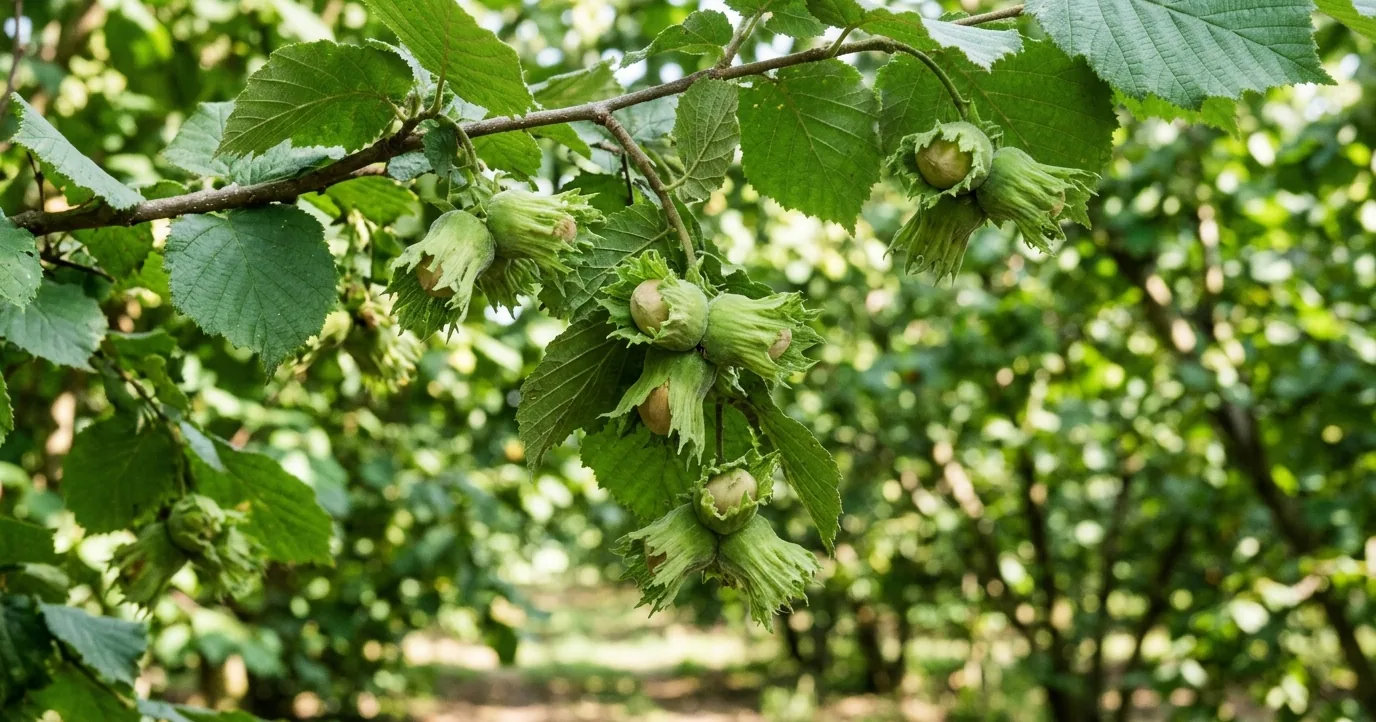
Two people can be told they are allergic to hazelnut in the same clinic on the same afternoon and walk out with very different diagnoses. One is an adult with spring hay fever whose mouth itches after a handful of raw hazelnuts, an itch that fades within minutes. The other is a preschooler whose lips swelled and who vomited after a few bites of a sandwich made with chocolate hazelnut spread. Same nut, same word on the chart, and in most cases a different protein doing the damage.
Hazelnut is the tree nut where that split matters most. Across much of northern Europe, and in birch country in the United States, a positive hazelnut test most often traces back to birch pollen rather than to the nut. A smaller group, many of them young children, react to the nut’s own storage proteins, and that group is far more likely to have a severe reaction. This guide explains how to tell the two apart, what a component test result is actually saying, what roasting does and does not change, and where hazelnut turns up in food that does not look nutty. For the wider family of nuts and how they cluster, start with our complete guide to tree nut allergy.
One Nut, Two Different Allergies
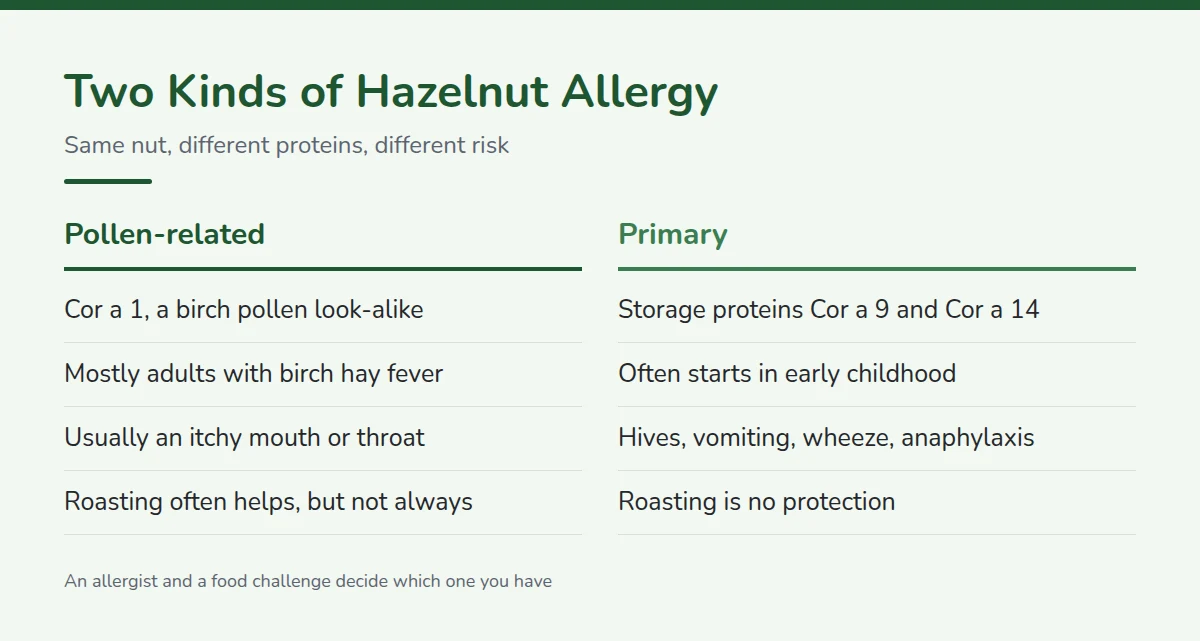
The main allergen in birch pollen is a protein called Bet v 1, and the plant world is full of look-alikes. Hazelnut’s version is Cor a 1. The resemblance is not a coincidence: the FDA’s own table of tree nuts files hazel under Betulaceae, the birch family. When Pastorello and colleagues mapped the proteins recognized by people with challenge-confirmed hazelnut allergy, antibody binding to the Bet v 1 look-alike could be blocked with birch extract, the signature of an antibody raised against pollen that happens to recognize the nut too.
That cross-reaction produces pollen food allergy syndrome, also called oral allergy syndrome. Raw hazelnut makes the lips, mouth, or throat itch or tingle within minutes. Cor a 1 is fragile and easily broken down by heat and digestion, which is why the reaction usually stays in the mouth. In a Dutch study that gave hazelnut-allergic patients gradually rising doses, oral itching was the first symptom in every person who reacted.
The second pattern, primary hazelnut allergy, is aimed at the nut itself. The targets are seed storage proteins, chiefly Cor a 9 and Cor a 14, whose job is to keep a seed alive through dormancy and which are correspondingly tough. This form typically starts in early childhood, often in children with no pollen allergy at all, and it sits behind most of the hazelnut reactions that go beyond the mouth: hives, vomiting, wheezing, and anaphylaxis.
A Dutch comparison by Masthoff and colleagues shows how differently the two age groups behave. Among 95 adults whose hazelnut allergy was confirmed by food challenge, 82 percent also had birch pollen allergy and 77 percent had only subjective symptoms such as itching. Among the children, just 39 percent had birch pollen allergy, 63 percent had objective symptoms (signs a clinician can see, such as hives or vomiting), and severe reactions were more common the younger the child.
One caution belongs right here. Pollen-related does not mean harmless. In a second Dutch study from the same group, nearly half of the adults whose hazelnut reactions went beyond subjective symptoms were sensitized only to Cor a 1. The team behind the roasting study described below also points out that while hazelnut symptoms tend to stay in the mouth and throat, some patients have had severe reactions involving the whole body. “It’s just oral allergy syndrome” is a conclusion for an allergist to reach, not something to assume because you also get hay fever.
Where You Live Changes the Diagnosis
The largest map of hazelnut allergy comes from EuroPrevall, a European research program. Datema and colleagues evaluated 731 people who reported reactions to hazelnut in 12 European cities and measured antibodies to seven separate hazelnut proteins in 423 of them. Birch-driven Cor a 1 sensitization dominated in most cities. The exceptions were Reykjavik, Sofia, Athens, and Madrid, where hazelnut allergy was reported less often in the first place. Storage protein sensitization turned up in fewer than one in ten people tested, mainly children.
In Athens, the leading component was Cor a 8, a lipid transfer protein, and antibodies to it tracked closely with antibodies to walnut, peach, apple, and several pollens, including plane tree and mugwort. Lipid transfer proteins behave in the opposite way to Cor a 1: they are heat-stable and hold up against digestion. In the Italian study by Pastorello’s team, the patients who had suffered severe anaphylaxis to hazelnut were the ones with antibodies to a heat-stable lipid transfer protein. The EuroPrevall authors suggest that this Mediterranean pattern is driven by diet combined with local pollen exposure.
The birch effect is not only European. Kattan, Sicherer and Sampson studied children in New York, which they describe as a birch-endemic area, and found the same pattern of positive tests that often meant little, as the next section shows.
Reading a Component Test Result
A skin prick test or a standard blood test for hazelnut measures antibodies to the whole nut at once, so birch antibodies that recognize Cor a 1 can turn it positive in someone who eats hazelnut without trouble. That problem got worse before it got better. According to the Mount Sinai team, a widely used blood test began adding extra Cor a 1 to its hazelnut reagent in 2007 to catch pollen-type reactions, and the change produced frequent positive results that meant nothing clinically for people sensitized to birch.
Their own numbers show the scale. Of 116 children sent for hazelnut food challenges at Mount Sinai, most of them with no history of objective reactions, only 7.8 percent reacted. Skin test size and hazelnut blood levels did not separate the children who reacted from those who did not, and all seven children with a hazelnut blood level above 100 kU/L, the top of the reporting scale, ate hazelnut without a reaction.
Component testing splits that single number into individual proteins. The four components on a typical hazelnut panel suggest different things:
- Cor a 1, the birch look-alike. In the Mount Sinai group it was positive in roughly four of five children whether they reacted or not, so on its own it points toward the pollen pattern without proving it.
- Cor a 8, the lipid transfer protein. It matters most in Mediterranean patients, where it travels with peach sensitization, and its heat stability is why allergists take a positive result seriously.
- Cor a 9 and Cor a 14, the storage proteins, and the strongest markers of primary allergy. At Mount Sinai, a Cor a 9 level of at least 2.0 kU/L or a Cor a 14 level of at least 1.0 kU/L identified reactive children with 92 percent sensitivity and 93 percent specificity. In the Dutch work, set cut-offs for the same two proteins were more than 90 percent specific for objective reactions.
A fifth protein, the oil body protein Cor a 12, turned up in 10 to 25 percent of EuroPrevall participants in every city, but its clinical meaning is still unsettled.
Severity is where components earn their place. Pooling the EuroPrevall patients, Datema and colleagues found that antibodies to Cor a 9 or Cor a 14 each raised the odds of a severe reaction during a hazelnut challenge about tenfold, while Cor a 1 was linked to lower odds. A model that combined Cor a 14 with a history of eczema, pollen allergy, and walnut antibodies did better than any single test, and it was strongest at ruling severe reactions out. The 2023 European diagnostic guideline from Santos and colleagues names Cor a 14 among the components that can support a diagnosis, especially in people who are also sensitized to pollen.
Two limits apply to all of it. First, sensitization is not allergy. In a Berlin birth cohort followed to school age, hazelnut was the most common food that tested children were sensitized to, yet parents reported hazelnut symptoms in only 1.9 percent of the 1,004 children followed up. Erhard and colleagues concluded that symptoms were far less common than sensitization and warned against changing a child’s diet on a test profile alone. Second, a Cor a 1-only result is reassuring rather than a guarantee, for the reason above. The reference standard is still a supervised oral food challenge, and our guide to when it is time to ask for a food challenge covers how that conversation with an allergist usually goes.
What Roasting Does, and What It Does Not
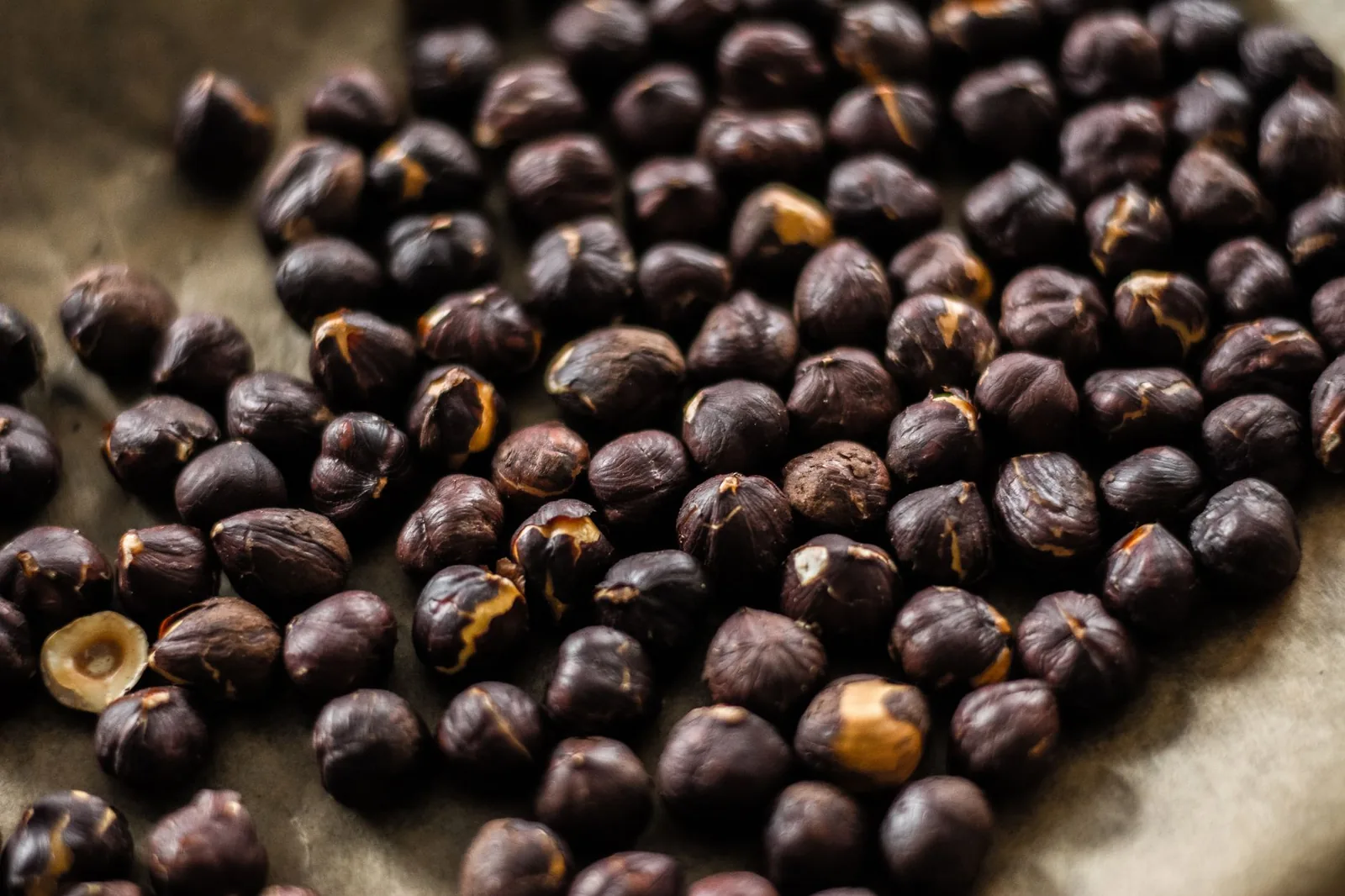
Roasting is where the two allergies part ways most clearly. A systematic review of tree nut processing by Masthoff and colleagues found that roasting reduces the allergenicity of hazelnut for birch-allergic people who react to it raw, because heat weakens the protein family Cor a 1 belongs to. Lipid transfer proteins and seed storage proteins, by contrast, were heat-stable in most of the laboratory studies the review covered.
“Reduces” still needs careful reading. Hansen and colleagues took 17 birch-allergic patients whose allergy to raw hazelnut had been confirmed by double-blind challenge, and challenged them again with hazelnuts roasted at 140°C for 40 minutes. Five of the 17 still reacted, with generally mild symptoms that included mouth symptoms in every case. Roasting cut allergenic activity on every test the team ran, and the authors still concluded that some hazelnut-allergic people cannot treat roasted nuts as safe.
For primary hazelnut allergy, roasting is no protection. The storage proteins survive it, and in the Berlin cohort above, a reaction to roasted hazelnut was the marker the researchers used to separate primary allergy from the pollen form.
Industrial research is pushing further. A 2025 review by Camus-Ela and colleagues, which pulls together recent work on hazelnut allergen characterization, processing, and detection, describes thermal and nonthermal techniques designed to lower allergenicity while keeping flavor, and concludes that processing can reduce exposure to hazelnut allergens but not eliminate it. It also stresses that processing changes how easily hazelnut proteins can be extracted from a food, which shapes how allergenic the finished product is. The same chemistry complicates lab testing, as we explain in what cooking actually does to an allergen, which is why a “not detected” result on a heavily processed food is weaker evidence than it sounds.
Where Hazelnut Hides
On a US package, hazelnut has to be named. The FDA’s tree nut table lists it as “filbert/hazelnut,” so either word can appear. In the EU and the UK, hazelnut is one of the named nuts that must be emphasized in the ingredient list, usually in bold. The trouble is the food that is not packaged, the label that is not in English, and the dishes where nobody thinks of hazelnut as an ingredient.

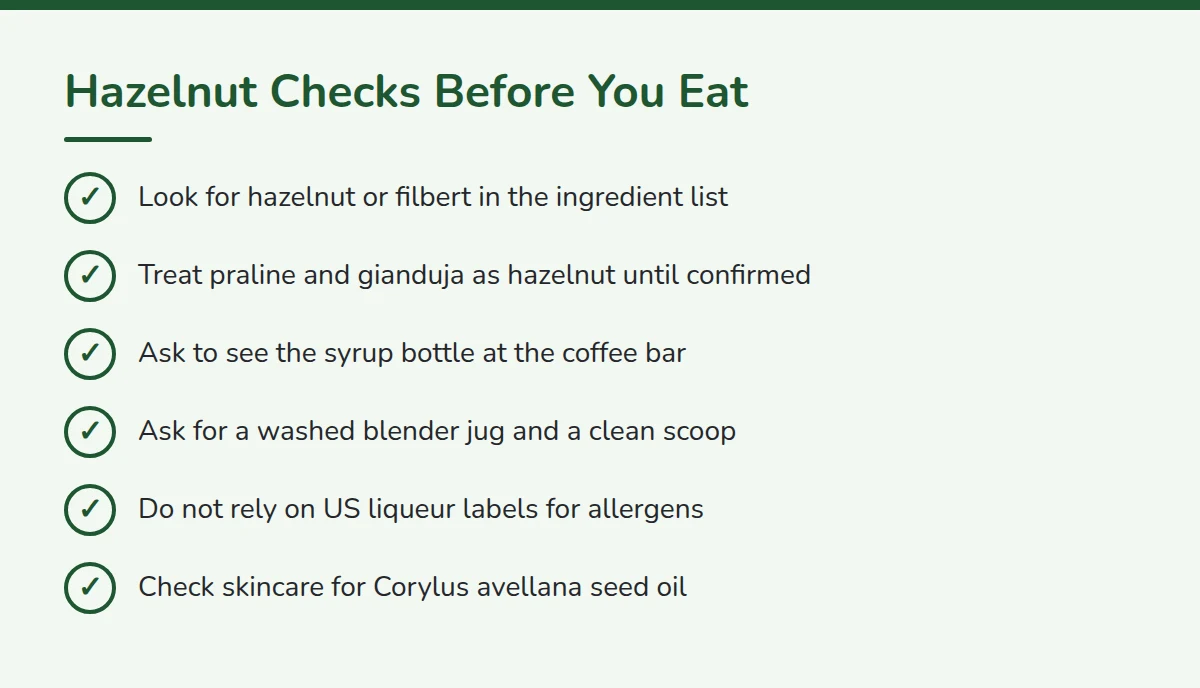
- Spreads, gianduja, and praline. Gianduja (also spelled gianduia) is chocolate blended with hazelnut paste, and it is the base of chocolate hazelnut spreads and many filled chocolates. Praline is the slippery word. In French pastry, praliné is a caramelized nut paste made from hazelnuts, almonds, or both. In Belgium, a praline is any filled chocolate. In the American South, it is a pecan candy. The word tells you nuts are likely, not which nut.
- Bakery and dessert fillings. Filled croissants, crepes, doughnuts, cookies, and macarons, plus layered meringue cakes such as dacquoise, which is made with ground almonds, hazelnuts, or both. Gelato counters treat nocciola (Italian for hazelnut) and gianduja as standard flavors, with scoops and spatulas moving between tubs.
- Flavored coffee. Hazelnut is a staple coffee flavor in syrups, creamers, and flavored whole beans. A hazelnut flavor can come from real nuts or be built from other ingredients, and the menu board does not say which. On a packaged syrup or creamer, a flavor that contains hazelnut protein has to be declared; the FDA’s own example is a “natural peanut flavor” that must appear in the Contains statement. The drink handed across the counter carries no allergen label at all, because federal allergen labeling does not apply to food placed in a container in response to a customer’s order. Ask to see the bottle, and ask whether flavored beans go through the same grinder as plain ones.
- Liqueurs and cocktails. Hazelnut liqueur turns up in coffee cocktails and dessert drinks. US allergen labeling on alcohol is still voluntary: the Alcohol and Tobacco Tax and Trade Bureau’s guidance, updated in October 2026, says current regulations do not require major allergens to be disclosed on alcohol labels. Even the EU and UK rules, which name hazelnut specifically, exempt nuts used to make alcoholic distillates. Our guide to bars, cocktails, and dating with food allergies covers how to handle a drinks menu.
- Savory plates. Dukkah, the Egyptian nut and spice blend, often contains hazelnuts. Romesco sauce can use hazelnuts alongside or instead of almonds. Hazelnut-crusted fish, salads finished with toasted hazelnuts, and roasted vegetables under a nut crumb are restaurant staples.
- The free-from aisle. Hazelnut flour in gluten-free and low-carb baking, hazelnut milk among the plant milks, and hazelnut in granola, muesli, and snack bars.
- Skin and hair care. Hazelnut oil appears on cosmetic labels under its botanical name, Corylus avellana seed oil. Witch hazel, a common toner ingredient, comes from an unrelated plant and is not hazelnut.
Shared Equipment, Blenders, and the Limits of “May Contain”
The amounts that matter are tiny. Blom and colleagues analyzed food challenges in Dutch children and estimated that 5 percent of those with hazelnut allergy would have an objective reaction to 0.29 mg of hazelnut protein, a lower dose than the 1.6 mg estimated for peanut in the same analysis. In a separate Dutch group, Wensing and colleagues estimated that half of their hazelnut-allergic patients would react to 6 mg of hazelnut protein, and noted that doses like these had already been found hidden in consumer products.
Factory cross-contact can be controlled, but only with the right cleaning. Röder and colleagues followed industrial cookie lines switching from a hazelnut cookie to a hazelnut-free one. With scraping alone, the hazelnut-free batch that followed on the cookie machine carried more than 1,000 mg of hazelnut protein per kilogram. Adding wet cleaning with hot water brought it to 1 mg per kilogram or less on every machine. Over 24 months, the team also found hazelnut traces in 16 percent of incoming raw materials, at 0.26 to 90 mg per kilogram, before anything reached the line.
Suppliers are where it slips. In December 2025, a Seattle chocolatier recalled a plant-based almond milk chocolate bar after its supplier found trace hazelnut from shared equipment, and the company had a report of one allergic reaction. The FDA classified the recall as Class I, its most serious category, in January 2026. According to the FDA’s enforcement report, the bar’s label warned that it might contain milk, peanuts, and sesame. It said nothing about hazelnut. If recall classes are unfamiliar, our explainer on recalls, public health alerts, and market withdrawals sets them out.
A “may contain” line would not have settled the matter either way. The FDA’s allergen guidance states that the labeling law does not address advisory statements such as “may contain.” They are voluntary, must be truthful and not misleading, and are no substitute for good manufacturing practice. A label that warns about some allergens and not others tells you what the manufacturer chose to mention, not what anyone tested for.
Cafés add the blender problem. In August 2023, 12-year-old Mia St Hilaire, who had a tree nut allergy, died after drinking a milkshake from a café in south-east London. An inquest that concluded in October 2026 found her drink contained hazelnut residue because the blender had not been washed after a hazelnut chocolate milkshake was made in it, and CCTV showed it was never cleaned in between. The café had already been fined £18,000 after admitting six food safety offenses, and her parents are calling for a dedicated allergy management rating for food businesses. Asking for a washed blender jug, a clean scoop, and a fresh spatula is a reasonable request, and a counter that cannot manage it has told you what you need to know.
Living With a Hazelnut Diagnosis
Whether you need to carry epinephrine depends on which allergy you have, and that is a decision for an allergist who has your history and your component results. Anyone with storage protein sensitization, a lipid transfer protein pattern, or any past reaction beyond the mouth is usually advised to carry two epinephrine auto-injectors and an emergency action plan. A confirmed pollen-only pattern may call for a lighter plan, but that should be your allergist’s call, not something inferred from a lab printout.
Primary hazelnut allergy that starts in childhood tends to last. The Mount Sinai team cites a figure of only about 9 percent of children outgrowing a tree nut allergy. Periodic retesting is still worthwhile, but outgrowing it is not something to count on.
Treatment is moving too. In a 2024 trial reported by Wood and colleagues, omalizumab, an injected antibody now approved in the US for food allergy, raised reaction thresholds in children allergic to peanut and at least two other foods, with hazelnut on the list of foods the trial accepted. It is used alongside avoidance, not instead of it, and it widens the safety margin for accidental exposure rather than curing the allergy.
The most useful step with a hazelnut diagnosis is getting it named precisely. A birch-driven itch and a storage protein allergy call for very different levels of caution, and only an allergist, ideally with component testing and a supervised food challenge, can tell you which one you have. Until you know, treat every hazelnut reaction as the serious kind.
Further reading (sources)
- Camus-Ela and colleagues on the 2025 update covering hazelnut allergens, processing, and detection
- Pastorello and colleagues for the birch look-alike and heat-stable proteins in challenge-confirmed hazelnut allergy
- Datema and colleagues with the EuroPrevall map of hazelnut allergy across 12 European cities
- Datema and colleagues on models that predict severe hazelnut reactions from components and history
- Masthoff and colleagues for why Cor a 9 and Cor a 14 flag objective reactions
- Masthoff and colleagues comparing hazelnut allergy in children and adults
- Masthoff and colleagues, a systematic review of heat and tree nut allergens
- Kattan, Sicherer and Sampson on component testing in New York children challenged with hazelnut
- Erhard and colleagues with primary and pollen-related hazelnut allergy in a Berlin birth cohort
- Santos and colleagues for the 2023 European guideline on diagnosing IgE-mediated food allergy
- Hansen and colleagues on double-blind challenges with roasted hazelnuts
- Blom and colleagues with threshold doses for five allergenic foods in children
- Wensing and colleagues on the range of doses that provoke hazelnut reactions
- Röder and colleagues for cleaning hazelnut residue off industrial cookie lines
- Wood and colleagues on omalizumab for children with multiple food allergies
- US Food and Drug Administration with its allergen labeling questions and answers, including the tree nut table
- US Food and Drug Administration, the allergy alert for the almond milk chocolate bar with undeclared hazelnut
- Alcohol and Tobacco Tax and Trade Bureau on why allergen disclosure on alcohol labels is still optional
- UK legislation for the allergen list in Annex II of Regulation 1169/2011 and the rule on emphasizing allergens in ingredient lists
- BBC News reporting the inquest into a milkshake made in an unwashed blender