Milk Allergy: The Complete Guide to IgE and Non-IgE Reactions, Hidden Milk, and Outgrowing It
Published on November 5, 2026

Milk is usually the first food allergy a family meets. It is the most common food allergy in infants and young children, it is the allergen most often left off the label when a US food is recalled, and it is the one most often confused with something else. The name also hides a complication. “Milk allergy” covers several different conditions with different symptoms, different tests, different emergency plans, and different timelines for outgrowing them, and knowing which one you are dealing with changes nearly every decision that follows.
This guide is the clinical companion to our dairy-free living guide, which covers the pantry, restaurant, and travel side. Here the focus is the condition itself: immediate reactions versus delayed ones such as FPIES and allergic proctocolitis, why lactose intolerance is a separate problem, which proteins matter, what the label rules do and do not promise, how the baked milk ladder works, and what outgrowing it looks like on a calendar.
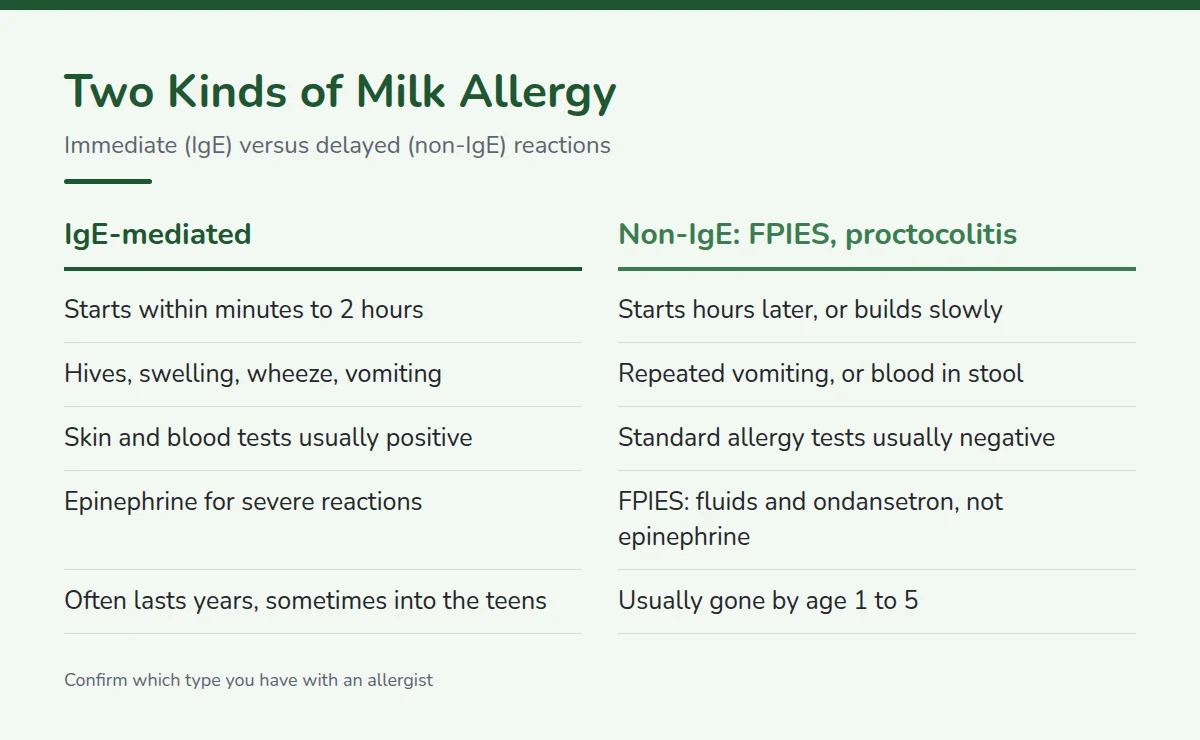
One Name, Several Different Conditions
IgE-mediated milk allergy is the classic, immediate kind. Symptoms begin within minutes to about two hours of eating or drinking milk: hives, swelling of the lips or face, vomiting, coughing or wheezing, and at worst anaphylaxis. It usually shows up on skin prick tests and on blood tests for milk-specific IgE, and the treatment for a severe reaction is epinephrine.
Non-IgE milk allergy runs through a different arm of the immune system. The reactions are delayed and mostly digestive, and standard allergy tests usually come back negative, which is why these conditions get mistaken for a stomach bug or reflux. A 2015 review by Nowak-Wegrzyn, Katz, Mehr, and Koletzko names cow’s milk and soy as the most common triggers and describes three main forms.
- Food protein-induced enterocolitis syndrome (FPIES). Profuse, repetitive vomiting that typically starts one to four hours after the trigger food, often with pallor and unusual floppiness or sleepiness, and sometimes diarrhea hours later. According to a Canadian Paediatric Society practice point, FPIES usually appears between 2 and 7 months of age, often when formula or solids enter the diet. Dehydration can make a reaction an emergency, but the treatment is fluids and the anti-nausea drug ondansetron, not an epinephrine auto-injector.
- Food protein-induced allergic proctocolitis (FPIAP). Streaks of blood in the stool of a baby who is otherwise healthy and growing, usually starting in the first weeks of life, with no vomiting or diarrhea. In breastfed babies it typically settles once cow’s milk (and often soy) comes out of the mother’s diet. In formula-fed babies it typically settles on an extensively hydrolyzed formula.
- Food protein-induced enteropathy. Now rarely diagnosed: chronic diarrhea without blood, poor absorption of nutrients, and poor weight gain.
In a prospective Israeli study, Katz and colleagues followed 13,019 infants from birth. Milk FPIES developed in 0.34 percent of them, every case within the first six months of life, and 8 of those 44 babies also had IgE-mediated milk allergy. The categories can overlap in one child.
Milk is also the most common trigger of eosinophilic esophagitis (EoE), a chronic inflammation of the esophagus that does not fit neatly into either group. Our guide to EoE elimination diets covers it in depth.
The type matters because the rules change with it. A child with IgE-mediated allergy needs epinephrine within reach, and the cautious default is to skip products labeled “may contain milk.” The Canadian practice point says neither applies to FPIES: no auto-injector is required, and precautionary labels generally do not need to be avoided. What an FPIES family needs instead is a written plan for the emergency department, because staff may not recognize a reaction that arrives as vomiting and pallor rather than hives, and the food must never be retried at home. If the paperwork you were given only says “milk allergy,” ask which kind.
Milk Allergy Is Not Lactose Intolerance
Lactose intolerance is a digestive problem with milk sugar. The National Institute of Diabetes and Digestive and Kidney Diseases describes it as bloating, diarrhea, and gas after lactose because the small intestine cannot break all of that sugar down, and it states plainly that lactose intolerance is different from a milk allergy, which is an immune system disorder. Different people tolerate different amounts of lactose before symptoms start. Milk allergy is a reaction to the proteins, not the sugar.
The practical trap is lactose-free milk. Its sugar has been broken down, but every protein is still there, so it is not safe for anyone with milk allergy, and lactase pills do nothing for an allergy. Lactose also turns up as a filler in tablets and inhalers, and our guide to allergens in medicine covers when pharmaceutical lactose carries enough milk protein to matter.
Casein, Whey, and Milk From Other Animals
Cow’s milk protein comes in two families. Casein makes up about 80 percent of it, according to the World Allergy Organization’s DRACMA guidelines, and heating barely changes how the immune system sees it. The whey proteins, beta-lactoglobulin and alpha-lactalbumin chief among them, make up most of the rest and are more easily altered by heat. That split is the basis of the baked milk ladder below. In a 2008 study of 100 milk-allergic children, the ones who reacted even to baked milk had higher casein-specific IgE, which is why some allergists check casein before a baked challenge.
Milk from goats and sheep is not a way around the allergy. The same guidelines explain that cow’s, sheep’s, and goat’s milk proteins are the most alike of any, because all three animals belong to the same family of ruminants, and they advise that goat’s, ewe’s, and buffalo’s milk should not be used to treat milk allergy because they can cause severe reactions. FARE gives the same warning, and the FDA now counts milk from domesticated cows, goats, sheep, or other ruminants as the major allergen “milk.” Horse and donkey milk are less similar, and the guidelines consider them, and camel milk after age 2, possible substitutes in specific cases. That is a decision for an allergist, not the grocery aisle.
Beef is a smaller question. Bovine serum albumin occurs in both milk and beef, and a 2002 review by Martelli and colleagues found that between 13 and 20 percent of children with milk allergy also react to beef. The same authors concluded that taking beef out of a milk-allergic child’s diet should be decided individually after testing, not as a blanket rule.
Reading the Label: Casein, Whey, and the “Nondairy” Loophole
Since 2006, federal law has required FDA-regulated packaged foods to name milk in plain English whenever an ingredient contains milk protein, either in parentheses after the ingredient, as in “whey (milk),” or in a “Contains: milk” line next to the ingredient list. The requirement, added to the Food, Drug, and Cosmetic Act by the Food Allergen Labeling and Consumer Protection Act (FALCPA), reaches flavorings, colorings, and incidental additives too. FARE notes that it also covers casein and whey made without cows: animal-free dairy proteins are still milk protein and must be labeled as milk.
The technical names still appear in the ingredient list, though, and imported foods, restaurant spec sheets, and some store-made items never carry a “Contains” line. FARE’s avoid list includes casein and caseinates in all forms, whey, lactalbumin, lactoglobulin, lactoferrin, curds, ghee, rennet casein, lactose, tagatose, and lactic acid starter culture. Its list of ingredients that only sound like milk includes calcium and sodium lactate, cocoa butter, cream of tartar, and plain lactic acid.
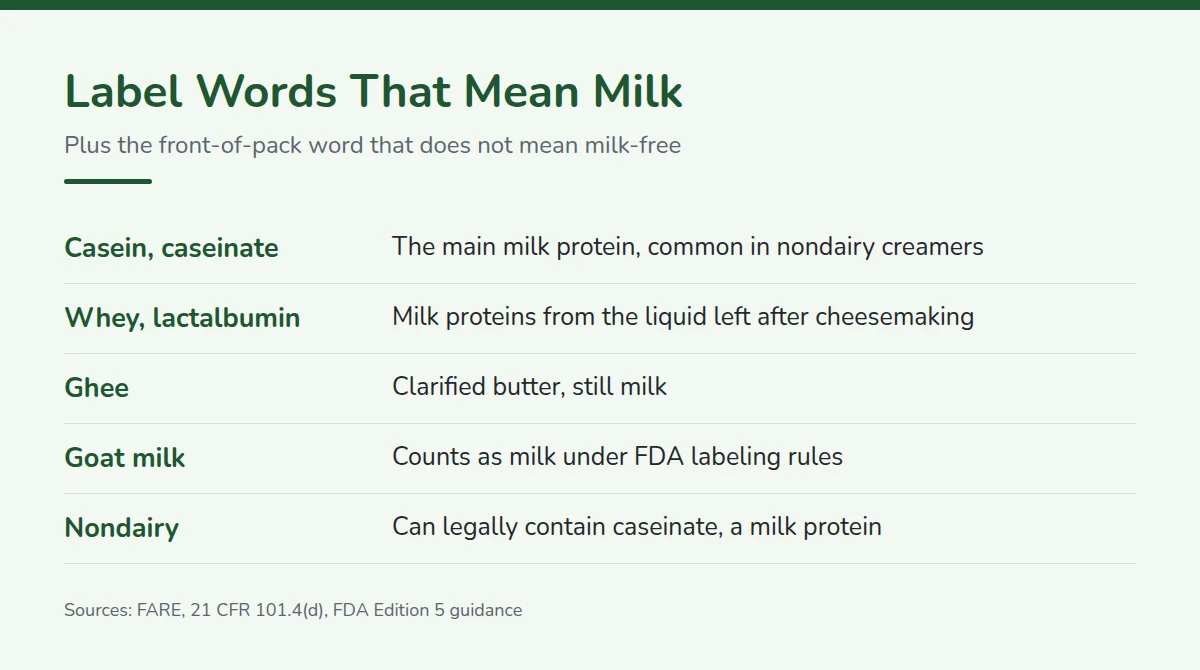
“Nondairy” is the phrase that catches people. A federal labeling regulation, 21 CFR 101.4(d), expressly allows a food described as “nondairy” to contain a caseinate ingredient, as long as the caseinate is followed by a note naming its source. The regulation’s own example is a nondairy creamer listing “sodium caseinate (a milk derivative).” Coffee whiteners and whipped toppings are the classic places to find it. The ingredient panel will say milk, but the front of the package can still say nondairy.
“Dairy-free” has a different gap. Apart from gluten-free, the FDA has not defined any “free” claim for an allergen. It expects a dairy-free product to contain no milk from any source and investigates when testing finds otherwise, and its testing has found otherwise: in 2018 and 2019, four of 52 dark chocolate products with dairy-free claims held potentially hazardous levels of milk, from 600 to 3,100 parts per million, and all four were recalled. The dairy-free living guide walks through all three rounds of that testing. “Vegan” and “plant-based” are not allergen claims at all.
Kosher marks help in one direction only. FARE explains that a “D” or the word “dairy” beside a kosher symbol means the product contains or is contaminated with milk protein. “Pareve” means milk-free under kosher law, but a pareve product can still hold enough milk protein to cause a reaction.
Goat milk now says so. Under the FDA’s Edition 5 allergen guidance, finalized in January 2025, milk ingredients from animals other than cows should name the animal, so a goat cheese reads “goat milk,” and a cheese made from both reads “Contains milk, goat milk.” For a shopper with cow’s milk allergy, “goat milk” on a label means milk.
“May contain milk” is voluntary and unmeasured. Precautionary statements have no legal definition and no threshold. With IgE-mediated allergy, the safe default is to treat them as a no unless your allergist says otherwise.
Where Milk Hides, and Why Bread Keeps Getting Recalled
In its dark chocolate report, the FDA called milk the most common undeclared food allergen, responsible for more than a third of US recalls over undeclared allergens in the preceding decade, and the leading cause of consumer reactions to foods recalled for that reason. The pattern has continued through 2026. In October, a national bakery brand recalled Hawaiian-style bread sold in Arkansas, Louisiana, New Mexico, Oklahoma, and Texas after a review of production records found packages that did not declare milk. In June, pepperoni rolls sold through convenience stores, grocery stores, and gas stations in Ohio and parts of West Virginia were recalled for undeclared milk as well.
Soft and sweet breads deserve a second look, because many recipes are enriched with milk, butter, or whey and nothing about the loaf gives it away.
Butter is the extreme case. In July 2025, 64,800 pounds of a wholesale “European style butter blend,” packed 36 one-pound blocks to a case, were recalled because the label did not declare milk, and the FDA classified the recall as Class II. A butter blend is made from milk, which is exactly the point: the law requires the word milk even on foods built from it, because butter, cream, ghee, and whey do not announce themselves as milk to a babysitter or a new line cook. Bulk ingredients like that one also end up in restaurant and bakery kitchens, where the diner never sees a label at all.
FARE flags several other places milk turns up:
- Pantry staples such as bread, pasta, and tortillas.
- Luncheon meat, hot dogs, and sausages, which may use casein as a binder, and deli slicers shared between meat and cheese.
- Some brands of tuna, which contain casein.
- Margarine, caramel, nougat, chocolate, artificial butter flavor, and snack foods.
- Shellfish, which is sometimes dipped in milk to cut the fishy smell.
- Specialty drinks such as smoothies and lattes made with plant milks on equipment shared with dairy.
- Grilled steaks, which many restaurants finish with butter you cannot see once it melts.
That last one is a restaurant problem, and US restaurants have no federal duty to disclose allergens. A handful of states now require more, and our state-by-state guide to restaurant allergen laws explains what you can expect where you live.
Babies, Breastfeeding, and Formula
Because milk allergy so often starts in infancy, feeding questions come first, and the answers depend on the type.
Breastfed babies. For proctocolitis, the Canadian practice point says the usual first step is removing cow’s milk, and often soy, from the mother’s diet. For FPIES, it says maternal elimination is usually not needed. For IgE-mediated allergy, ask your allergist, and if a breastfeeding parent does cut out dairy, a dietitian can help replace the calcium and vitamin D.

Formula. Extensively hydrolyzed formula, in which the milk proteins are broken into small fragments, is the usual first choice for formula-fed babies with milk allergy. Amino acid formula, built from individual amino acids with no intact protein, is held for babies who still react or whose risk is highest; the World Allergy Organization guidelines suggest it over hydrolyzed formula for children with IgE-mediated allergy who have had anaphylaxis. Formula made from goat’s milk is not a substitute, and a carton of plant milk is not infant formula.
Growth. A 2014 analysis of national survey data on 6,189 US children by Robbins, Wood, and Keet found that children with milk allergy had lower average weight, height, and BMI percentiles than their peers. A dietitian who knows food allergy can check calcium, vitamin D, and protein, and the Canadian practice point calls close monitoring of nutrition and growth essential when foods are restricted.
The Baked Milk Ladder
Most children with IgE-mediated milk allergy can eat milk that has been baked thoroughly into a wheat-based food. In the 2008 study by Nowak-Wegrzyn and colleagues, 100 milk-allergic children were challenged with extensively heated milk: 68 tolerated baked milk but still reacted to plain milk, 9 tolerated both, and 23 reacted to the baked form. Those 23 also had more severe reactions during their baked challenge than the tolerant children had when they later tried plain milk, which is why the first baked step happens in a clinic.
What happened next is the reason ladders exist. Kim and colleagues followed 88 of these children for a median of about three years, moving them from baked milk muffins to baked cheese on pizza and then to plain milk. Children who tolerated baked milk at the start were 28 times more likely to end up tolerating plain milk than those who reacted to it, and children who kept baked milk in their diet were 16 times more likely than a matched comparison group to outgrow the allergy. It was an observational study, so part of the effect may be that baked-tolerant children were already on their way out, but tolerating baked milk is a good sign either way.

There are two kinds of milk ladder, and mixing them up is the common mistake. Allergy UK’s parent leaflet explains that the ladder was designed for infants with non-IgE (delayed) milk allergy, typically starting around 9 to 12 months of age, in versions with 4, 6, or 12 steps. All of them begin with milk baked into a wheat-flour food such as a biscuit for about 20 to 30 minutes, then work through less-cooked forms to fresh milk, and a child may stay on one step for a week or for several months. The leaflet is blunt about the limits. The ladder has been used for IgE-mediated allergy only after review by an allergy team, never on a parent’s own initiative, and it should not be used at all for FPIES, where reintroduction belongs in hospital.
So the order depends on the type. With proctocolitis or mild non-IgE allergy, your clinician may start a home ladder. With IgE-mediated allergy, the first baked step is a supervised challenge, and later rungs follow the allergist’s plan. With FPIES, the Canadian practice point suggests a supervised challenge as early as 12 to 18 months after the last reaction, in a setting with ready access to IV fluids. Our guide to outgrowing food allergies covers how allergists decide when a challenge is worth booking.
Outgrowing It: What the Timelines Look Like
The delayed forms usually go first. Proctocolitis typically resolves by the first birthday, and the 2015 review puts most food protein-induced enteropathy at one to three years and most FPIES at one to five. Milk FPIES can be quicker: in the Israeli cohort, 90 percent of children had recovered by age 3.
IgE-mediated milk allergy takes longer than the old “gone by age 3” reassurance suggests. In a multicenter US study that enrolled infants aged 3 to 15 months, Wood and colleagues found that about half had outgrown it, at a median age of just over 5. At the Johns Hopkins referral clinic, Skripak and colleagues followed 807 children: 19 percent had outgrown it by age 4, 42 percent by 8, 64 percent by 12, and 79 percent by 16. Referral clinics see the more stubborn cases, so their numbers run slower than a typical child’s.
Several things predict the slower path: a high milk IgE (in the Johns Hopkins data, the highest value a child ever recorded was a strong predictor), coexisting asthma or hay fever, a large skin test or severe eczema at enrollment in the multicenter study, and reacting to baked milk. Some children only outgrow milk allergy as teenagers, so a teenager with a childhood diagnosis deserves a fresh look rather than an assumption.
Adults are not exempt. FARE lists milk among the four most common food allergies in US adults, alongside shellfish, peanut, and tree nut. Some adults with a milk “allergy” have lactose intolerance instead, and some carry a childhood diagnosis that nobody ever rechecked, so a confirmed diagnosis is worth having at any age.
What to Do This Month
- Get the type in writing. IgE-mediated, FPIES, proctocolitis, or a mix. The emergency plan, the label rules, and the ladder all depend on it.
- Match the emergency plan to the type. For IgE-mediated allergy, two epinephrine auto-injectors and an anaphylaxis action plan. For FPIES, a letter for the emergency department that names the diagnosis and the treatment: IV fluids and ondansetron.
- Learn the label words. Casein and caseinates, whey, lactalbumin, ghee, “goat milk,” and the word “nondairy” on the front of a package.
- Ask about the next rung. A supervised baked milk challenge for IgE-mediated allergy, a home ladder for proctocolitis if your clinician agrees, and never a home trial for FPIES.
- See a dietitian. Formula choice, calcium, vitamin D, protein, and a growth check.
- Retest on a schedule. Milk allergy changes over years, sometimes not until the teens.
Milk allergy is really a family of conditions, and most children leave it behind, some within months and some only in their teens. Until then the work is unglamorous and reliable: know which type you have, read the whole ingredient panel rather than the front of the box, treat “nondairy” and “goat milk” as milk, keep the right emergency plan close, and let the allergist rather than the kitchen decide when it is time to climb the next rung.
Further reading (sources)
- Nowak-Wegrzyn, Katz, Mehr and Koletzko on the delayed, non-IgE forms of food allergy in the gut
- Canadian Paediatric Society with its practice point on managing FPIES and allergic proctocolitis
- Katz and colleagues for how often milk FPIES appeared in 13,019 infants, and how quickly it faded
- National Institute of Diabetes and Digestive and Kidney Diseases on how lactose intolerance differs from milk allergy
- World Allergy Organization DRACMA panel covering milk proteins, other animals’ milk, and formula choices
- Martelli and colleagues on beef allergy in children who are allergic to milk
- Food Allergy Research and Education for where milk hides, and the ingredients that only sound like milk
- Food Allergy Research and Education with the most common food allergies in US children and adults
- Legal Information Institute on the federal allergen labeling requirement in 21 U.S.C. 343(w)
- Legal Information Institute for the “nondairy” caseinate rule in 21 CFR 101.4(d)
- U.S. Food and Drug Administration on counting goat and sheep milk as milk under the Edition 5 guidance
- U.S. Food and Drug Administration with its dairy-free dark chocolate testing and the recall record behind it
- Food Safety News reporting the Hawaiian bread recalled in five states for undeclared milk
- Food Safety News on pepperoni rolls recalled in Ohio and West Virginia
- Kids With Food Allergies with the alert on a butter blend recalled for undeclared milk
- Robbins, Wood and Keet on lower weight and height in milk-allergic US children
- Nowak-Wegrzyn and colleagues for the study that found three in four milk-allergic children tolerate baked milk
- Kim and colleagues with what happened when children kept baked milk in their diet
- Allergy UK for its parent leaflet on the cow’s milk ladder
- Wood and colleagues on milk allergy resolution in a multicenter infant cohort
- Skripak and colleagues covering milk allergy outcomes to age 16 at a referral clinic